
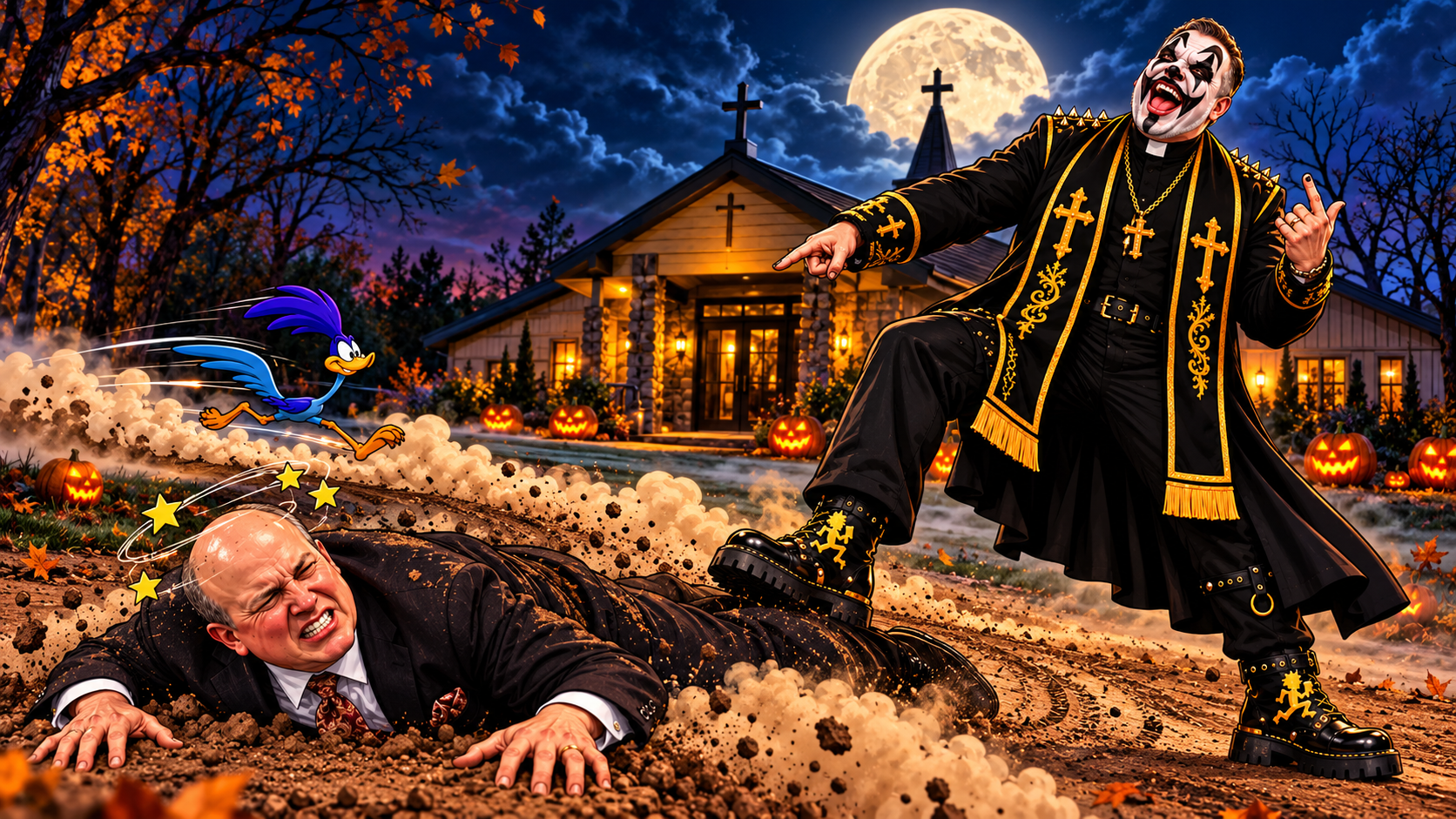
Historical records challenge claims published by The Church of Valdosta, raising questions about religious teaching, truthfulness, and accountability under Yahweh’s Word.
By Rev. Joseph Allen Wolfe
Founder, Publisher & Editor-in-Chief
JAW GA News | October 20, 2026
People. Facts. Accountability.
VALDOSTA, GEORGIA — When a preacher stands before a congregation and claims to be teaching the truth, shouldn’t that truth be able to stand up to scrutiny?
That’s the question JAW GA News is raising after reviewing an article published by Pastor Scott Smith of The Church of Valdosta.
On September 24, 2025, Smith published an excerpt from his booklet titled The Hidden Horror of Halloween. In that publication, Smith describes Halloween as completely evil, connects its traditions to witchcraft and spiritual danger, and uses several Bible passages to support his teachings.
But here’s the problem.
When JAW GA News examined the historical claims presented in Smith’s publication, we found multiple statements that conflict with documented history.
And that raises an important question.
When does teaching personal religious beliefs cross into spreading false information under the authority of Yahweh’s Word?
HALLOWEEN’S HISTORY IS NOT WHAT SMITH PRESENTS
Halloween did not simply appear as a celebration of evil.
Its history stretches back through centuries of seasonal customs, Christian observances, folklore, and community celebrations.
One important historical influence is Samhain, a traditional Gaelic festival associated with the end of the harvest and the beginning of winter.
Some traditions surrounding Samhain involved beliefs about spirits, the dead, and the changing seasons.
But historians do not have a complete record of exactly how ancient Celtic communities observed this festival.
Much of the surviving written material comes from medieval Ireland, centuries after Christianity had become established there.
The Library of Congress identifies Samhain as an important influence on Halloween.
However, English Heritage historian Dr. Michael Carter explains that the surviving historical evidence does not establish a simple story of Christians taking an unchanged pagan festival and turning it into Halloween.
That’s an important distinction.
The holiday developed through centuries of cultural and religious change. Historians continue to debate exactly how much of modern Halloween can be traced directly to pre-Christian Samhain.
The name Halloween itself comes from All Hallows’ Eve, the evening before the Christian observance of All Saints’ Day.
All Saints’ Day honors saints, while All Souls’ Day became associated with remembering the dead.
Over time, seasonal folklore, religious observances, costumes, games, community gatherings, and other customs contributed to the Halloween celebrations people recognize today.
In America, Halloween also developed into a largely commercial and community-centered holiday.
Today, different people observe it for different reasons.
Some practice religious traditions. Others decorate their homes, attend parties, or take their children trick-or-treating.
And here’s the point.
Participating in a costume party or community Halloween event does not, by itself, establish that someone is practicing witchcraft or worshipping Satan.
Those are claims about people’s religious beliefs and actions that require evidence.
CLAIM ONE: CONSTANTINE AND THE CHANGING OF HALLOWEEN
Smith’s publication describes the Roman emperor Constantine sending missionaries to convert pagans. It then presents the church as gradually adopting older customs and connecting them with Christian holidays.
But the historical timeline matters.
Constantine ruled the Roman Empire during the fourth century, from 306 to 337 AD.
The November 1 observance of All Saints’ Day became established in Western Christianity centuries later.
Historical records connect important developments in that observance to Pope Gregory III during the eighth century, followed by wider adoption during the ninth century.
Smith’s account places Constantine’s missionary efforts within a narrative that leads toward the establishment of All Saints’ Day.
However, the historical record does not support treating those developments as one continuous, clearly documented policy originating with Constantine.
To be precise, Smith does not explicitly claim Constantine personally established the November 1 feast.
The problem is that his explanation compresses separate historical developments and leaves readers with an incomplete account of how those observances changed over time.
Historical connections should be supported by historical evidence, not simply assumed because events share certain traditions.
CLAIM TWO: MARTIN LUTHER AND THE PROTESTANT REFORMATION
Smith’s publication also connects Martin Luther’s actions on October 31, 1517, with opposition to Christianity mixing pagan customs into its religious practices.
But that’s not what Luther’s Ninety-five Theses were about.
Luther challenged the sale of indulgences and church teachings and practices involving repentance, forgiveness, and punishment for sin.
His protest became a defining event in the Protestant Reformation.
The Library of Congress preserves a historical edition of the Ninety-five Theses and identifies the sale of indulgences as a central concern.
The theses were not written as a campaign against Halloween.
And there’s another important distinction.
Just because Luther’s protest is traditionally dated October 31 does not mean the protest was directed at Halloween celebrations.
Sharing a date does not establish a shared purpose.
Smith’s explanation gives readers a misleading impression of why Luther challenged the church.
That’s not a religious disagreement between JAW GA News and Pastor Smith.
That’s a matter of documented history.
CLAIM THREE: THE PURITANS ARRIVED IN AMERICA IN 1605
Smith’s booklet also refers to Puritans arriving in America in 1605.
That date does not match the documented history of Puritan settlement in New England.
The Plymouth Separatists arrived aboard the Mayflower in 1620.
The major Puritan migration into Massachusetts Bay began in 1629 and expanded during the 1630s.
American Ancestors, through its Great Migration Study Project, documents these settlement periods.
Its research distinguishes the Plymouth Separatists from the larger wave of Puritans who followed.
The year 1605 is not the recognized starting date of those New England settlements.
And that’s the problem with Smith’s historical timeline.
A date can be checked.
A historical event can be checked.
And when those facts are used to support religious teachings, their accuracy matters.
THE DIFFERENCE BETWEEN RELIGIOUS BELIEF AND HISTORICAL FACT
We want to make something very clear.
Pastor Scott Smith has the constitutional right to believe Halloween is wrong.
He has the right to preach against it.
He has the right to encourage members of his congregation not to participate.
But his religious freedom does not automatically make every historical statement in his teachings accurate.
There is a difference between saying that your religious beliefs prohibit you from celebrating Halloween and claiming that the holiday has always represented evil throughout history.
One expresses a religious conviction.
The other makes a sweeping claim about historical events and traditions.
Smith’s publication goes beyond explaining his personal decision not to celebrate Halloween.
It presents broad spiritual judgments about the holiday and people who embrace its frightening themes.
Those are theological interpretations.
They are not historical proof that everyone attending a Halloween celebration is participating in a religious ceremony.
When a preacher uses inaccurate historical claims to strengthen religious warnings, those claims deserve to be challenged.
And that’s exactly what JAW GA News is doing.
We cannot establish from Smith’s publication whether he knew those historical statements were inaccurate when he wrote them.
But their accuracy can be examined regardless of his intentions.
WHAT DOES YAHWEH SAY ABOUT FALSE WITNESS?
Now let’s get into something that should matter to every person who claims to preach Yahweh’s Word.
Exodus 20:16 (KJV) states:
“Thou shalt not bear false witness against thy neighbour.”
Proverbs 30:6 (KJV) warns:
“Add thou not unto his words, lest he reprove thee, and thou be found a liar.”
And Deuteronomy 4:2 teaches against adding to or taking away from Yahweh’s commandments.
Those scriptures establish a serious responsibility concerning honesty and the handling of Yahweh’s Word.
From the perspective of The Holy Divinity Ministry, using inaccurate claims to condemn the beliefs or actions of other people raises a serious concern about false witness.
A preacher has a responsibility to distinguish between what Yahweh actually commanded, what scripture teaches, and what the preacher personally believes.
That distinction matters.
The Bible verses Smith cites concerning fear, love, and violence do not specifically identify Halloween or every person celebrating it as evil.
His application of those scriptures to Halloween is his own religious interpretation.
That does not mean he is prohibited from teaching it.
But presenting that interpretation as though it establishes the religious intentions of everyone participating in Halloween is a different matter.
Here is the question religious leaders should be willing to answer.
Are they teaching what scripture actually says, or are they adding their own conclusions and presenting those conclusions as unquestionable truth?
The Holy Divinity Ministry regards knowingly misrepresenting others through false claims as contrary to Yahweh’s command against bearing false witness.
That is a theological accountability position.
It is not a finding that Yahweh has personally judged Scott Smith or that Smith intentionally deceived his congregation.
Nevertheless, the historical inaccuracies documented in his publication deserve correction.
A preacher’s claims do not become true simply because they are delivered with conviction.
A sermon can be passionate and still contain inaccurate information.
And a religious title does not place anyone beyond questions about the truth.
THE HAHIRA CONNECTION: WHEN RELIGIOUS BELIEFS ENTER PUBLIC DISCUSSION
This historical fact-check also comes during a separate JAW GA News investigation involving public events and official conduct in Hahira, Georgia.
Screenshots provided to our newsroom show a Facebook post attributed to Pastor Smith expressing hope for heavy rain during Hahira’s Witches Night Out event.
Another screenshot shows a response attributed to Hahira City Councilman David Lindsey expressing support for the statement.
A separate screenshot shows an email attributed to Lindsey discussing a proposed Christian Christmas display and characterizing Witches Night Out as a religious activity.
The original communications, complete dates, and any resulting official decisions remain subjects of ongoing verification.
What we can independently verify is how Hahira describes its event.
The City of Hahira’s official calendar identifies the October 9, 2026 Witches Night Out as a family-friendly downtown gathering featuring vendors, games, and businesses remaining open later to serve visitors.
The city’s event records also identify an earlier Witches Night Out held on October 10, 2025.
The 2026 event description does not establish that the celebration was organized as a religious ceremony.
It describes a community event.
That matters when public officials discuss the event in religious terms.
A preacher can oppose Halloween.
A council member can agree with that preacher.
Both have constitutional rights to express religious views.
But when an elected official discusses public facilities, public events, or possible government action, the public has the right to examine what facts were used to support those decisions.
JAW GA News has submitted press inquiries seeking the original communications, meeting records, applicable city policies, and any public expenditures connected with the proposed religious displays.
Additional inquiries have been directed toward verifying public employment and relevant conduct policies.
At this stage, no finding of official misconduct has been established against Smith or Lindsey.
The investigation remains open.
ACCOUNTABILITY DOES NOT STOP AT THE CHURCH DOOR
Here’s what people need to understand.
JAW GA News is not fact-checking Scott Smith because he dislikes Halloween.
We are examining historical claims he publicly published under his name and ministry.
There is a difference.
Religious freedom protects his right to preach.
But religious freedom does not prevent journalists, historians, members of his congregation, or the general public from examining whether his historical statements are correct.
And when a preacher uses scripture to reinforce historical arguments, those arguments still need to withstand factual examination.
Why should the public demand honesty from elected officials, police officers, teachers, and government employees, yet refuse to question inaccurate claims from religious leaders?
We shouldn’t.
Everyone deserves the same standard of accountability.
That includes pastors.
That includes council members.
And that includes JAW GA News.
If we publish something inaccurate, we have an obligation to correct it.
We cannot demand truth from others while making excuses for ourselves.
The same principle should apply to religious teaching.
OUR FINDINGS AND CONTINUING QUESTIONS
After examining Smith’s September 24, 2025 publication and comparing its historical assertions with independent sources, JAW GA News reached the following findings.
First, the account connecting Constantine’s missionary efforts to the development of All Saints’ Day leaves out centuries of important history and presents an overly simplified explanation.
Second, Smith’s description of Martin Luther’s 1517 protest incorrectly connects its purpose to opposition to pagan holiday traditions. The Ninety-five Theses primarily challenged indulgences and related church practices.
Third, Smith’s reference to Puritans arriving in America in 1605 does not agree with the documented timeline for the Plymouth settlement and the Great Puritan Migration.
Fourth, the historical evidence does not support treating every modern Halloween celebration as one continuous religious ritual inherited unchanged from ancient Celtic practices.
Finally, Smith’s broader statements about the spiritual meaning of Halloween represent his theological interpretation rather than independently established facts about what every participant believes or practices.
These findings do not establish that Smith deliberately falsified historical information.
They do not establish a violation of law or professional employment misconduct.
But they do establish legitimate questions about the historical accuracy of material he published through his ministry.
JAW GA News invites Pastor Scott Smith to provide historical documentation supporting the disputed claims, explain his interpretation, and identify any corrections he believes should be considered.
His response, including any supporting evidence, will be reviewed fairly.
FINAL THOUGHTS: TRUTH SHOULD NEVER FEAR SCRUTINY
The issue here is not whether somebody chooses to celebrate Halloween.
The issue is whether historical facts are being presented accurately, especially when they are used to make religious judgments about other people.
You cannot turn a historical claim into truth simply by placing scripture beside it.
You cannot replace documented history with assumptions and expect nobody to question those assumptions.
And you cannot demand that others follow Yahweh’s commandments while treating the responsibility to speak truthfully as optional.
Exodus 20:16 does not create an exception for preachers.
The responsibility to avoid false witness applies to everyone.
From a biblical accountability standpoint, making false claims about others is serious. From a journalistic standpoint, determining whether those claims are accurate requires evidence.
We must respect both distinctions.
If Pastor Smith believes Halloween is spiritually wrong, he is free to teach that belief.
But when he publishes historical claims to support that teaching, those claims are open to examination.
And when those claims fail to match the historical record, they deserve to be corrected.
That’s not persecution.
That’s accountability.
JAW GA News will continue following the records, examining public statements, and seeking answers from everyone involved.
We don’t decide who is guilty.
We examine the records, question the claims, and let the evidence speak.
People. Facts. Accountability.
JAW GA News
Building trust through credibility, not popularity.
SOURCES AND SUPPORTING DOCUMENTATION
- The Church of Valdosta: The Hidden Horror of Halloween — Pastor Scott Smith, September 24, 2025. Primary document examined.
- Library of Congress: The Origins of Halloween Traditions — Historical and cultural influences on Halloween.
- English Heritage: A Brief History of Halloween, All Saints’ Day and All Souls’ Day — Dr. Michael Carter discusses medieval observances and disputed historical claims about Samhain.
- Heritage Ireland: Samhain, the Roots of Halloween — Irish seasonal traditions and folklore.
- Heritage Ireland: Historical Background of Halloween — Christian origins of the name Halloween and the development of All Saints’ Day.
- Library of Congress: Martin Luther’s Ninety-five Theses — Primary historical document establishing the principal subjects of Luther’s protest.
- American Ancestors: New England’s Great Migration — Settlement history beginning in 1620 and the major Puritan migration.
- City of Hahira: Official Events — Municipal event listings for Witches Night Out in 2025 and 2026.
- City of Hahira: Witches Night Out, October 9, 2026 — Official public event description.
- King James Version Bible — Exodus 20:16; Proverbs 30:6; Deuteronomy 4:2.

Leave a Reply
You must be logged in to post a comment.