
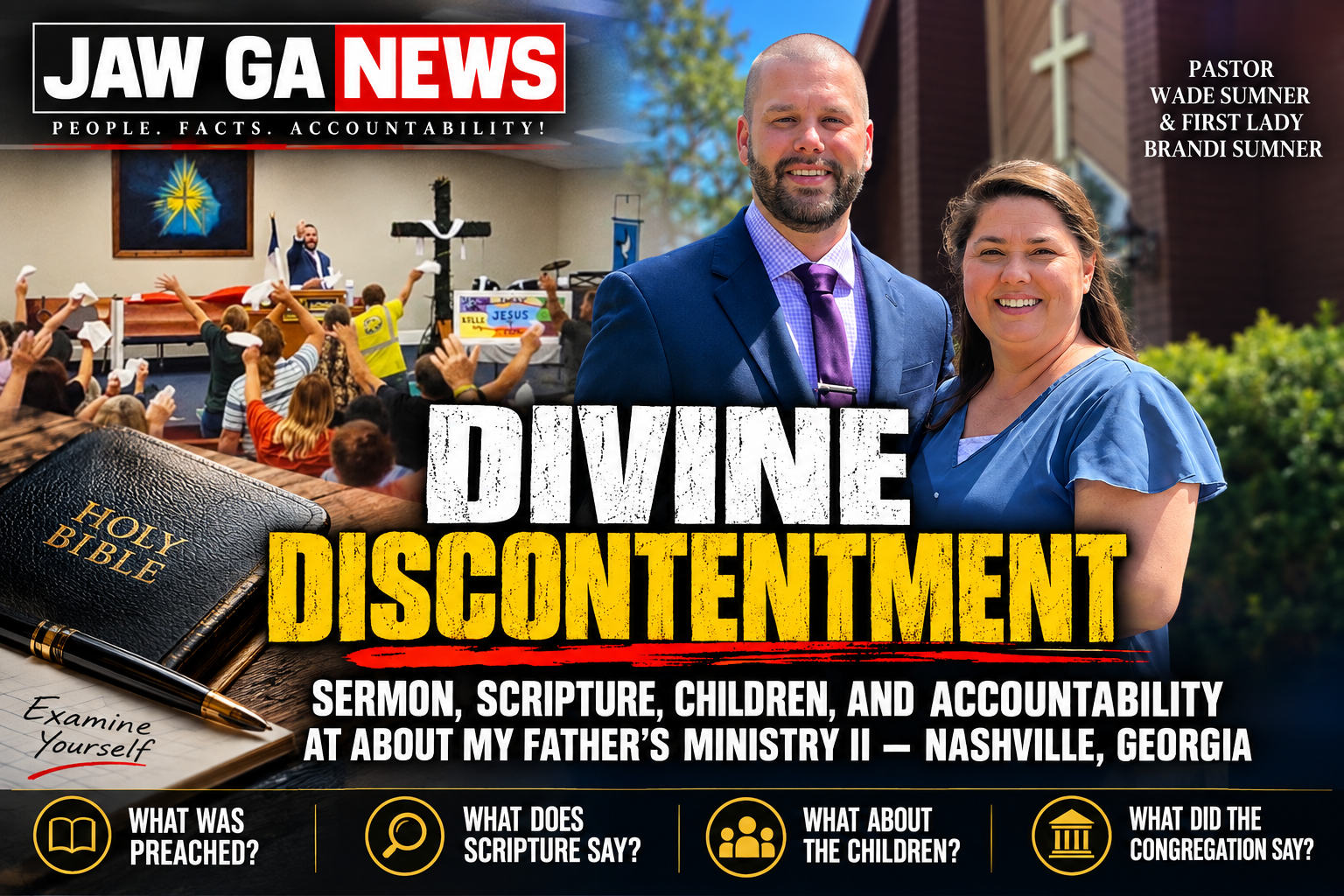
Pastor Wade Sumner’s sermon sparks questions about scripture, adult subjects discussed before children, and whether the congregation applies the same standards it preaches.
JAW GA NEWS | PEOPLE. FACTS. ACCOUNTABILITY!
October 25, 2026 | Nashville, Georgia
What happens when a pastor preaches about repentance, self-examination, and divine discontentment, only to have his own teachings questioned by someone outside his congregation?
That is exactly what unfolded in Nashville, Georgia, following a JAW GA News examination of sermons delivered by Pastor Wade Sumner of About My Father’s Ministry II, Nashville Campus.
What began as an examination of biblical interpretation and adult language used during preaching developed into a public discussion involving congregation members, critics, and eventually the pastor’s wife, Brandi Cofield Sumner.
The discussion raised questions about how scripture is interpreted, how children are taught, and whether religious leaders should face the same examination they encourage others to undertake.
And while some members defended their pastor without reservation, others acknowledged that the concerns were worth discussing.
JAW GA News reviewed two portions of a sermon transcript and documented the public responses shared during the October 25 discussion. Our findings concern the recorded preaching, the cited scripture, and the statements made in response. They do not establish misconduct beyond what the available evidence supports.
The Church and Its Leadership
About My Father’s Ministry II is located at 404 Briarcliff Drive in Nashville, Georgia.
According to the ministry’s official website, Pastor Wade Sumner and his wife, Brandi Sumner, began leading the Nashville campus in April 2023.
The Nashville congregation operates under the broader About My Father’s Ministry organization, which was founded by Pastor Buck Crumley.
The ministry describes itself as a full-gospel church emphasizing biblical teaching, discipleship, and making Jesus known.
The issue raised by JAW GA News was never whether people should be allowed to practice their religion. It was whether the preaching at this particular church was being delivered responsibly, supported accurately by scripture, and presented appropriately for the congregation’s younger members.
The Sermon That Started the Audit
The sermon examined by JAW GA News began with Psalm 42, a passage dealing with spiritual longing, sorrow, distress, and hope in God.
Pastor Sumner introduced the subject as “Divine Discontentment.”
He explained that he had originally planned to continue discussing the tabernacle and the altar of incense but believed God had interrupted those plans to deliver a more urgent message.
He told the congregation that the message could change their lives and even affect future generations.
Throughout the opening portion of the sermon, Sumner repeatedly asked the congregation to examine its spiritual condition.
He questioned whether listeners were truly living according to God’s expectations and whether God was pleased with their lives.
He also emphasized repentance, describing it as a complete change in direction rather than simply an emotional response.
Those subjects have recognizable biblical foundations.
However, the sermon later moved into a discussion of money, prosperity, drugs, pornography, prostitution, alcohol, and suicide.
That portion of the sermon became one of the central issues examined by JAW GA News.
The $25 Million Scenario
During his discussion of material wealth and spiritual prosperity, Pastor Sumner introduced a hypothetical situation involving someone receiving $25 million.
He suggested that such wealth could lead a person toward destructive choices rather than spiritual fulfillment.
The illustration became increasingly graphic.
Sumner suggested that a person receiving that money would purchase expensive possessions, turn toward illegal drugs, engage in prostitution, abuse alcohol, and potentially destroy themselves.
He used the phrase:
“You’d blow your brains out, proverbially, on the ceiling.”
Although Sumner used the word “proverbially,” the reference to suicide was unmistakably graphic.
This raised two separate questions for our investigation.
First, what scripture actually supports the particular claims presented in this scenario?
Second, what consideration should be given to the ages of children who may be present when a pastor delivers such material?
Those are questions about biblical interpretation and responsible adult leadership, not objections to discussing difficult subjects in every circumstance.
What the Scriptures Actually Say
JAW GA News examined the passages used in the sermon against the 1599 Geneva Bible.
Psalm 42 concerns a person longing for Yahweh while experiencing sorrow and spiritual distress.
The passage describes tears, oppression, remembrance, and the struggle to maintain hope.
It does not describe someone receiving millions of dollars and subsequently turning toward addiction, prostitution, or suicide.
Sumner also referenced Jeremiah 1:5 when discussing God’s plans for people’s lives.
However, Jeremiah 1:5 specifically concerns Yahweh knowing Jeremiah before his birth and appointing him as a prophet to the nations.
The passage does not promise every individual financial prosperity or establish what would happen if someone received $25 million.
There are biblical passages addressing the dangers associated with wealth.
For example, 1 Timothy 6:9–10 warns against the desire to become rich and the temptation that may accompany greed.
But there is a significant difference between scripture warning that greed can lead to destruction and a preacher predicting that his audience would use sudden wealth to engage in drugs, prostitution, and self-destructive behavior.
The $25 million scenario was Sumner’s own hypothetical illustration. It was not a narrative contained in Psalm 42 or Jeremiah 1:5.
Another issue emerged when Sumner discussed choosing whom to serve.
His sermon combined language associated with Joshua 24:15, where Joshua challenges the people to choose whom they will serve, and 1 Kings 18, where Elijah confronts the worshippers of Baal.
Both passages concern allegiance to God, but they describe separate biblical events.
Combining related passages for illustration is not automatically an improper preaching method. The question is whether the speaker accurately represents their original context and distinguishes scripture from his own explanation.
The distinction matters because several congregants subsequently insisted that everything their pastor preached was directly backed by biblical scripture.
Our review found that the sermon contained biblical teachings alongside interpretations, illustrations, and statements that went beyond the specific passages cited.
The Concern About Children
One of the earliest public statements from JAW GA News explained why the language used during the sermon had raised concern.
Our publisher recalled attending church as a child, when younger members received instruction separately from adults until they were old enough to better understand mature subjects.
The purpose was not to hide scripture from children.
It was to teach them according to their age and understanding.
JAW GA News questioned whether references to pornography, prostitution, drug abuse, and suicide were appropriate for young children who might be sitting in the congregation.
This concern became even more significant because the church’s members were also discussing Halloween and the potential influence of certain costumes and imagery on children.
The underlying question was simple.
If adults are concerned about what children encounter outside the church, shouldn’t they be equally concerned about how mature subjects are presented inside the church?
Adults are expected to serve as role models for younger generations.
Teachers, pastors, parents, and other authority figures carry responsibilities that cannot simply be dismissed because children might encounter worse behavior elsewhere.
Anna Clanton Roland Defends the Pastor
Anna Clanton Roland was among the first people to challenge the criticism.
She encouraged JAW GA News to attend an entire service and argued that children already hear worse language at school.
JAW GA News responded that the sermon had been listened to and examined, and that exposure to inappropriate language elsewhere did not automatically make the pastor’s delivery appropriate.
Anna later argued that parents decide whether their children sit through a church service and questioned why the pastor should alter his sermon because children were present.
She also compared the sermon to biblical passages containing sexual subject matter.
That argument raises an important distinction.
The presence of adult subjects in scripture does not mean every passage must be taught to every age group in precisely the same manner.
Children’s Bibles, Sunday school materials, and age-appropriate religious lessons exist for that reason.
Anna also said she had not necessarily heard the pastor preach against Halloween, while explaining that the church did not worship demons, witches, or warlocks.
Later, she defended Wade Sumner’s character and said he was a humble and caring pastor who did not receive payment for his pastoral work.
She also rejected accusations that the church begged for money, explaining that online donation information allowed members who could not attend services to contribute their tithes.
Those financial statements are Anna’s account. JAW GA News did not independently examine the church’s compensation records or finances as part of this audit.
But one of her statements became especially important.
Anna argued that those upset with the pastor’s preaching should direct their anger toward God because the pastor preached God’s word.
That raises an unavoidable question.
Since when does questioning a pastor’s interpretation automatically mean questioning Yahweh Himself?
A pastor is a human being interpreting scripture.
A sermon can be examined independently of the preacher’s reputation, popularity, or the affection his congregation holds for him.
And criticism of an interpretation does not automatically constitute an attack on someone’s religious faith.
Anna also questioned the use of Google or artificial intelligence in developing religious arguments.
JAW GA News does not regard research assistance as a substitute for examining source material. The accuracy of an argument depends on its evidence, not merely on whether a person used research tools to organize or verify it.
Eston Lee Hutto and the Question of Biblical Authority
Another congregation member, Eston Lee Hutto, offered a lengthy defense of the pastor.
Eston described his personal transformation after attending the church, explaining that he had experienced difficult circumstances and found acceptance within the congregation.
JAW GA News does not dispute his account of how meaningful that experience was to him.
However, personal testimony does not independently establish the accuracy of every interpretation offered from the pulpit.
Eston argued that the pastor’s sermons were grounded in scripture and expressed frustration with what he considered attacks against the church.
When JAW GA News asked why the preaching should be beyond examination, Eston acknowledged that nothing was beyond examination.
Nevertheless, he later accused the publication of attacking rather than examining the pastor.
He also defended the use of adult subject matter before children by recalling that, when he was young, children remained in the pews and listened to the same preaching as adults.
His argument was that children already encounter subjects involving sex, drugs, alcohol, and pornography throughout society.
But whether children encounter a subject elsewhere does not settle whether the particular words used by an adult speaker are appropriate for their age.
JAW GA News returned the conversation to the scriptural question.
Where did the passages cited by Sumner establish the particular $25 million scenario he described?
No specific verse supporting that exact illustration was supplied in the exchange.
This distinction remains important.
Something may be delivered during a sermon without being directly stated in scripture.
And something may be preached passionately without every part of the message representing the original meaning of the biblical text.
The publisher also referenced a separate examination involving Pastor Justin Bickford’s discussion of Cyrus, expressing concern about a broader pattern of biblical narratives being adapted to fit a preacher’s intended message.
That comparison reflected JAW GA News’ wider concern about scriptural interpretation. The present findings, however, concern Sumner’s own sermon and the passages examined here.
Natosha Hutto and Accusations of Spiritual Opposition
Natosha Hutto also defended the church, Pastor Sumner, and his wife.
She argued that the messages being preached came from scripture and described criticism of the church in terms of the devil’s work.
JAW GA News challenged that reasoning by referring to Matthew 23, where Jesus confronts religious leaders over hypocrisy and their conduct.
The point was straightforward.
Religious criticism does not become evil simply because it challenges someone standing behind a pulpit.
The examination of religious leadership is not inherently opposed to faith.
In fact, the biblical record itself contains repeated examples of prophets and religious teachers challenging the behavior of people claiming spiritual authority.
The question isn’t whether someone calls himself a man of God. The question is whether his words and conduct withstand examination.
Other Community Members Raise Concerns
Not everyone in the discussion defended the church.
Teresa Evans shared negative experiences with churches she had previously attended, including allegations of gossip, judgment based on financial circumstances, and discrimination.
She questioned why parents might object to certain language being used around their children outside church but accept similar language from a pastor.
Her statements concerned her personal experiences and views, not independently verified misconduct at the Nashville campus.
Heather Tennison also participated in the discussion.
Heather explained that she had not personally attended Pastor Sumner’s church or heard the sermon, but had seen online comments she found troubling.
Anna responded that she had attended the church for three years and had never known the pastor to speak badly about someone.
Wendy Michelle Rentz supported the argument for separate children’s instruction when adult themes are discussed.
Wendy also criticized the use of tithes and donations and questioned the church’s Trunk or Treat event.
She alleged that the pastor had removed a previous comment and blocked her after she criticized that event.
JAW GA News has not independently confirmed the alleged blocking or established improper financial conduct by the church.
These concerns were part of the public discussion but should not be confused with the documented findings involving the sermon.
Another commenter, Angie Bullard, encouraged JAW GA News to find another church, suggesting the criticism reflected personal dissatisfaction.
But the examination was never an attempt to select a place of worship.
It concerned a public sermon and whether the teaching should withstand scrutiny.
Brandi Cofield Sumner Enters the Discussion
A significant development occurred when Brandi Cofield Sumner, the pastor’s wife, publicly responded to Heather Tennison’s concerns about online comments.
Brandi said that the remarks Heather had encountered were hers, not her husband’s.
She acknowledged that she had previously made comments she considered inappropriate and inconsistent with her faith.
According to Brandi, she subsequently apologized publicly and privately to those involved and addressed her congregation to acknowledge her behavior.
She also offered another apology directly to Heather.
That response deserves acknowledgment.
Brandi accepted personal responsibility for the conduct she described rather than simply dismissing the criticism.
Her statement also clarified an important question of attribution regarding the earlier social media comments.
Her account of the apologies has not been separately verified by JAW GA News, but her public acknowledgment is documented.
That exchange demonstrated that criticism and accountability do not have to prevent a constructive conversation.
The First Significant Development Concerning Children
The discussion took another important turn when Brandi responded directly to JAW GA News’ concerns about children attending adult-oriented sermons.
She acknowledged that the church needed a separate place for children and said arrangements were being worked on.
She explained that repairs to the building were being completed gradually.
This was an important statement.
It established that someone in the Nashville campus’s leadership recognized a need to improve the arrangements available for children.
However, Brandi specifically disagreed with the reasoning behind JAW GA News’ criticism.
Her acknowledgment should therefore not be misrepresented as an admission that the sermon was inappropriate.
The broader ministry’s official website identifies children’s classes and youth ministry activities, but the publicly available description does not by itself establish what facilities or age-separated instruction were available at the Nashville campus during the sermon examined.
The exact timetable for the separate children’s space, the program’s structure, and the supervision arrangements remain unconfirmed.
Brandi Explains the Church’s Approach to Mature Subjects
Brandi subsequently provided the most detailed response from someone in the church’s leadership.
She explained that children in the congregation had encountered serious issues involving suicide and depression, and that church leaders believed those subjects needed to be addressed.
She also discussed drugs, alcohol, pornography, and sexual behavior.
According to Brandi, the church addresses these subjects because children may already encounter them at school, through other young people, or in their personal lives.
She described the church’s intention as helping children understand these issues through religious teaching rather than leaving them without guidance.
She also stated that she and her husband believe the church should welcome people regardless of their financial circumstances or appearance.
Brandi rejected the suggestion that the congregation functioned as a cult and defended her husband’s preaching as spiritually directed.
She also invited JAW GA News to attend the church and experience its fellowship.
These statements clarified the church’s position.
The church’s defense was not that these subjects were absent from its preaching. Its defense was that discussing them was part of its religious mission.
That matters because it brings the disagreement into focus.
JAW GA News has never argued that children should be prevented from learning about drugs, exploitation, depression, or other difficult issues.
Children need accurate information and responsible guidance.
The concern is how those subjects are presented, whether the instruction is appropriate for different age groups, and whether the adults delivering it recognize the distinction between educating children and exposing them to unnecessarily graphic language.
The church believes direct preaching can help address these issues.
JAW GA News questions whether the particular words used in the sermon represent responsible, age-appropriate instruction.
Those are the positions that emerged from the exchange.
Halloween, Trunk or Treat, and Consistent Standards
The church’s approach to Halloween also became part of the public debate.
Brandi explained that the church objects to imagery involving devils, demons, witches, warlocks, and vampires because it regards those subjects as spiritually harmful.
She also explained that the congregation did not object to superhero costumes.
Other comments confirmed that the church had planned a Trunk or Treat event.
That distinction matters because the disagreement was not simply about whether the church celebrated Halloween at all.
The controversy concerned the religious standards used to distinguish acceptable and unacceptable influences on children.
JAW GA News questioned why certain costumes or imagery were treated as inappropriate while graphic references to drugs, prostitution, and suicide could be presented during a service attended by children.
The church’s response was that those adult subjects were discussed for religious instruction and moral guidance.
That is an explanation of its position.
But it still leaves an important question.
What consistent standards does the church use to determine which subjects, examples, and language are appropriate for younger children?
That question remains relevant regardless of whether the disagreement concerns Halloween, a sermon, school, or something children encounter online.
The Meaning of Divine Discontentment Comes Full Circle
Perhaps the most striking development in the entire audit is the connection between the sermon itself and the public controversy that followed.
Pastor Sumner told his congregation that God had interrupted his original preaching plans because there was a message they needed to hear.
He called that message “Divine Discontentment.”
He encouraged the congregation to examine itself, reject hypocrisy, repent, and make changes.
Those were among the central themes of his message.
JAW GA News subsequently examined the sermon and questioned whether the pastor and congregation were applying those same principles to their own teachings.
Our publisher also explained publicly that the church had been brought to the publication’s attention for a reason.
That was an expression of personal religious conviction, not something JAW GA News presents as independently provable.
The parallel, however, became central to the exchange.
Sumner called for self-examination.
JAW GA News called for that same examination to extend to the pulpit.
The congregation was encouraged to question its spiritual condition.
JAW GA News questioned how its religious leaders delivered their messages.
Some members responded by defending their pastor.
Others raised concerns.
Brandi eventually entered the discussion, clarified the church’s reasoning, and acknowledged the need for improved arrangements for children.
Whether one agrees with the criticism or the church’s response, the sermon became the foundation for an unusually direct public discussion about religious accountability.
Matthew 7:5 and Matthew 23
JAW GA News concluded its public exchange by invoking Matthew 7:5 and Matthew 23.
Matthew 7:5 teaches the importance of confronting one’s own faults before attempting to correct another person.
Matthew 23 records Jesus confronting religious leaders over hypocrisy, outward displays of righteousness, and failures to practice the principles they taught.
These passages are relevant because religious leaders frequently call on their congregations to repent and examine their lives.
Those leaders must also remain open to questions about their own interpretations, judgment, and conduct.
Religious authority does not automatically establish that every interpretation is correct.
Nor should loyalty to a pastor replace an examination of the words being preached.
If self-examination is necessary for the congregation, it should not become unnecessary when the examination reaches the pulpit.
The Audit Findings
Following our review of the sermon material and the public exchanges, JAW GA News has documented the following findings.
Finding One: The sermon contained graphic adult language.
The supplied sermon transcript includes references to pornography, drugs, prostitution, and suicide, including the graphic $25 million illustration. This finding is directly supported by the sermon material reviewed.
Finding Two: The specific $25 million scenario was not contained in the cited biblical passages.
Psalm 42 and Jeremiah 1:5 do not establish the hypothetical sequence described by the pastor. His illustration drew on broader themes of temptation and material wealth but went beyond the words of those passages.
Finding Three: Separate biblical passages were combined during the preaching.
Sumner drew from language associated with Joshua 24:15 and 1 Kings 18. Both passages concern choosing allegiance to God, but they are separate biblical events.
Finding Four: Members of the congregation defended the sermon on religious and personal grounds.
Several commenters described the pastor’s positive influence and argued that direct preaching about sin is necessary. Those views are documented in the discussion.
Finding Five: The pastor’s wife confirmed that the church deliberately addresses mature subjects.
Brandi Cofield Sumner explained that church leaders discuss issues involving suicide, drugs, alcohol, pornography, and sexual behavior because they believe young people need religious guidance about them.
Finding Six: Brandi acknowledged that better arrangements for children were needed.
She stated that the church was working toward providing a place for children while gradually making repairs. The completion date and precise arrangements remain unconfirmed.
Finding Seven: Brandi publicly accepted responsibility for earlier inappropriate Facebook comments.
She stated that she authored the comments, apologized to those affected, and addressed the congregation. Her acknowledgment corrected a possible misattribution to the pastor.
Finding Eight: The church has publicly explained its objections to certain Halloween imagery.
Brandi distinguished between costumes depicting subjects the church considers demonic and costumes it considers acceptable, such as superheroes. The church’s stated standards remain part of the wider discussion about age-appropriate influences.
Finding Nine: Other allegations remain unverified.
Claims concerning the pastor’s compensation, alleged blocking of a commenter, and financial solicitation were discussed publicly but were not independently established by this audit.
Finding Ten: Pastor Wade Sumner’s own direct response to the specific audit findings has not been documented in the material reviewed.
His wife and congregation members provided extensive explanations and defenses. No separate, direct statement from Sumner addressing JAW GA News’ scriptural findings was included in the available record.
What Remains Unanswered
Although this phase of the audit is complete, several questions remain.
What age groups were present during the sermon examined?
What arrangements were available for younger children during that service?
When will the separate children’s space mentioned by Brandi become available?
Will age-appropriate teaching be offered when adult subjects are addressed during worship?
What supervision and child-safeguarding procedures will accompany those arrangements?
How does Pastor Sumner distinguish direct biblical teachings from his own illustrations when presenting scripture to the congregation?
And will he personally address the specific questions raised about Psalm 42, Jeremiah 1:5, and the $25 million scenario?
These are legitimate questions arising from the documented sermon and public responses.
They do not require anyone to abandon their religion or surrender their convictions.
They require explanations.
JAW GA News Final Assessment
This investigation was not about deciding who is the better Christian.
It was not about preventing religious people from worshipping.
And it was not about attacking someone simply because he stands behind a pulpit.
It was about examining what was preached, comparing that preaching with scripture, and asking whether the standards used to judge influences outside the church were being applied consistently within it.
The review established that Pastor Sumner’s sermon contained graphic language and illustrations that went beyond the specific scriptural passages he cited.
The public discussion also established that the church deliberately addresses mature subjects as part of its ministry.
Most importantly, Brandi Cofield Sumner acknowledged the need for improved arrangements for children, even while defending the church’s existing approach to preaching.
That is a meaningful development, although it is not the same as proving every criticism correct.
Religious freedom protects a church’s ability to teach its beliefs.
It does not place those beliefs, interpretations, or public statements beyond examination.
And protecting children from inappropriate influences should never be treated as a concern that ends when someone walks through the church doors.
For JAW GA News, the central principle remains unchanged.
Adults are supposed to lead by example. Religious leaders are no exception.
Pastor Sumner preached about Divine Discontentment, repentance, and self-examination.
Our examination has now placed those same subjects before the congregation and its leadership.
What they choose to do with the questions raised is their responsibility.
Our responsibility was to examine the evidence and report what we found.
We have done that.
PEOPLE. FACTS. ACCOUNTABILITY!
JAW GA News
A Stronger Georgia.
Sources and Documentation
This audit draws on the sermon transcripts reviewed by JAW GA News, screenshots and text of public Facebook comments shared during the October 25, 2026 discussion, and the following publicly available references:
- About My Father’s Ministry: Official Leadership
- About My Father’s Ministry: Church History
- About My Father’s Ministry: Official Website
- Psalm 42, 1599 Geneva Bible
- Jeremiah 1:5, 1599 Geneva Bible
- Joshua 24:15, 1599 Geneva Bible
- 1 Kings 18:21–23, 1599 Geneva Bible
- 1 Timothy 6:6–10, 1599 Geneva Bible
- Matthew 7:5, 1599 Geneva Bible
- Matthew 23, 1599 Geneva Bible
Editorial note: Sermon quotations are drawn from transcript material provided for this investigation. Public comment statements are attributed to their respective authors. The recording date, full audiovisual context, attendance of specific children, and certain claims raised by commenters were not independently established. The complete unedited sermon recording was not independently verified against the supplied transcript. JAW GA News welcomes documented corrections and further responses from those discussed in this report.
© 2026 JAW GA News. All rights reserved.

Leave a Reply
You must be logged in to post a comment.