
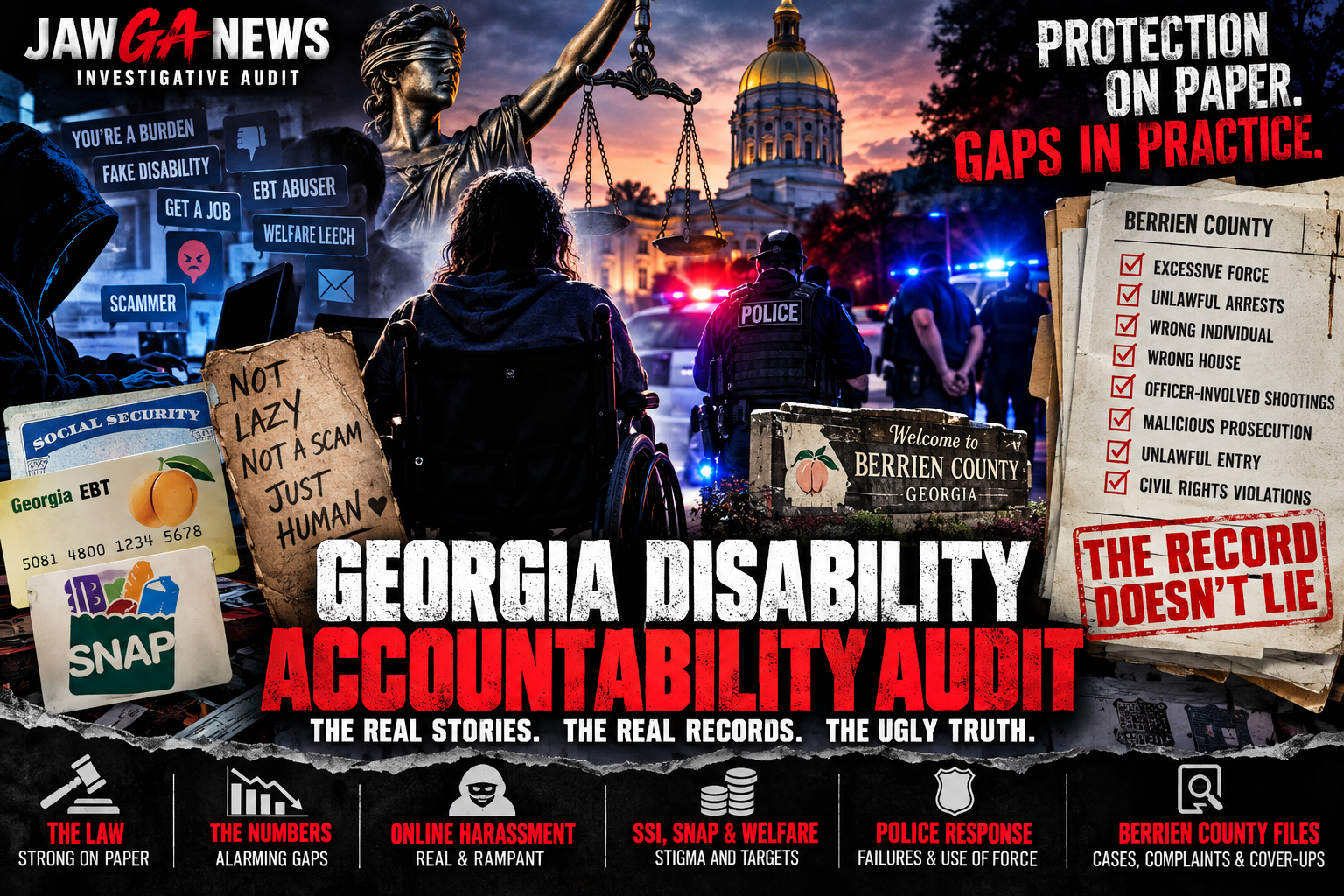
GEORGIA DISABILITY ACCOUNTABILITY AUDIT
Protection on Paper. Gaps in Practice.
Georgia law expressly recognizes mental and physical disability as protected categories under its hate-crime framework.
Georgia law criminalizes repeated electronic harassment.
Georgia law recognizes electronic communications as potential stalking.
Georgia requires law enforcement to document apparent disability-motivated crimes through a Bias Crime Report even when nobody is arrested.
Yet when available statistics, court records, public complaints, cyberharassment experiences, officer-involved deaths and Berrien County’s own civil-rights history are placed beside those protections, a much uglier picture emerges:
Georgia can describe what disabled people are legally entitled to.
It has a considerably harder time showing what actually happens after they ask for help.
This audit examines that gap.
I. THE LAW
Georgia’s hate-crime sentencing statute, O.C.G.A. §17-10-17, expressly includes both mental disability and physical disability.
If a person intentionally selects a victim because of an actual or perceived mental or physical disability, and the required bias finding is proved beyond a reasonable doubt, Georgia law provides enhanced punishment for qualifying offenses.
https://law.justia.com/codes/georgia/title-17/chapter-10/article-1/section-17-10-17
But the more important provision for this audit may be O.C.G.A. §17-4-20.2.
When a law-enforcement officer investigates a crime and it appears a victim may have been deliberately selected because of an actual or perceived mental or physical disability, Georgia law says the officer “shall” prepare a Bias Crime Report.
That requirement applies whether or not anybody is arrested.
That creates an accountability trail:
CRIME REPORTED
↓
POSSIBLE DISABILITY BIAS IDENTIFIED
↓
BIAS CRIME REPORT
↓
GBI REPORTING
↓
PROSECUTOR
↓
POSSIBLE HATE-CRIME ENHANCEMENT
If nobody asks about disability bias at the beginning, the rest of that chain can simply disappear.
https://law.justia.com/codes/georgia/title-17/chapter-4/article-2/section-17-4-20-2
II. WHAT GEORGIA’S OFFICIAL NUMBERS SHOW
Federal hate-crime statistics show remarkably few reported disability-bias incidents in Georgia.
| Year | Reported Georgia Disability-Bias Incidents |
|---|---|
| 2021 | 3 |
| 2022 | 5 |
| 2023 | 2 |
In 2023, disability represented approximately 1.4% of Georgia’s reported hate-crime incidents.
https://www.justice.gov/hatecrimes/state-data/georgia
Now compare that with Georgia’s SSI population.
In December 2025, Social Security Administration figures showed approximately 241,000 SSI recipients in Georgia, with more than 210,000 classified as disabled rather than qualifying solely because of age.
https://www.ssa.gov/policy/docs/statcomps/ssi_sc/2025/ga.html
Those statistics do NOT prove underreporting.
They raise a question:
How can Georgia determine whether disability-bias crime is genuinely rare when the public reporting system does not tell us how many disabled people reported harassment, stalking, threats or related offenses that were never classified as disability-bias incidents?
The denominator is missing.
III. THE ONLINE HARASSMENT PROBLEM
National research makes Georgia’s tiny official numbers even more worthy of scrutiny.
A nationally representative 2024 Anti-Defamation League survey found that 45% of adults with disabilities reported experiencing online harassment during the previous year, compared with 36% of adults without disabilities.
Severe harassment was reported by 31% of disabled adults compared with 19% of adults without disabilities.
https://www.adl.org/resources/report/online-hate-and-harassment-american-experience-2024
Georgia law already reaches electronic conduct.
O.C.G.A. §16-11-39.1 potentially criminalizes repeated electronic contact made for purposes including harassment, threats and intimidation.
https://law.justia.com/codes/georgia/title-16/chapter-11/article-2/section-16-11-39-1
Georgia’s stalking statute, O.C.G.A. §16-5-90, expressly includes communications through computers, computer networks and other electronic devices.
https://law.justia.com/codes/georgia/title-16/chapter-5/article-7/section-16-5-90
So “it happened online” is not, by itself, an answer to an allegation of criminal harassment.
The Internet is not some magical territory where Georgia criminal law suddenly loses Wi-Fi.
IV. PUBLIC COMPLAINTS SHOW THE GAP
Public complaints do not establish misconduct by themselves.
They do reveal recurring allegations worth examining.
In January 2026, a Covington resident publicly reported that police refused to accept a stalking complaint even though the person said repeated incidents had been extensively documented.
https://answers.justia.com/question/2026/01/05/what-can-i-do-if-ga-police-refuse-to-acc-1097795
In another Georgia public complaint, a disabled adult described online threats, intimidation and repeated Facebook targeting severe enough that the person said it was aggravating an existing illness.
https://answers.justia.com/question/2025/08/19/disabled-adult-facing-online-threats-and-1072954
These accounts cannot establish a statewide rejection rate.
But they demonstrate that disabled Georgians publicly report the exact conduct this audit is examining.
The better question is:
How many disabled Georgians reported electronic harassment, threats or stalking, and how many of those complaints were ever screened for disability bias?
Georgia does not publicly provide that number.
V. SSI, SNAP AND PUBLIC-BENEFIT STIGMA
Disabled adults can also encounter another overlapping form of hostility: stigma surrounding public assistance.
SSI serves qualifying aged, blind and disabled individuals.
SNAP provides nutrition assistance.
EBT is simply an electronic delivery mechanism for certain benefits.
None of those phrases means “person who refuses to work.”
Yet public conversations repeatedly contain assumptions that recipients are lazy, fraudulent, undeserving or living from somebody else’s labor.
That distinction matters when online harassment specifically references:
a person’s disability;
their inability to work;
their SSI benefits;
SNAP or EBT;
or their reliance upon public assistance.
That language does not automatically transform offensive speech into a criminal hate crime.
But where an underlying criminal offense exists, evidence establishing why someone was targeted can become extremely important.
VI. SWATTING: WHEN ONLINE TROLLING WEAPONIZES THE POLICE
One form of cyberharassment deserves special attention because it deliberately turns law enforcement into part of the attack.
It is commonly called “swatting.”
The FBI describes swatting as the malicious use of false emergency reports to provoke an armed law-enforcement response at an unsuspecting victim’s location.
It can be used for harassment, intimidation and retaliation.
Federal prosecutions have also involved swatting as one component of wider cyberstalking and harassment campaigns.
The tactic effectively allows an online harasser to weaponize emergency services against another human being.
The troll does not need to physically confront the victim.
Police are manipulated into doing the confrontation for them.
That creates obvious danger.
Officers may believe they are arriving at a violent emergency.
The person inside may have absolutely no idea why armed officers are suddenly at the door.
If false information includes claims that the target is armed, violent, suicidal or mentally unstable, the consequences can be catastrophic.
VII. A FIRST-PERSON CASE STUDY: JOSEPH ALLEN WOLFE
This investigation is not purely academic for JAW GA News founder and publisher Joseph Allen Wolfe.
Wolfe reports that beginning in 2019 he experienced a prolonged online harassment campaign involving multiple individuals and accounts operating across several social-media platforms.
According to Wolfe, the conduct included coordinated harassment, impersonation or misleading representations, repeated unwanted targeting, attacks concerning disability and public benefits, and attempts to use outside institutions against him.
Wolfe reports preserving screenshots, recordings, archived posts, videos, URLs and other digital material documenting portions of that history.
Most significantly for this investigation, Wolfe reports multiple situations in which police or emergency services were contacted concerning him or people close to him under circumstances he believes formed part of the wider online harassment campaign.
Because this audit concerns institutional response rather than publicly assigning criminal responsibility, alleged harassers are not identified by name.
The issue being examined is what happens after a person reports a prolonged electronic harassment campaign that allegedly crosses from speech into repeated unwanted contact, threats, impersonation, stalking or swatting.
VIII. THE NASHVILLE POLICE TECHNOLOGY EXPLANATION
Wolfe says he approached the Nashville, Georgia Police Department regarding his online harassment complaints.
According to Wolfe, the officer he spoke with told him the department did not have the technology necessary to investigate the matter.
JAW GA News examined publicly available information concerning Nashville Police Department’s investigative and technological capabilities.
We could find no public evidence that Nashville PD maintains its own dedicated cybercrime laboratory or advanced digital-forensics unit.
That part may therefore reflect a legitimate local limitation.
But it does not tell the entire story.
The Georgia Bureau of Investigation employs digital-forensics personnel capable of examining computers, mobile devices and electronic media while providing technical assistance to other law-enforcement agencies.
Georgia local agencies can begin investigations, preserve evidence and request specialized assistance where necessary.
A patrol officer does not need an advanced cyber laboratory to:
take an incident report;
collect screenshots;
document usernames;
record URLs;
preserve dates and timestamps;
document phone numbers;
interview witnesses;
establish a timeline;
identify repeated conduct;
document alleged swatting incidents;
evaluate possible harassing communications;
evaluate possible stalking;
or determine whether another agency should become involved.
Those are ordinary investigative functions.
Therefore, a blanket statement that an investigation could not begin merely because a small police department lacked advanced technology would be incomplete.
JAW GA News cannot presently establish that the Nashville officer knowingly lied.
That would require evidence concerning the officer’s actual knowledge, department policy and training.
But the explanation Wolfe reports receiving does not describe the complete investigative and referral resources available to Georgia law enforcement.
That deserves clarification from the department.
IX. WHY ALLEGED SWATTING SHOULD CHANGE THE RESPONSE
Multiple alleged false emergency calls should not be treated as merely another collection of unpleasant Internet comments.
The FBI identifies swatting as a potentially dangerous cyberharassment tactic.
It recommends preserving:
usernames;
email addresses;
websites;
platform information;
photographs;
videos;
and other electronic evidence.
It also recommends reporting incidents to law enforcement.
The FBI does not tell victims simply to abandon the Internet.
The useful investigative questions include:
Who made the emergency call?
What exactly was reported?
What number or service was used?
Was caller-ID spoofing involved?
Were similar calls made previously?
Did anyone threaten online to contact police before the response?
Did users discuss or celebrate the police response afterward?
Were multiple accounts involved?
Were false claims made about disability, mental illness, suicide or dangerousness?
Did dispatchers identify multiple suspicious calls involving the same residence?
Was the matter ever referred to the GBI or FBI?
Those questions examine a pattern.
Treating every call as an unrelated event can prevent authorities from ever seeing one.
X. WHEN POLICE ENCOUNTER PEOPLE WITH MENTAL DISABILITIES OR PSYCHIATRIC CRISES
This is where the disability audit becomes considerably more serious.
Georgia has repeatedly experienced fatal law-enforcement encounters involving people with documented mental illness or people whom dispatchers were specifically told were experiencing psychiatric crises.
The following cases are among the strongest publicly documented examples identified during this audit.
These cases do NOT establish that every officer acted unlawfully.
They establish that mental-health information or documented disability existed before or during encounters that ultimately became fatal.
| Year | Region | Person | Location / Agency | Mental-health evidence | Fatal encounter |
|---|---|---|---|---|---|
| 2026 | North | Dakota Simmons, 24 | Gainesville / Gainesville Police Department | A 911 caller explicitly reported that Simmons was experiencing a mental-health crisis. | Officers exchanged gunfire with Simmons. He was shot and died at the hospital. |
| 2026 | Northwest / West Metro | Gustavo Guimaraes, 34 | Powder Springs / Powder Springs Police Department | GBI states officers were dispatched specifically to a mental-health-related call. | GBI says Guimaraes produced a handgun and officers fired. He died. |
| 2026 | North | Lawrence Charles Michels, 51 | Jasper / Jasper Police Department | Michels was at a Veterans Affairs clinic seeking a walk-in mental-health consultation. | After allegedly killing a VA social worker, Michels exchanged gunfire with police and an armed civilian and was killed. |
| 2026 | North / Metro | William Peak, 29 | Marietta / Cobb County Police Department | The caller warned dispatch before officers arrived that Peak was experiencing a mental-health crisis. | A welfare check escalated into a SWAT response. Peak was shot and killed. |
| 2026 | West / South Fulton | Eric Bates, 55 | South Fulton / South Fulton Police Department | Dispatch information described a suicidal man with a gun. | GBI says Bates had shot his wife and later fired at officers. Police returned fire and Bates died. |
| 2022 | East | Nelson Graham, 33 | Augusta / Richmond County Sheriff’s Office | Deputies were serving a court order requiring Graham to undergo a mental-health evaluation. | A deputy used a Taser. Graham became unresponsive and later died. GBI investigated the force used. |
| 2017 | Central / North Metro | Scout Schultz, 21 | Georgia Tech / Georgia Tech Police | Family reported a history of depression; public reporting described Schultz as suicidal and possibly experiencing a mental breakdown. | Schultz was shot and killed by a campus police officer during the crisis. |
| 2016 | South | Robert Lee Brown, 55 | Albany / Albany Police Department | Family said Brown was receiving treatment for mental illness, took medication and had fallen behind on it. | Officer Derrick Williams shot Brown after police said Brown stabbed Williams. Autopsy and death-certificate reporting showed the fatal gunshot entered Brown’s back. A civil grand jury later found the shooting justified and recommended no charges. |
| 2015 | Metro / North-Central | Anthony Hill, 26 | DeKalb County / DeKalb County Police Department | Hill had documented diagnoses of bipolar disorder and PTSD and had been medically discharged from the Air Force. | Hill was naked and unarmed when Officer Robert Olsen shot him twice. Olsen was later convicted of aggravated assault and oath violations. The aggravated-assault conviction was later overturned on appeal, and Olsen entered a negotiated guilty plea in 2025 resolving the case. |
Sources:
Dakota Simmons:
https://gbi.georgia.gov/press-releases/2026-03-21/gbi-investigates-officer-involved-shooting-gainesville
Gustavo Guimaraes:
https://gbi.georgia.gov/press-releases/2026-03-04/gbi-investigates-officer-involved-shooting-powder-springs
Lawrence Charles Michels:
Georgia Bureau of Investigation officer-involved shooting reporting, Jasper, March 2026.
William Peak:
https://gbi.georgia.gov/press-releases/2026-05-04/gbi-investigates-officer-involved-shooting-cobb-county-ga
Nelson Graham:
https://www.wrdw.com/2022/12/22/man-dies-after-richmond-county-deputy-uses-stun-gun-him/
Scout Schultz:
Atlanta Journal-Constitution reporting and subsequent litigation concerning the Georgia Tech shooting.
Robert Lee Brown:
https://www.walb.com/story/33149885/gbi-autopsy-reveals-victim-of-fatal-albany-police-shooting-shot-in-back/
Anthony Hill:
Atlanta Journal-Constitution reporting and Georgia court records concerning the prosecution of Robert Olsen.
XI. WHAT THAT TIMELINE ACTUALLY SHOWS
The important issue is not simply that these victims had mental-health problems.
It is what authorities knew before force occurred.
The cases fall into several evidentiary categories:
CONFIRMED DIAGNOSIS
Anthony Hill had documented bipolar disorder and PTSD.
KNOWN TREATMENT HISTORY
Robert Lee Brown’s family reported that he was receiving mental-health treatment and had fallen behind on medication.
MENTAL-HEALTH EVALUATION
Nelson Graham was being taken for a court-ordered mental-health evaluation.
MENTAL-HEALTH CALL
Gustavo Guimaraes was the subject of a call specifically characterized by GBI as mental-health related.
PSYCHIATRIC-CRISIS WARNING
Dispatchers were explicitly told that Dakota Simmons and William Peak were experiencing mental-health crises.
SUICIDE-RELATED CALL
Eric Bates was reported as suicidal and armed.
ACTIVE MENTAL-HEALTH TREATMENT SEEKING
Lawrence Michels was physically present at a VA facility seeking a mental-health consultation.
These are different circumstances.
They should not be flattened into a single accusation against law enforcement.
But collectively they establish something important:
Mental-health information was frequently available before deadly encounters occurred.
That makes dispatch procedures, de-escalation, Crisis Intervention Team training, supervisory response, less-lethal equipment and accommodation legitimate subjects for statewide examination.
XII. ANTHONY HILL: THE BENCHMARK CASE
Anthony Hill remains one of Georgia’s clearest cases involving law enforcement and documented mental disability.
Hill was an Air Force veteran diagnosed with bipolar disorder and PTSD.
On March 9, 2015, Hill was naked and unarmed when DeKalb County Police Officer Robert Olsen shot him twice outside his apartment complex.
The criminal prosecution became one of Georgia’s most significant cases involving police use of deadly force against a person experiencing serious mental illness.
The case demonstrates why several questions must remain separate:
Was the force criminal?
Was the force constitutionally unreasonable?
Was the person’s known disability appropriately considered?
Were reasonable de-escalation measures available?
Was crisis-intervention training relevant?
A disability-related police encounter is not automatically a hate crime.
But known disability can still be central to evaluating tactics, training, accommodation and use of force.
XIII. THE STATEWIDE PATTERN IS NOT NEW
An Atlanta Journal-Constitution examination of Georgia fatal police shootings found that roughly one-quarter of people fatally shot by Georgia police during 2017 were involved in incidents connected to mental illness.
That does not prove those shootings were unlawful.
It demonstrates that mental-health crises comprise a meaningful portion of deadly police encounters.
That raises another missing-data question:
How many Georgia officer-involved deaths each year begin as:
welfare checks;
suicide calls;
mental-health evaluations;
family requests for assistance;
or calls where dispatch was explicitly told the person had a psychiatric disability?
Georgia does not currently make that statewide answer easy for the public to obtain.
XIV. THREE DIFFERENT LEGAL QUESTIONS
This audit separates three legal issues that are too often thrown together.
HATE CRIME
Was somebody intentionally targeted because of actual or perceived disability?
ADA / CIVIL RIGHTS
Did authorities appropriately respond to a known disability, including potential reasonable accommodations where legally required?
USE OF FORCE
Was the amount of force objectively reasonable under the circumstances?
One case may raise one question.
Another may raise all three.
They are not interchangeable.
XV. BERRIEN COUNTY: THE LOCAL CIVIL-RIGHTS FILE
The Berrien County portion of this audit deserves particular attention because concerns involving police power cannot simply be dismissed as online rumor.
There is documented federal criminal misconduct involving a former sheriff.
Former Berrien County Sheriff Anthony Heath pleaded guilty in federal court in 2016 to two counts of violating the civil rights of non-resistant arrestees through excessive force.
According to the U.S. Department of Justice, his admitted conduct included kicking, punching and kneeing restrained people who were not resisting.
That is not an allegation.
That is a federal guilty plea.
A subsequent civil lawsuit brought by Jimmy Kyle Hooks concerned one of those encounters.
The fact that Berrien County itself was dismissed under municipal-liability principles does not erase independently established misconduct by an official.
XVI. THE KENNETH GRAHAM CASE
Another Berrien County case involved Kenneth Graham.
Berrien County investigator Wayne Luke obtained an arrest warrant after a convenience-store employee identified Graham’s driver’s-license photograph as the person who passed a fraudulent check.
Graham was later:
arrested;
transferred to Berrien County;
fingerprinted;
photographed;
strip-searched;
and detained.
He maintained that he had lost his driver’s license, had never visited the store and was working somewhere else when the check was passed.
The charges were eventually dismissed through nolle prosequi.
Graham later brought a federal lawsuit.
The federal courts ruled for investigator Luke, finding that the identification provided sufficient probable cause or arguable probable cause for qualified-immunity purposes.
Therefore, this case should NOT be represented as a judicial finding of unlawful arrest.
It remains relevant to an audit examining mistaken identity, investigative thoroughness and the consequences of erroneous identification.
XVII. ENIGMA: CURRENT MALICIOUS-PROSECUTION ALLEGATIONS
Former Enigma Acting Mayor James Douglas Webb and former City Clerk Latasha Luke filed a federal civil-rights lawsuit in September 2026 against former Enigma Police Chief Tony Perkins.
The lawsuit concerns arrests arising from GPS tracking devices placed on a city-owned police vehicle.
The criminal charges were later dismissed.
The federal lawsuit alleges malicious prosecution and claims critical facts were omitted when arrest warrants were obtained.
Those claims have not yet been adjudicated.
They belong in an active-litigation category, not a confirmed-misconduct category.
That distinction is mandatory for responsible reporting.
XVIII. BERRIEN COUNTY OFFICER-INVOLVED SHOOTINGS
The Georgia Bureau of Investigation has documented fatal and nonfatal officer-involved shootings within Berrien County.
On June 1, 2021, Ray City Police responded to a wellness check involving Donald Myers, 48.
According to the GBI, Myers approached officers carrying a knife.
Both officers fired.
Myers later died.
The phrase “wellness check” makes the underlying dispatch records important to this audit.
The publicly available GBI release does NOT establish that Myers had a mental disability.
Therefore JAW GA News will not label him mentally disabled without supporting evidence.
The CAD report, 911 audio and underlying investigative records could establish why the wellness check was requested and what officers were told before arriving.
In September 2024, a Georgia State Patrol trooper fired during an encounter with Roy Kyle Mathis after a traffic stop became a pursuit.
Mathis was not struck by gunfire and survived.
A separate Nashville incident involving Dearius Lamar Reed in 2020 was initially treated publicly as an officer-involved shooting.
The GBI later stated Reed died from a self-inflicted gunshot wound.
He therefore should NOT be counted as someone killed by law enforcement.
Accuracy still matters when the correction makes the story less dramatic.
XIX. WHAT THIS AUDIT HAS NOT ESTABLISHED
This audit has not established that Georgia law enforcement routinely commits disability hate crimes.
It has not established that every fatal police encounter involving mental illness was unlawful.
It has not established that most SSI recipients experience cyberharassment.
It has not established that most electronic-harassment reports are rejected.
It has not established criminal responsibility for the alleged swatting incidents reported by Joseph Allen Wolfe.
It has not established that Donald Myers had a mental disability.
It has not established that every disputed Berrien County arrest was unlawful.
And it has not established that the Nashville Police officer knowingly lied when describing the department’s technological capabilities.
Those conclusions would exceed the available evidence.
XX. WHAT THE EVIDENCE DOES SHOW
Georgia law requires disability bias to be recognized and reported.
Official statistics show remarkably few disability-bias hate crimes.
National research shows disabled adults experience disproportionately high levels of online harassment.
Georgia law recognizes electronic harassment and electronic stalking.
Federal authorities recognize swatting as a dangerous cyberharassment tactic.
A Georgia complainant reports experiencing multiple alleged swatting incidents during a years-long harassment history.
That complainant reports being told by Nashville Police that the department did not possess the technology to investigate the online conduct.
Georgia nevertheless maintains statewide digital-forensics resources through the GBI that can assist local law-enforcement investigations.
Public complaints show that some Georgia victims describe difficulty getting stalking and electronic-harassment complaints acted upon.
Georgia does not publicly provide a statewide pipeline showing:
how many disabled victims reported harassment;
how many complaints became criminal investigations;
how many were screened for disability bias;
how many Bias Crime Reports were completed;
how many were forwarded to prosecutors;
and how many resulted in hate-crime enhancements.
Georgia also does not provide the public with an easily searchable statewide dataset identifying fatal police encounters where known mental illness or psychiatric crisis existed before officers used force.
And in Berrien County, excessive-force concerns cannot simply be dismissed as rhetoric because a former sheriff actually pleaded guilty in federal court to violating the civil rights of non-resistant arrestees.
XXI. THE ACCOUNTABILITY GAP
The system operates through multiple silos.
A victim reports harassment.
A patrol officer decides whether to document it.
Someone decides whether a criminal offense exists.
Someone decides whether disability bias is relevant.
The GBI receives only what is reported or referred.
A prosecutor receives only what survives long enough to reach that office.
The court sees only what becomes a case.
The statistics count what remains at the end.
Anything lost near the beginning becomes statistically invisible.
Official hate-crime statistics cannot measure incidents that were never recognized as hate crimes.
Arrest statistics cannot measure complaints where no report was taken.
Prosecution statistics cannot measure incidents never sent to prosecutors.
Swatting statistics cannot identify campaigns where false emergency reports were never connected together.
And officer-involved-shooting statistics cannot explain the significance of mental disability when the public cannot easily determine what officers knew before the encounter.
An absent statistic is not proof that nothing happened.
Sometimes it means nobody counted it.
XXII. RECORDS JAW GA NEWS SHOULD SEEK
The next phase of this audit should seek statewide and local records from July 1, 2020 through the present involving:
- All Bias Crime Reports involving actual or perceived mental or physical disability.
- Disability-bias reports resulting in no arrest.
- Originating agency and county.
- Underlying criminal offense.
- Harassing communications.
- Electronic stalking.
- Aggravated stalking.
- Terroristic threats involving electronic communications.
- Alleged swatting and knowingly false emergency reports.
- Repeat emergency calls to the same residence.
- GBI or FBI referrals involving alleged swatting.
- Prosecutorial referrals.
- Hate-crime enhancement notices.
- Final case dispositions.
- Citizen complaints alleging refusal to accept cyberharassment or stalking reports.
- Department policies governing electronic evidence.
- Department policies governing cybercrime referral.
- Digital-forensics resources available to each agency.
- Officer training concerning electronic harassment and swatting.
- Officer-involved shootings involving known psychiatric crisis.
- In-custody deaths involving known psychiatric crisis.
- Welfare-check deaths.
- Suicide-response deaths.
- Court-ordered mental-health evaluation encounters.
- Crisis Intervention Team training of officers involved in those incidents.
- Use of Tasers or other less-lethal force in psychiatric encounters.
- For Nashville Police specifically, all 2025-2026 reports involving electronic harassment, social-media threats, cyberstalking, impersonation, doxing or false emergency calls.
- Nashville PD policies concerning referral to the GBI.
- For Berrien County agencies, complaints involving excessive force.
- Unlawful entry or search complaints.
- False-arrest complaints.
- Wrong-person arrests.
- Wrong-address warrant service.
- Malicious-prosecution complaints.
- Taser incidents.
- Deaths following restraint.
- Internal-affairs findings arising from those complaints.
- POST disciplinary actions related to sustained findings.
That information could finally allow the public to compare legal protections with measurable institutional behavior.
CONCLUSION
Georgia’s disability protections exist.
That is not the issue.
The issue is whether those protections survive contact with reality.
A disabled person can be mocked because they receive SSI.
They can be followed from platform to platform.
They can receive threats.
Their personal information can be circulated.
Someone can allegedly call police using fabricated information.
Officers can arrive believing they are confronting a dangerous person while the person inside has no idea why police are standing outside.
Someone experiencing an actual psychiatric crisis can call for help or have family request assistance and wind up in an armed police encounter.
And the resulting government statistics may tell the public very little about the disability component of either situation.
The cases identified in this audit stretch across North, South, East and West Georgia.
Some involved people who were armed.
Some involved alleged attacks on officers.
Some involved people seeking treatment.
Some involved welfare checks.
Some involved court-ordered mental-health intervention.
And some, like Anthony Hill, involved an unarmed disabled person whose death ultimately resulted in prosecution of the officer.
Those differences matter.
They are exactly why Georgia needs better data rather than broad assumptions.
Georgia law says electronic harassment matters.
Georgia law says stalking matters.
Georgia law says disability bias matters.
Federal authorities say swatting matters.
Civil-rights law says police use of force matters.
The question JAW GA News is asking is painfully simple:
When a disabled Georgian asks the system for protection, does the protection actually exist outside the statute book?
Because a right that survives only on paper is decoration.
Accountability begins when somebody enforces it.
JAW GA NEWS
People. Facts. Accountability.
Building trust through credibility, not popularity.

Leave a Reply
You must be logged in to post a comment.