JAW GA NEWS | SPECIAL INVESTIGATIVE REPORT
By Rev. Joseph Allen Wolfe
Founder, Publisher, and Editor-in-Chief
October 11, 2026
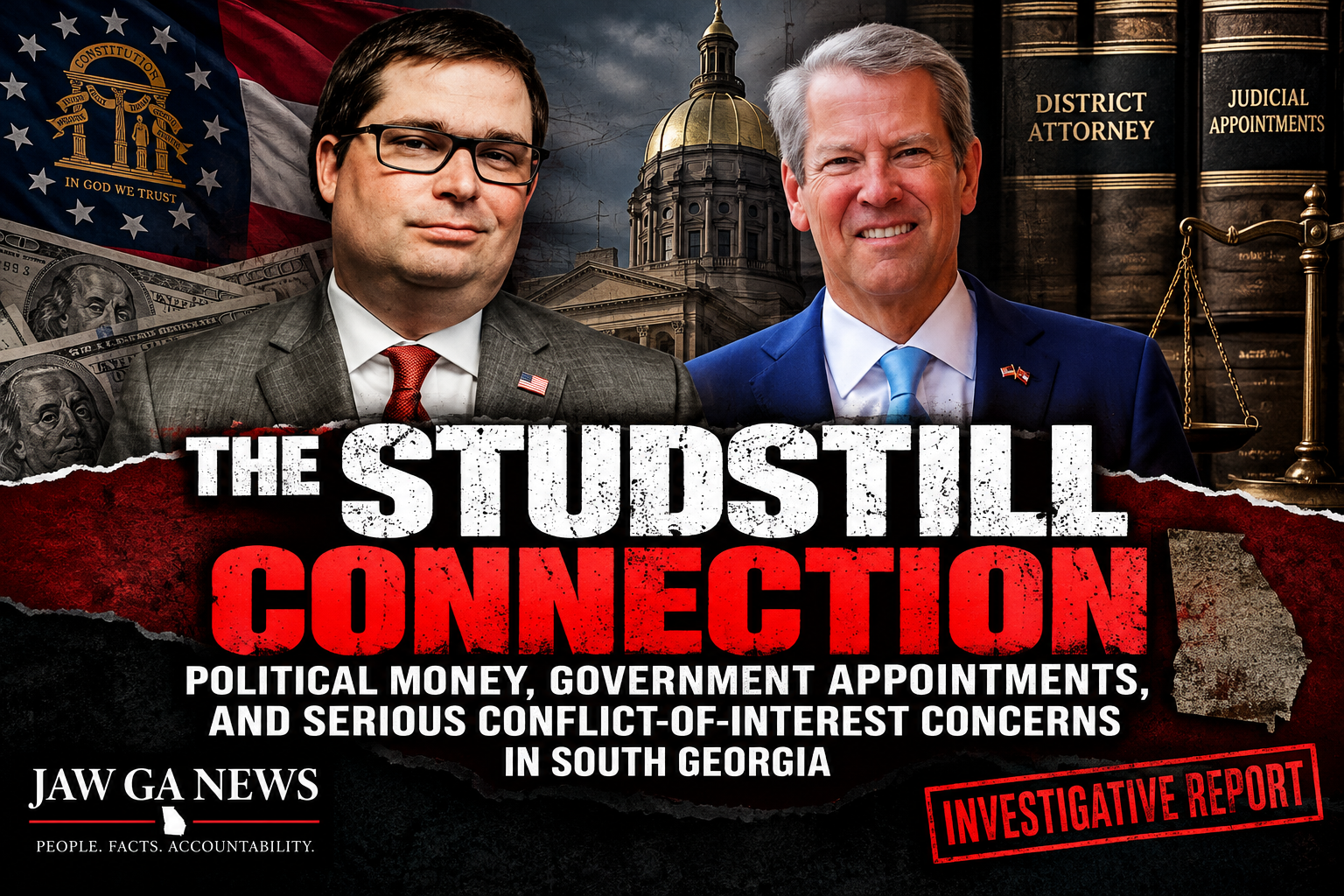
Folks, I have been doing some serious digging into the history of our Alapaha Judicial Circuit District Attorney, Chase Studstill, and what started as a simple investigation into his background has uncovered something much bigger involving Governor Brian Kemp, political campaign contributions, multiple appointments within the Studstill family, and documented problems within the judicial system.
And I want everybody to pay close attention to what we’re about to explain, because we aren’t talking about something somebody whispered behind closed doors or posted on Facebook. We’re talking about actual government records, campaign-finance disclosures, court decisions, and official appointments made by the Governor of Georgia.
What we discovered raises serious concerns about political favoritism and potential conflicts of interest.
Now, some folks are probably going to say that political connections are nothing unusual in Georgia. Well, that’s exactly the problem I believe deserves examining. Just because something has become common practice doesn’t mean the public should automatically accept it without asking questions.
Especially when those political relationships involve the person responsible for overseeing criminal prosecutions across five counties.
And that’s the point of this investigation.
IT STARTED WITH GOVERNOR KEMP’S APPOINTMENT
On April 23, 2021, Governor Brian Kemp announced that he was appointing Chase Studstill as District Attorney of the Alapaha Judicial Circuit, serving Atkinson, Berrien, Clinch, Cook, and Lanier counties.
The appointment followed Kemp’s earlier decision to appoint then-District Attorney Dick Perryman to the Superior Court bench.
In other words, Kemp appointed Perryman to a judgeship, which created a vacancy in the District Attorney’s Office, and then Kemp selected Studstill to fill that vacancy.
Now, according to the governor’s own announcement, Studstill had worked as a public defender in the Tift Judicial Circuit since 2017.
Before becoming a licensed attorney, Studstill had worked as a part-time office manager and legal assistant at the Studstill family law firm from 2007 through 2016. He also worked as a legal assistant in the Alapaha District Attorney’s Office in 2016.
So when Kemp selected Studstill in 2021, he had approximately four years of experience practicing law, primarily as a criminal defense attorney.
I’m not saying that being a public defender disqualifies someone from becoming a prosecutor. It certainly doesn’t.
However, when you compare his professional background with that of an attorney who was already working inside the office, things become considerably more interesting.
That brings us to Rebekah Maddox Ditto.
THE EXPERIENCED PROSECUTOR ALREADY IN THE OFFICE
According to the United States Department of Justice, Rebekah Ditto had been serving as an Assistant District Attorney in the Alapaha Judicial Circuit since 2013.
By March 2020, she had become Chief Assistant District Attorney and was sworn in as a Special Assistant United States Attorney for the Middle District of Georgia.
She graduated from the University of Georgia and Vermont Law School.
Following Perryman’s departure, Ditto also served as Acting District Attorney.
Now, think about this for a moment.
We had an attorney with approximately eight years of direct prosecutorial experience, federal prosecution responsibilities, and leadership experience within the very District Attorney’s Office that needed a permanent replacement.
Meanwhile, Studstill had approximately four years of experience practicing law, primarily representing defendants.
And Kemp selected Studstill.
Now, I want people to understand why that matters.
We’re not saying that years of experience alone automatically determine who should receive an appointment. Other qualifications can certainly matter.
But when the person selected has considerably less direct prosecutorial experience than someone already serving in a leadership capacity, I believe the public deserves to know exactly what qualifications were considered.
Who recommended Studstill? What interviews were conducted? What professional experience was given the greatest weight? And what made Kemp decide that Studstill was the appropriate person to lead this particular office?
Those aren’t unreasonable questions.
They’re exactly the questions the governor should be prepared to answer.
And when we started following the campaign money, we discovered another part of this story.
FOLLOWING THE MONEY STRAIGHT TO KEMP’S CAMPAIGN
According to an investigation published by Jessica Szilagyi of The Georgia Virtue, the Studstill family contributed approximately $92,250 to Brian Kemp’s political campaigns between 2017 and 2021.
Now, before anybody misunderstands that figure, it concerns reported donations associated with members of the Studstill family and related interests. It does not mean Chase Studstill personally contributed that entire amount.
JAW GA News has also independently examined official Georgia campaign-finance disclosures.
Among the documented contributions were:
May 14, 2018: Studstill Firm LLP contributed $6,600 to Kemp’s campaign.
July 12, 2018: Daniel L. Studstill PC contributed $1,000.
July 12, 2018: Daniel L. Studstill contributed another $1,500 individually.
October 7, 2019: Studstill Firm LLP contributed $7,000.
That’s $16,100 in four specifically identified contributions, and all four occurred before Kemp appointed Chase Studstill in April 2021.
Those contributions are recorded in Georgia’s official campaign-finance system.
Now, here’s my question.
When a governor receives documented political financial support from members of a family and their associated businesses, then appoints a member of that family to a powerful government position, shouldn’t we examine whether those relationships influenced the decision?
I certainly believe so.
Political donations are not automatically illegal. Neither is appointing someone whose relatives supported a campaign.
But that doesn’t eliminate legitimate concerns about favoritism, preferential access, or whether political considerations were allowed to influence an important public appointment.
And what makes this investigation especially significant is that Chase Studstill wasn’t the only member of his family who subsequently received an appointment from Kemp.
THE STUDSTILL FAMILY’S ADDITIONAL GOVERNMENT APPOINTMENTS
On October 27, 2021, approximately six months after Chase’s appointment was announced, Kemp appointed Haynes Studstill to Georgia’s Judicial Nominating Commission.
Haynes is Chase Studstill’s sister-in-law and a partner at Studstill Firm LLP.
The Judicial Nominating Commission plays a role in evaluating and recommending individuals for judicial appointments throughout Georgia.
Then, in January 2025, Kemp appointed Haynes Studstill to the University System of Georgia Board of Regents, publicly announcing the appointment in February.
Now, Haynes Studstill has her own legal qualifications and professional accomplishments. Her family also has an established history of serving on the Board of Regents.
We’re not overlooking those facts.
But we now have documented contributions from Studstill-associated donors to Kemp’s campaigns, followed by Chase Studstill receiving the District Attorney appointment and Haynes Studstill receiving appointments to two influential statewide bodies.
That’s a pattern of repeated appointments involving the same politically connected family.
Whether those appointments were influenced by campaign support is a separate question, but the pattern itself is documented.
And I’m going to ask something that I believe every Georgian ought to be asking.
What safeguards were in place to make sure these appointments were based on legitimate qualifications and the public interest rather than political relationships?
Where were the checks and balances?
Were potential conflicts reviewed?
Did anyone associated with the family advocate for Chase’s appointment?
Did the governor’s office document the reasons for selecting him?
Because those are the records that would tell us whether the appearance of favoritism reflects the actual decision-making process.
This isn’t about disliking a family because they happen to be politically connected. It’s about whether the public can have confidence that powerful government appointments are being made fairly.
THE 2022 ELECTION AND ANOTHER APPOINTMENT CONNECTION
Let’s move forward to May 2022.
Chase Studstill faced attorney Matt Bennett in the Republican primary for District Attorney.
Bennett had his own legal background, including work at Hamilton & Perryman in Nashville, Georgia, and service as a solicitor for local courts.
Studstill won the primary and advanced to an uncontested general election.
Then, in 2024, no opponent qualified to challenge him for reelection.
Georgia’s official election results show Studstill receiving 21,795 votes as the only listed candidate for District Attorney in November 2024.
But here’s another interesting development.
On December 23, 2025, Governor Kemp announced that he was appointing Matt Bennett, the same attorney who challenged Studstill in 2022, to a newly created Superior Court judgeship in the Alapaha Judicial Circuit.
That judgeship was created through legislation, and Bennett’s appointment followed a recommendation from Georgia’s Judicial Nominating Commission.
The commission’s official recommendation document lists Haynes Studstill among its members.
Now, we have not established whether Haynes personally participated in Bennett’s evaluation or recommendation.
But consider the documented sequence.
Kemp appointed Perryman to Superior Court.
Kemp appointed Chase Studstill to replace Perryman as District Attorney.
Bennett challenged Studstill in 2022.
Kemp later appointed Bennett to another Superior Court position.
And Chase’s sister-in-law was a member of the commission that recommended Bennett for consideration.
That is a documented network of professional and political relationships within the same judicial circuit.
It does not prove that the appointments were improperly coordinated. But it gives the public another reason to examine the process rather than treating each appointment as an unrelated event.
NOW LET’S EXAMINE STUDSTILL’S RECORD IN OFFICE
This investigation didn’t stop with the political appointments.
We also began examining documented problems, controversial decisions, appellate cases, and the public financial records of the District Attorney’s Office.
And we found several matters deserving attention.
One involved the treatment of parents in Atkinson County.
On September 7, 2022, WALB reported that approximately 50 to 100 parents received letters demanding that they appear at the courthouse or potentially face arrest warrants concerning their children’s school attendance.
Several parents questioned the wording and believed the notices resembled subpoenas.
According to WALB, Studstill acknowledged that the letters were misleading.
No warrants or arrests resulted from those letters, according to the report.
That’s not some allegation somebody invented. That’s a documented administrative problem that Studstill himself acknowledged in contemporary news reporting.
On October 9, 2026, JAW GA News submitted an Open Records Act request seeking the standard notice associated with that controversy.
Studstill personally responded that same evening and supplied the August 2022 Atkinson County Schools attendance notices in English and Spanish, along with copies of Georgia’s compulsory attendance law.
We acknowledge that he responded promptly and provided documents without charging our organization.
However, the school-board notices warned about possible court referrals and criminal penalties but did not contain the specific courthouse-appearance language described in WALB’s reporting.
We subsequently sent Studstill a separate press inquiry asking him to clarify whether another notice existed, whether his office retained a copy, and what language had been considered misleading.
That clarification is pending.
And that’s exactly how our investigations operate.
We examine the original controversy, request the records, compare the documents, and ask follow-up questions when something doesn’t match.
COURT CASES WITH DOCUMENTED RED FLAGS
Our examination also identified appellate decisions involving cases from the Alapaha Judicial Circuit.
In October 2022, the Georgia Court of Appeals reversed the denial of Nathaniel Allen’s motion for a new trial because evidence concerning another armed robbery had been improperly admitted during his 2018 trial.
In October 2022, the Georgia Supreme Court also ruled in Victor Moten’s case that the trial court had improperly refused to consider an amended motion for a new trial.
And in March 2023, the Georgia Supreme Court ordered corrections to Steven Monroe’s sentence after identifying legal sentencing errors.
These decisions document actual problems identified by appellate courts.
However, the original trials occurred before Studstill became District Attorney in 2021, and the errors cannot automatically be attributed to him personally.
What they do demonstrate is that cases moving through the circuit’s justice system have required appellate intervention.
That makes the handling of inherited prosecutions, motions, appellate proceedings, and corrective action legitimate subjects for continued review.
Our audit also examined the Devonia Inman wrongful-conviction case, which involved serious evidence-disclosure violations by earlier prosecutors. Studstill was not responsible for the original prosecution and moved to dismiss the remaining charges after the conviction was overturned in December 2021.
That action also belongs in an accurate account of his administration.
We are not going to pretend every case involving his office proves misconduct. But neither are we going to ignore documented errors simply because they originated before his appointment.
THE COOK COUNTY RICO CASE AND THE FORFEITURE MONEY
Another matter we examined involved a 2024 civil RICO forfeiture case in Cook County.
On January 12, 2024, Studstill filed a civil action against members of the Meadows family and related defendants involving allegations concerning counterfeit merchandise.
According to the Adel News-Tribune’s reporting on Cook County Superior Court documents, the State subsequently entered into a consent judgment requiring the forfeiture of $414,841.31.
The agreement required the State to dismiss the civil action with prejudice after the settlement obligations were satisfied.
That dismissal occurred on March 28, 2024.
Now, let’s be clear. This was a negotiated civil settlement. The dismissal itself does not prove that Studstill mishandled the case.
However, the case introduced another important area of our audit: money received and spent through the District Attorney’s forfeiture accounts.
Georgia’s official asset-forfeiture reporting system contains filings submitted under Studstill’s name.
His office’s 2025 report records $443,338.67 in state forfeited currency received and $436,678.16 in expenditures.
One reported RICO-related currency receipt, dated September 12, 2025, was $441,722.58.
The expenditure records also identify two payments on September 30, 2025, categorized as forensic services.
Those payments were $115,400.20 and $64,942.70.
Then, on October 15, 2025, three additional payments totaling $165,000 were recorded as reimbursements for shared indirect government costs.
That means five reported transactions accounted for $345,342.90 in government expenditures.
Now, I am not accusing Studstill of pocketing that money. These are reported government transactions, not evidence of his personal income.
But the amounts are substantial, and we want to know who received those payments, what services were provided, what invoices support them, and which cases or government purposes they were associated with.
Those are legitimate questions about government financial accountability.
And that’s why this investigation has included the forfeiture records.
We’re following both the political contributions surrounding the appointment and the public money managed by the office afterward.
Those are separate financial trails, and both deserve proper examination.
THE CONFLICT-OF-INTEREST CONCERN
Now that we’ve walked through these records, let’s return to the central issue.
The documented concern is not simply that Chase Studstill received a government appointment.
It’s that Governor Kemp selected Studstill after receiving political support from family-associated donors, then subsequently appointed another member of the same family to influential statewide positions.
We also have independently documented evidence showing that the circuit had experienced prosecutorial leadership when the District Attorney vacancy arose.
That combination raises a serious appearance-of-favoritism concern.
And I believe it warrants scrutiny of potential conflicts of interest.
However, identifying a political relationship and repeated favorable appointments is not the same as establishing that someone violated a particular conflict-of-interest law. That requires evidence of an improper interest, influence, or decision under the applicable legal standards.
So what we’re demanding is simple.
Explain the appointment.
Explain the selection criteria.
Explain who recommended Studstill.
Explain whether political contributors or family representatives advocated for him.
And explain how political fundraising was kept separate from the selection process.
If everything was handled properly, the governor’s office should be able to explain the process and the basis for its decision.
That’s what accountability looks like.
JAW GA NEWS HAS CONFRONTED THE GOVERNOR’S OFFICE
On October 11, 2026, JAW GA News sent a formal press inquiry to Governor Kemp’s communications office.
The inquiry was addressed to Press Secretary Carter Chapman, with Deputy Press Secretary Annalise Morning copied.
We submitted seven questions specifically concerning the appointment of Chase Studstill.
We asked what qualifications were considered, who evaluated the candidates, whether written recommendations were prepared, and whether individuals associated with campaign contributions had contacted the governor’s office about the vacancy.
We also asked what safeguards were used to prevent political fundraising relationships from improperly influencing government appointments.
We have requested a written response by October 16, 2026.
As of the publication of this report, the governor’s response remains pending.
Whatever explanation is provided will be examined against the documented public records.
And if the office declines to answer, we’ll report that accurately as well.
Because the people of Georgia deserve a government that can explain its decisions.
THE PEOPLE DESERVE ACCOUNTABILITY
Folks, here’s what I want everyone to understand.
We’re not talking about some minor county position that has no influence over people’s lives.
We’re talking about the District Attorney.
This is an office that makes decisions involving criminal prosecutions, plea agreements, evidence, victims, defendants, and the administration of justice.
Those decisions can affect whether someone goes to prison, whether charges are dismissed, and whether a family receives the answers they’ve been seeking.
That kind of authority deserves serious scrutiny.
And when the governor appoints an individual whose family has an established financial political relationship with his campaign, the public has every reason to ask whether that relationship had any influence over the appointment.
Especially when other attorneys in the same circuit had substantially more direct prosecutorial experience.
Now, I know some people are going to accuse JAW GA News of conducting a witch hunt just because we’re questioning politically connected individuals.
But here’s my response to that.
Since when did examining government records become a witch hunt?
Since when did asking public officials to explain their appointments become harassment?
And since when did political campaign contributions and government appointments become subjects that journalists aren’t supposed to investigate?
We’re not making these records up.
The governor’s appointment announcements exist.
The campaign-finance disclosures exist.
The professional histories exist.
The appellate rulings exist.
The truancy controversy was publicly documented.
And the forfeiture expenditures are recorded in the State of Georgia’s reporting system.
Those are facts.
Our investigation has established a substantial pattern of political relationships and repeated appointments involving the Studstill family. It has also identified documented administrative problems, court cases requiring corrective action, and substantial financial transactions that warrant public explanation.
The outstanding question is whether political favoritism actually influenced Kemp’s 2021 selection and whether any legally improper conflict existed.
We’re not going to turn an unanswered question into a fictional criminal conviction.
But we’re also not going to stop asking questions simply because the people involved occupy powerful positions.
The public deserves to know who recommended Chase Studstill, what qualifications were considered, and why the governor made the decision he did.
That’s not asking too much.
That’s asking the government to account for the authority it exercises over the people.
And that’s exactly what JAW GA News was established to do.
We don’t decide who is guilty.
We examine the evidence, ask the questions, and hold those in authority accountable for their answers.
People. Facts. Accountability.
Building trust through credibility, not popularity.
JAW GA News
A STRONGER GEORGIA.
DOCUMENTED SOURCES
- Governor Kemp’s April 23, 2021 appointment announcement:
https://gov.georgia.gov/press-releases/2021-04-23/gov-kemp-appoints-studstill-alapaha-judicial-circuit - U.S. Department of Justice, Rebekah Ditto’s March 2020 federal prosecutorial appointment:
https://www.justice.gov/usao-mdga/pr/south-georgia-prosecutor-takes-oath-special-ausa-effort-fight-crime - Georgia campaign-finance records, May 2018 Studstill Firm contribution:
https://media.ethics.ga.gov/search/Campaign/reportTBD.aspx?confirmID=C20170002276172 - Georgia campaign-finance records, July 2018 Studstill contributions:
https://media.ethics.ga.gov/search/campaign/Campaign_ByContributions_RFR.aspx?CDRID=133483&FilerID=C2017000227&Name=Kemp%2C+Brian+P.&NameID=478&Report=6+Days+before+Primary+Run-Off&Year=2018 - Georgia campaign-finance records, October 2019 Studstill Firm contribution:
https://media.ethics.ga.gov/Search/Campaign/Campaign_ByContributions_RFR.aspx?CDRID=142966&FilerID=C2017000227&Name=Kemp%2C+Brian+P.&NameID=478&Report=January+31st+-+Non-Election+Year&Year=2020 - The Georgia Virtue, reporting on Studstill family contributions:
https://www.thegeorgiavirtue.com/bulloch-local-government/chief-ada-to-serve-as-acting-da-kemp-to-appoint-someone-to-fill-remainder-of-busbees-term/ - Kemp’s 2021 Judicial Nominating Commission appointments:
https://gov.georgia.gov/press-releases/2021-10-27/gov-kemp-names-35-judicial-nominating-commission - Kemp’s February 2025 board and commission appointments:
https://gov.georgia.gov/press-releases/2025-02-10/gov-kemp-announces-104-appointments-boards-authorities-and-commissions - Kemp’s December 2025 judicial appointments:
https://gov.georgia.gov/press-releases/2025-12-23/gov-kemp-announces-superior-and-state-court-appointments - Georgia’s certified November 2024 election results:
https://sos.ga.gov/sites/default/files/2024-11/contest_results_comparison_0.pdf - WALB’s September 2022 Atkinson County truancy investigation:
https://www.walb.com/2022/09/07/atkinson-co-district-attorney-addresses-truancy-issues/ - Georgia Court of Appeals, Nathaniel Anthony Allen v. State:
https://law.justia.com/cases/georgia/court-of-appeals/2022/a22a0969.html - Georgia Supreme Court, Moten v. State:
https://caselaw.findlaw.com/court/ga-supreme-court/1972457.html - Georgia Supreme Court, Monroe v. State:
https://law.justia.com/cases/georgia/supreme-court/2023/s22a1116.html - Adel News-Tribune, Cook County RICO civil settlement:
https://www.adelnewstribune.com/2024/04/12/state-dismisses-civil-action-under-rico-act/ - Georgia Prosecuting Attorneys’ Council, Alapaha 2025 asset-forfeiture report:
https://georgiaassetforfeiture.org/da-submission/88 - Atlanta Journal-Constitution, Devonia Inman’s December 2021 release:
https://www.ajc.com/news/georgia-news/devonia-inman-freed-after-23-years-in-prison-for-wrongful-conviction/BM33TUI5QVB4LFSVIZOKKFYUZQ/
EDITOR’S NOTE: This report distinguishes documented public actions, court findings, financial disclosures, and JAW GA News’ investigative questions. Further findings and any substantive response from Governor Kemp’s office will be reported as they become available.