
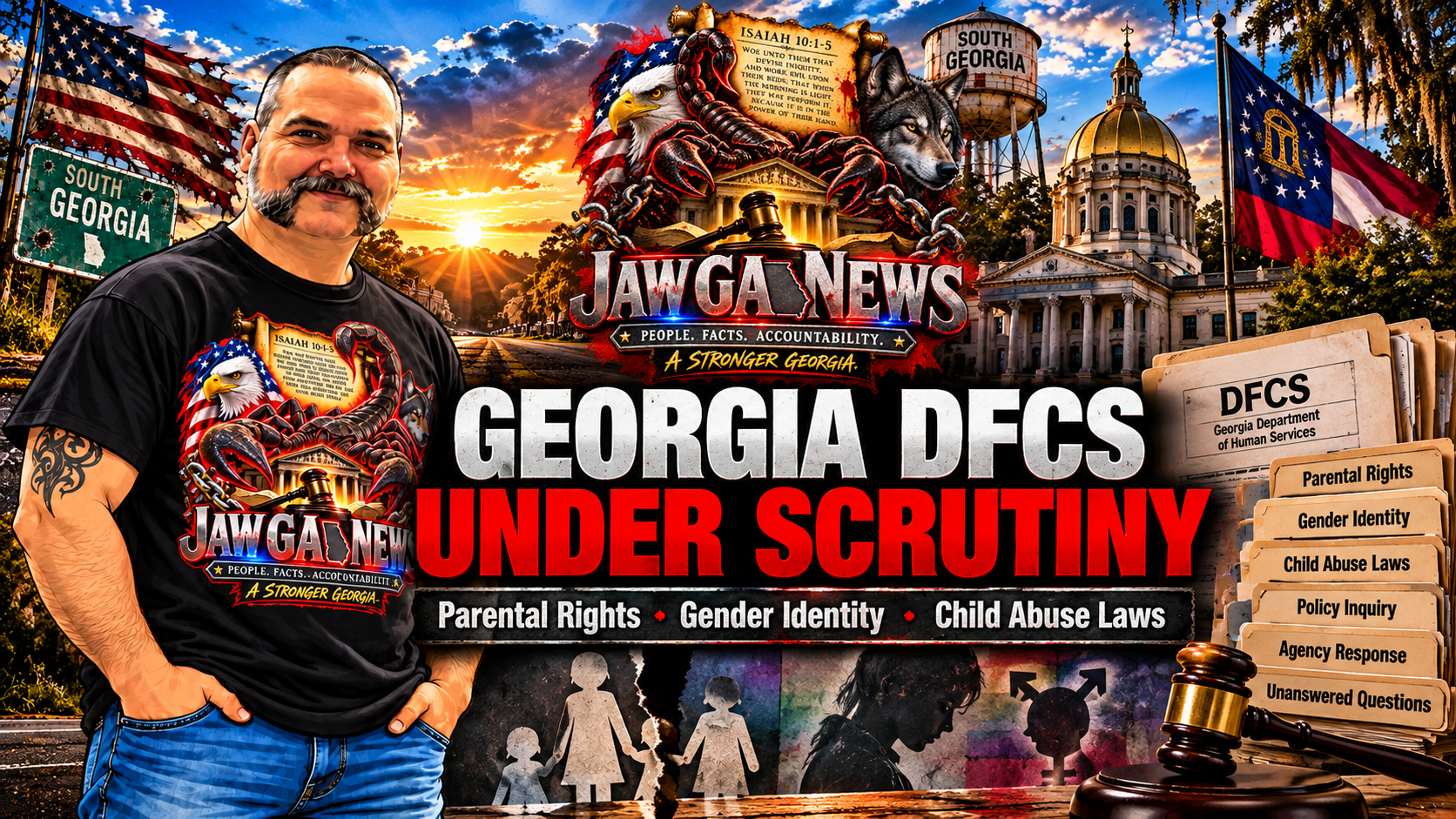
Agency cites Georgia law and juvenile court authority but leaves key questions about parental non-affirmation unanswered
JAW GA News | Investigative Report | October 14, 2026
GEORGIA — Can a parent in Georgia be investigated for child abuse simply because they refuse to acknowledge their child’s gender identity, use preferred pronouns, or permit a social transition?
That is the question JAW GA News set out to investigate after a political controversy in Texas brought renewed attention to the relationship between parental rights, gender identity, and child-welfare laws.
Our investigation included a review of Georgia legislation, publicly available child-welfare policies, and direct correspondence with the Georgia Department of Human Services, which oversees the Division of Family and Children Services, commonly known as DFCS.
What we discovered is that Georgia’s laws recognize emotional abuse and other forms of child maltreatment, but our review did not identify a statewide law or publicly available DFCS policy expressly declaring that a parent’s refusal to affirm a child’s gender identity, standing alone, automatically constitutes child abuse.
However, questions remained about how Georgia’s child-welfare agency evaluates complaints involving parental disagreement over gender identity.
Rather than speculate, JAW GA News contacted the agency directly.
THE TEXAS CONTROVERSY THAT RAISED THE QUESTION
The investigation began after a video resurfaced showing former Texas state Representative James Talarico participating in an April 3, 2019, legislative committee discussion concerning House Bill 1910.
The legislation addressed whether a parent’s willingness or unwillingness to acknowledge a child’s gender identity should be considered in certain child-abuse and parental-rights proceedings.
During the discussion, Talarico expressed concern that refusing to acknowledge a child’s gender identity could be harmful. He described such conduct as abusive and objected to legislation that would categorically exclude it from consideration as abuse.
Texas Attorney General Ken Paxton later circulated the recording with allegations that Talarico believed parents who refused to transition their children were abusive and should have their children taken away.
However, the recording itself did not establish that Talarico advocated automatically removing children from every parent who disagreed with a child’s gender identity. Nor did it establish a demand that parents authorize medical transition.
Additional legislative records revealed that in 2025, Talarico voted in favor of an amendment to Texas House Bill 1106 that would have classified refusal to affirm a child’s gender identity or sexual orientation as abuse under the proposed statutory language.
That amendment failed.
Texas ultimately enacted legislation taking the opposite approach, expressly excluding certain parental refusals to affirm a child’s gender identity from its statutory definitions of abuse and neglect.
The controversy raised an important question for Georgia residents.
Could something similar happen under Georgia law?
GEORGIA HOUSE BILL 1210: LAWMAKERS ADDRESSED THE ISSUE
On February 6, 2026, Georgia House Bill 1210 appeared in the Georgia House of Representatives’ official legislative records.
The bill was sponsored by Representatives Noelle Kahaian, Charlice Byrd, Emory Dunahoo, Dale Washburn, and Josh Bonner.
According to the official legislative summary, the proposal sought to amend several areas of Georgia law.
Those areas included dependency proceedings, child-abuse provisions, social services, and limitations on certain state employees and government contractors concerning parent-child relationships.
The proposal also addressed protections involving children whose asserted identity differs from their sex, along with the rights of certain caregivers to exercise religious or other strongly held beliefs.
These subjects are significant because they concern the boundaries between parental decision-making, caregiver beliefs, state intervention, and child protection.
House Bill 1210 was referred to the Georgia House Committee on Judiciary, Juvenile.
The bill did not become Georgia law.
That distinction is essential. Proposed legislation cannot be presented as an existing legal protection or an existing legal requirement.
Nevertheless, its introduction demonstrated that Georgia lawmakers were considering how these issues should be addressed through state law.
WHAT GEORGIA’S CHILD-WELFARE POLICIES SAY
Georgia’s child-welfare system recognizes several forms of child maltreatment, including physical abuse, neglect, sexual abuse, and emotional abuse.
The state’s legal framework also addresses serious threats to a child’s physical, mental, or emotional health.
DFCS is responsible for evaluating reports of suspected maltreatment and determining whether child-safety concerns require further action.
However, a child-abuse report, an agency investigation, a substantiated maltreatment finding, and a juvenile court’s determination that a child is dependent are not interchangeable legal outcomes.
An allegation does not automatically establish abuse, and an investigation does not automatically result in the removal of a child.
Our review of publicly available statewide DFCS policy did not identify an express rule declaring that refusing a child’s requested pronouns, declining to acknowledge an asserted gender identity, or refusing to permit social transition automatically constitutes child abuse by itself.
At the same time, the broader legal framework concerning emotional harm raises questions about whether conduct involving a child’s gender identity could become relevant when considered alongside additional allegations.
That distinction became the focus of our formal press inquiry.
JAW GA NEWS CONTACTS GEORGIA DFCS
On September 15, 2026, JAW GA News submitted a formal press inquiry to the Georgia Department of Human Services.
The inquiry was originally addressed to Communications Director Ellen Brown.
An automatic response indicated that Brown was on maternity leave and directed media inquiries to Kylie Winton, Assistant Deputy Commissioner for External Affairs.
JAW GA News forwarded the original inquiry to Winton.
On September 17, Winton acknowledged the inquiry and requested a reporting deadline.
Our newsroom responded that September 21, 2026, at 5 p.m. Eastern Time was the preferred deadline, while offering the agency additional time if necessary to provide a complete and accurate response.
On September 21, Winton provided an official statement.
THE TEN QUESTIONS WE ASKED DFCS
JAW GA News requested clarification on ten specific issues.
- Whether refusing to use a minor child’s requested name or pronouns, standing alone, can constitute abuse, neglect, emotional abuse, or maltreatment.
- Whether refusing to acknowledge or affirm a minor child’s asserted gender identity, standing alone, can constitute abuse or neglect.
- Whether refusing to permit a child to socially transition, standing alone, can justify a child-abuse finding or DFCS intervention.
- Whether parental opposition to gender-transition-related medical treatment, standing alone, can constitute abuse or neglect.
- What additional circumstances, if any, could make parental conduct involving gender identity relevant to a maltreatment determination.
- Whether DFCS maintains internal guidance, memoranda, directives, training materials, or caseworker instructions addressing gender identity and parental affirmation that are not publicly available.
- Whether child-protection personnel receive specific training concerning allegations involving a child’s gender identity.
- Whether DFCS has received referrals involving parental refusal to affirm gender identity, and whether any such allegations have been substantiated.
- Whether parental non-affirmation may be considered alongside other conduct when assessing serious mental or emotional harm.
- What safeguards and evidentiary standards distinguish parental disagreement from legally actionable abuse or neglect.
The inquiry requested policy clarification and aggregate information only. It did not seek confidential records identifying individual children or families.
GEORGIA DHS PROVIDES AN OFFICIAL RESPONSE
On September 21, 2026, Kylie Winton responded on behalf of the Georgia Department of Human Services.
She expressly authorized JAW GA News to attribute the following statement to an agency spokesperson.
Official Georgia DHS statement:
“The Juvenile Code contains definitions of abuse and neglect. Those are the definitions used by the agency and Georgia’s juvenile courts to determine if caregiver conduct rises to the level to meet a dependency standard.
Georgia juvenile courts are ultimately responsible for determining what caregiver conduct rises to the level of dependency, including emotional abuse as defined under Georgia law. DFCS considers all facets of a family dynamic when assessing for the safety of a child and presents evidence to the court to determine if caregiver conduct constitutes dependency.”
The response establishes three important points.
First, DFCS relies on definitions contained in Georgia’s Juvenile Code when evaluating abuse and neglect in the dependency context.
Second, Georgia’s juvenile courts ultimately determine whether caregiver conduct meets the legal standard for dependency.
Third, DFCS considers the circumstances of a family’s situation when assessing child safety and presenting evidence to the court.
But the response did not directly answer several of the questions JAW GA News submitted.
WHAT THE AGENCY DID NOT CLARIFY
The agency did not expressly state whether refusing preferred pronouns, standing alone, constitutes child abuse.
It did not expressly state whether refusing to acknowledge a child’s asserted gender identity, standing alone, can satisfy Georgia’s maltreatment standards.
It did not directly address whether refusing social transition or opposing gender-transition-related medical treatment can independently justify a DFCS intervention.
Nor did the response identify specific internal training materials, policies, or caseworker guidance addressing these circumstances.
The agency also did not provide referral statistics or indicate whether complaints involving parental non-affirmation have resulted in substantiated findings.
Those omissions do not establish that the agency maintains undisclosed policies, has investigated such complaints, or is withholding information.
They establish that the requested information was not provided in the response.
There is an important difference.
WHY THE DISTINCTION MATTERS
Georgia parents have a legitimate interest in understanding what conduct can trigger state intervention.
Children also have a legitimate interest in protection from abuse, neglect, and serious harm.
Those interests can become difficult to reconcile when family disagreements involve deeply held religious beliefs, parental authority, a child’s mental health, or questions concerning gender identity.
A parent’s disagreement with a child is not necessarily the same thing as legally actionable abuse.
Likewise, the existence of a parental disagreement does not prevent authorities from investigating separate allegations of threats, coercion, violence, neglect, or serious harm.
That is why the specific legal standard matters.
And that is why JAW GA News asked the agency to explain how it distinguishes disagreement from maltreatment.
The agency’s response emphasized individualized assessment and juvenile court authority, but it did not provide a definitive answer concerning parental non-affirmation standing alone.
WHAT OUR INVESTIGATION ESTABLISHED
Based on the public records reviewed and the agency’s written response, JAW GA News can establish the following findings.
Georgia recognizes emotional abuse and other forms of maltreatment under its child-welfare laws.
Georgia lawmakers introduced House Bill 1210 in 2026 to address protections involving children whose asserted identity differs from their sex, along with related caregiver and parent-child issues.
That legislation did not become law.
Our review did not identify a publicly available statewide DFCS rule expressly declaring that parental refusal to affirm a child’s gender identity automatically constitutes abuse.
Georgia DHS confirmed that DFCS uses statutory definitions of abuse and neglect, evaluates family circumstances, and presents evidence to juvenile courts, which ultimately determine dependency.
The agency did not directly resolve whether parental non-affirmation, by itself, meets those standards.
It also did not provide the requested information about internal guidance, training, referrals, or substantiated findings.
These findings do not establish that Georgia parents are automatically subject to child-abuse findings for refusing gender affirmation. They also do not establish that such conduct could never be considered in an investigation involving additional circumstances.
THE BOTTOM LINE
This investigation began with a political controversy in Texas, but the question for Georgia residents was never about choosing sides in that controversy.
It was about determining what Georgia law actually says, what the state’s child-welfare agency actually does, and where the legal boundaries of parental authority and government intervention exist.
JAW GA News gave Georgia DHS an opportunity to explain its position directly.
The agency responded, and we are publishing the substance of that response accurately.
What remains unresolved is whether Georgia’s child-welfare system has more specific operational standards concerning parental non-affirmation than those identified in the publicly available policies reviewed for this report.
We will not claim those standards exist without evidence.
We will not claim they do not exist merely because the agency did not identify them.
And we will not confuse political accusations, proposed legislation, or individual opinions with established Georgia law.
The public deserves a clear distinction between what is known, what is alleged, and what remains unanswered.
That is the purpose of this investigation.
JAW GA News
People. Facts. Accountability.
A Stronger Georgia.
PRIMARY SOURCES AND DOCUMENTATION
Georgia General Assembly
Georgia House Bill 1210, 2025–2026 legislative session.
Georgia House First Readers, February 6, 2026.
Georgia Division of Family and Children Services
Official Child Welfare Policy Manual.
https://pamms.dhs.ga.gov/dfcs/cws/
Georgia Department of Human Services
Official written statement provided to JAW GA News by Kylie Winton, Assistant Deputy Commissioner for External Affairs, September 21, 2026.
Texas Legislature
House Bill 1910, 86th Legislature, 2019.
https://capitol.texas.gov/tlodocs/86R/billtext/html/HB01910I.htm
House Bill 1106, 89th Legislature, 2025.
https://capitol.texas.gov/tlodocs/89R/billtext/pdf/HB01106F.pdf
Proposed Amendment Number Four to House Bill 1106.
https://capitol.texas.gov/tlodocs/89R/amendments/html/HB01106H24.HTM
Texas House Journal, 89th Legislature.
https://journals.house.texas.gov/HJRNL/89R/HTML/89RDAY63FINAL.HTM
Editorial disclosure: This report distinguishes proposed legislation from enacted law, official agency statements from newsroom analysis, and documented findings from unanswered questions. No confidential child-welfare case information was requested or published.

Leave a Reply
You must be logged in to post a comment.