
October 18, 2026 | JAW GA News | Investigative Newsroom
NASHVILLE, GEORGIA — Folks, we’re opening another investigation here in Berrien County, and this one involves a convicted child molester, a plea agreement from 2020, a sentence that raises some serious questions, and a sex offender registry that still doesn’t show a completed risk level more than six years after the convictions.
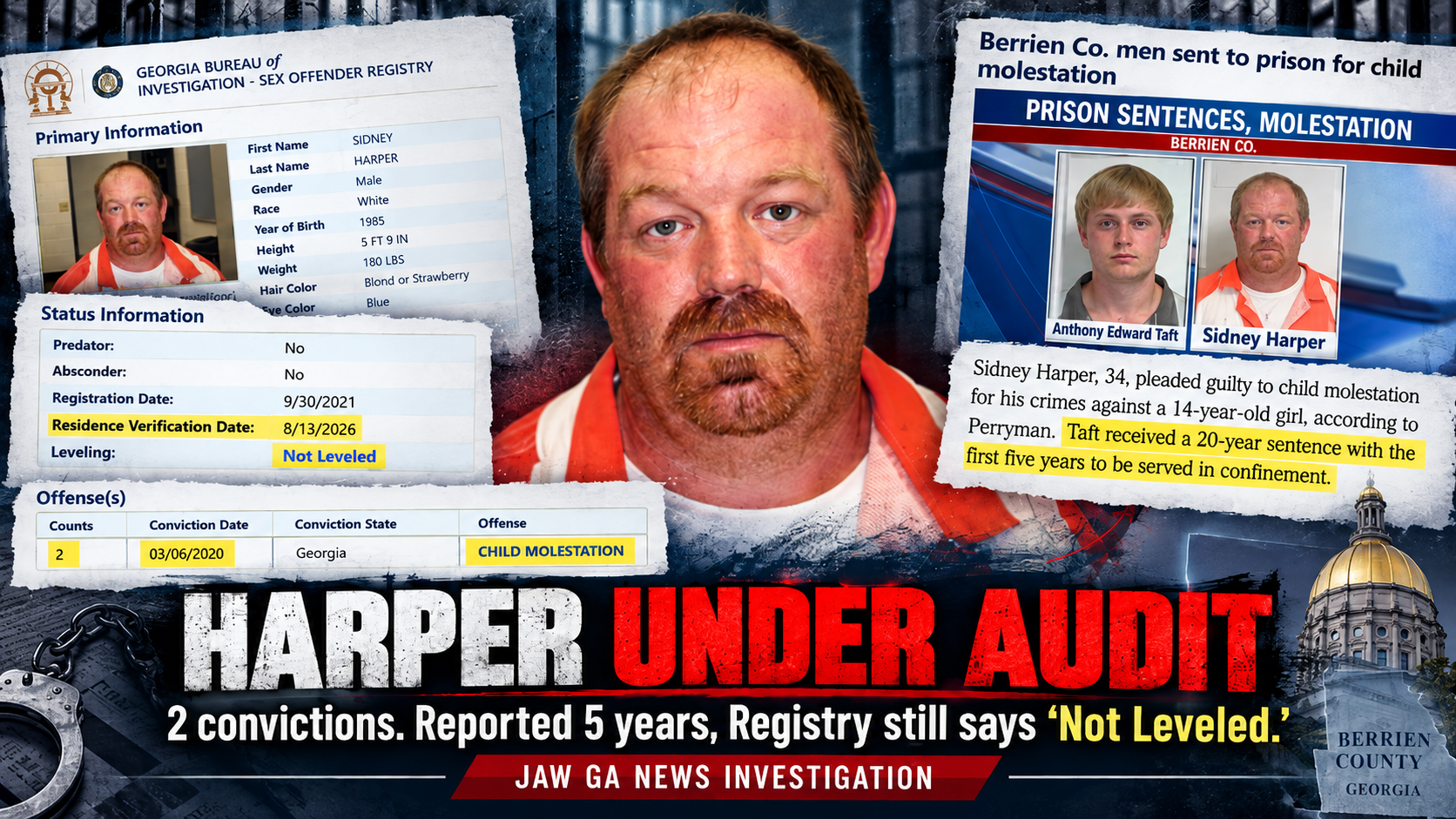
And I want to make something clear before we get started. We’re not talking about somebody who was simply accused of child molestation. We’re talking about Sidney Harper, a man whose official Georgia Bureau of Investigation sex offender registry record shows two child-molestation convictions dated March 6, 2020.
Now here’s where things start getting interesting, because the more we look into this case, the more questions we have about what actually happened inside the Berrien County justice system.
Back on March 10, 2020, WALB News published an article about two Berrien County men who were sent to prison following child-molestation cases.
One of those men was Sidney Harper, who was 34 years old at the time. According to WALB, Harper pleaded guilty to child molestation involving a 14-year-old girl.
Now pay attention to this next part, because this is where we discovered something that needed to be cleared up.
WALB also reported on another man by the name of Anthony Edward Taft, who was involved in a separate child-molestation case. According to their article, Taft received a 20-year sentence, with the first seven years to be served in prison.
But when the article gets to Harper’s case, it appears somebody made a mistake.
The paragraph discussing Harper goes on to describe another 20-year sentence, with five years to be served in confinement. However, instead of naming Harper, WALB names Taft again.
That’s right. Two separate men, two separate cases, and the same name appearing in both sentencing statements.
Now, we’re not saying WALB intentionally misreported anything. Mistakes happen. But when you’re reporting on serious criminal convictions, especially crimes involving children, getting the names and sentences right matters.
And that’s exactly why JAW GA News has requested the original court documents instead of simply repeating what another news outlet published.
Based on how the article was written, it appears Harper may have received a 20-year sentence, with only five years ordered to be served in confinement.
But until we receive the signed sentencing order, we’re not going to present that as a confirmed court finding.
Now let’s talk about something else that has me questioning this case.
Georgia law, under O.C.G.A. § 16-6-4, generally allowed a sentence of five to twenty years for a first felony child-molestation conviction under the law in effect in 2020.
Harper’s official GBI record shows two convictions.
Two!
That means, depending on the counts, the sentencing rules, and whether the judge ordered the sentences to run one after another, the court potentially could have imposed sentences totaling 40 years.
Now, before somebody jumps into the comments telling us we don’t understand the law, let’s be clear about something.
A 20-year sentence with five years in confinement does not automatically mean somebody was supposed to spend 20 years behind bars. Georgia allows sentences that are split between prison time and probation.
In other words, somebody could be sentenced to 20 years, serve five years in prison, and spend the remaining 15 years on probation under the conditions imposed by the court.
We understand that.
We also understand that just because a judge can impose a longer sentence doesn’t mean the judge is legally required to impose the maximum.
But here’s my problem with this.
We’re talking about two child-molestation convictions.
And if Harper really received only five years of confinement for those convictions, then I believe the public has every right to question whether that punishment was enough.
Because in my opinion, five years for two counts of child molestation is a slap on the wrist compared to the damage these kinds of crimes can cause.
Those children don’t get to simply erase what happened to them after five years.
They don’t get to turn back the clock.
And they certainly don’t get to pretend the trauma never happened.
So why shouldn’t the justice system be expected to take the full weight of these crimes seriously?
Personally, I believe a substantially longer prison sentence should have been considered. If the law allowed a total sentence as high as 40 years, I want to know why the prosecution agreed to the punishment that was reported and why the judge approved it.
Now, we don’t have the complete plea agreement yet. There may have been circumstances the court considered, including the evidence, the child’s welfare, or the reasons prosecutors chose to negotiate.
That’s why we’re investigating.
We want the actual facts, not assumptions.
But the fact that a sentence may be legal doesn’t mean it’s beyond criticism.
And that brings us to another problem.
When we reviewed Harper’s official Georgia Sex Offender Registry information on October 18, 2026, we noticed something that immediately caught our attention.
His risk classification was listed as “Not Leveled.”
Now think about that.
The registry shows two child-molestation convictions from March 6, 2020. It lists an initial registration date of September 30, 2021, and a residence verification date of August 13, 2026.
Yet his risk classification still says “Not Leveled.”
According to Georgia’s Sexual Offender Risk Review Board, that classification means the board has not yet reviewed the offender’s case.
It does not mean the person was reviewed and found to be safe.
It does not mean the person was determined to be a low risk.
It means there is no completed risk classification reflected in that entry.
And here’s what I want to know.
Why?
Why, more than six years after these convictions, does this man’s official registry information still not show a completed risk assessment?
Was his case ever referred to the board?
If it was, when?
Was the assessment delayed?
Was something missing from the paperwork?
Or is there another explanation that hasn’t been made public?
Georgia has laws governing how these risk assessments are supposed to be handled. O.C.G.A. § 42-1-14 addresses that process, including when assessments are supposed to take place.
Now, we’re not going to sit here and automatically accuse the state of violating the law just because the registry says “Not Leveled.”
But we absolutely want to know why that classification remains incomplete.
And I want to clear up one more thing.
Harper’s registry also indicates that he is not designated as a sexually dangerous predator.
That designation is not automatically assigned just because someone has two convictions. Georgia has a separate legal assessment process for determining that classification.
But a lack of that designation should never be mistaken for proof that somebody poses no risk.
That’s the point.
The public deserves accurate information, especially when we’re talking about people convicted of sexual offenses against children.
Now let’s get into who was responsible for prosecuting this case back in 2020.
At the time Harper was convicted, Richard L. “Dick” Perryman III was serving as District Attorney for the Alapaha Judicial Circuit.
According to WALB’s original reporting, Perryman announced the outcome of the child-molestation cases, and Assistant District Attorney Allen Lawson was recognized for his involvement in the prosecutions.
Perryman later became a Superior Court judge in 2021.
So here’s where JAW GA News comes in.
We’re officially opening an accountability audit into the 2020 prosecution of Sidney Harper under Perryman’s leadership.
We’re going to examine the plea agreement, the sentencing recommendations, the charges involved, and what the court actually ordered.
Because I want to know why a case involving two child-molestation convictions reportedly resulted in only five years of confinement.
Was that the sentence prosecutors recommended?
Was there an agreement between the prosecution and defense?
Were both counts handled separately?
Did the sentences run together?
And what was the reasoning behind that decision?
These are fair questions.
We’re not accusing Perryman of committing a crime or engaging in misconduct. We’re examining the decisions made while he was responsible for that District Attorney’s Office.
Being a public official means the decisions made under your leadership can be questioned, especially when those decisions involve the safety of children.
And that same standard applies to the judge who accepted the plea agreement.
At this time, JAW GA News has not confirmed which Superior Court judge presided over Harper’s March 2020 sentencing.
That’s why we’ve already sent a court records inquiry to Berrien County Superior Court Clerk Shawna Hughes, seeking the original indictment, plea agreement, signed sentencing order, and court records identifying the presiding judge.
Once we establish who that judge was, we’ll examine the sentencing decision as part of this ongoing investigation.
Let me make something clear here, too.
We’re not accusing an unidentified judge of doing something illegal just because we disagree with the reported punishment.
Judges have authority under Georgia law to make sentencing decisions, and plea agreements are a normal part of the criminal justice system.
But that doesn’t mean those decisions should be made without public scrutiny.
If a judge accepted a negotiated sentence involving two child-molestation convictions, I believe the public deserves to know what was presented to that judge and what punishment was actually imposed.
We’re also looking into Harper’s reported March 2026 booking for a felony probation violation.
We have not yet confirmed the reason for that reported violation, the court proceedings involved, or its final outcome. So we’re keeping that issue separate until the official records establish what happened.
And that’s important because this investigation isn’t about throwing accusations around and hoping something sticks.
It’s about following the evidence.
We’ve already contacted Berrien County authorities regarding the more recent information connected to Harper, and we’ve requested the court records needed to examine the original 2020 prosecution.
We intend to seek additional answers concerning his actual prison admission and release dates, the conditions of his probation, and the status of his sex offender risk assessment.
But I want people to understand why we’re taking this case seriously.
When a child is sexually abused, the consequences can follow that child for years, sometimes for the rest of their life.
The emotional damage doesn’t simply disappear because somebody enters a guilty plea.
And while Georgia law gives prosecutors and judges discretion when handling these cases, the public also has the right to question whether the punishment reflects the seriousness of the crime.
That’s why I don’t believe a reported five-year confinement term for two child-molestation convictions represents enough accountability.
That’s my opinion, and I’m not going to pretend otherwise.
But my opinion isn’t going to replace the evidence.
We’re going to find out what the court actually ordered, what the prosecutors recommended, and whether the state properly handled the legal requirements that followed those convictions.
We’re also going to give the officials involved an opportunity to explain their decisions.
If the records show that everything was handled according to Georgia law, we’ll report that.
If the records reveal mistakes, failures, or violations, we’ll report those too.
That’s how investigative journalism is supposed to work.
We don’t decide who is guilty of misconduct, and we don’t convict people through Facebook comments.
We examine the facts, question the people responsible, and let the evidence tell the story.
And right now, that evidence has left us with some serious questions about the 2020 prosecution of Sidney Harper, the sentence that was reportedly imposed, and why his risk classification remains unresolved on the official registry.
This is only the beginning of our investigation.
JAW GA News will continue examining the prosecution under former District Attorney Richard L. “Dick” Perryman III, the sentencing decision made by the presiding Superior Court judge, and Georgia’s handling of Harper’s sex offender classification.
Because justice shouldn’t stop at a guilty plea.
And accountability shouldn’t stop at a press release.
People. Facts. Accountability.
A STRONGER GEORGIA.
Sources and References
WALB News, March 10, 2020: Berrien County Men Sent to Prison for Child Molestation
Official Georgia Bureau of Investigation Sex Offender Registry
Georgia Code § 16-6-4, Child Molestation (2020)
Georgia Code § 17-10-6.2, Sexual-Offense Sentencing
Georgia Code § 42-1-14, Risk Assessment Classification
Georgia Sexual Offender Risk Review Board
Governor’s Office: Appointment of Chase Studstill, April 23, 2021
JAW GA News
Independent Investigative Newsroom
Rev. Joseph Allen Wolfe
Founder, Owner, Publisher and Editor-in-Chief

Leave a Reply
You must be logged in to post a comment.