

Political change does not begin beneath the gold dome in Atlanta. It begins when ordinary Georgians decide that decisions being made in their names deserve closer attention. From rural counties and small towns to Georgia’s largest cities, citizens have the power to question public officials, attend government meetings, examine records, organize around issues, contact representatives, speak publicly, and ultimately vote.
At JAW GA News, we believe those community voices deserve to be heard without being reduced to political stereotypes. Accountability is not exclusively Republican, Democratic, conservative, liberal, independent, or anything else humans have managed to squeeze onto a campaign sign. Citizens from completely different political backgrounds can share legitimate concerns about government transparency, public spending, law enforcement, infrastructure, taxation, education, public safety, civil liberties, and ethical leadership.
But demanding change requires more than anger.
Effective civic participation begins with information.
Before accusing an official of misconduct, examine the evidence. Before repeating a political claim, verify it. Before condemning a government decision, understand who made it and why. And when officials make promises to their communities, preserve those promises and compare them with what happens afterward.
JAW GA News exists in part to help strengthen that connection between citizens, evidence, and accountability. We investigate government actions, explain complicated records and proceedings, amplify legitimate community concerns, and give public officials an opportunity to answer the questions being raised.
Because political power may operate from government buildings, but its legitimacy ultimately comes from somewhere else.
The people.
“Change does not begin when politicians decide to listen. It begins when informed citizens refuse to stop asking questions, demanding answers, and reminding government exactly who it serves.”
— JAW GA News
Community voices become powerful when frustration is transformed into documented, sustained civic action. Speaking at public meetings, submitting public-records requests, contacting elected representatives, examining government spending, organizing community groups, following legislation, and participating in elections give citizens ways to challenge decisions without depending entirely on political parties or established institutions to speak for them.
At JAW GA News, community concerns can also become starting points for investigative journalism. A citizen may notice something unusual in a budget, encounter problems obtaining public records, question an official decision, or identify contradictions between what government representatives said publicly and what documents appear to show. Those observations deserve examination, but they must still be verified. A tip begins an investigation. It does not establish the conclusion.
That distinction protects both the community and the credibility of the reporting. We can amplify voices that might otherwise go unheard while independently examining the evidence behind their concerns. When records support those concerns, we report what they establish. When evidence contradicts an allegation, that matters too.
Real political influence is stronger than outrage alone. An informed citizen armed with records, dates, votes, budgets, and verified facts can ask questions that political rhetoric cannot easily dismiss. Community voices create lasting change when they move beyond demanding that government listen and begin demanding that government answer.
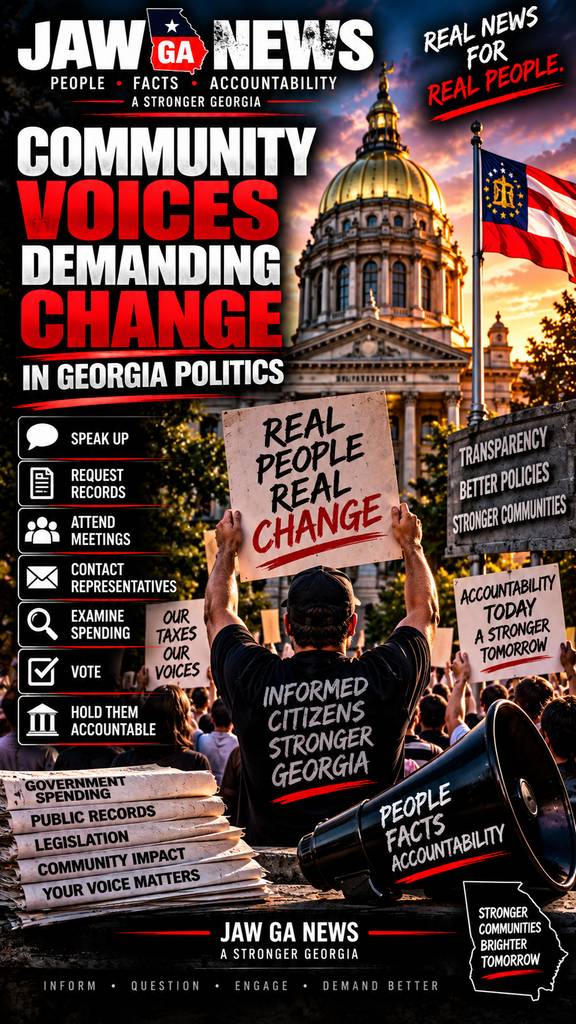
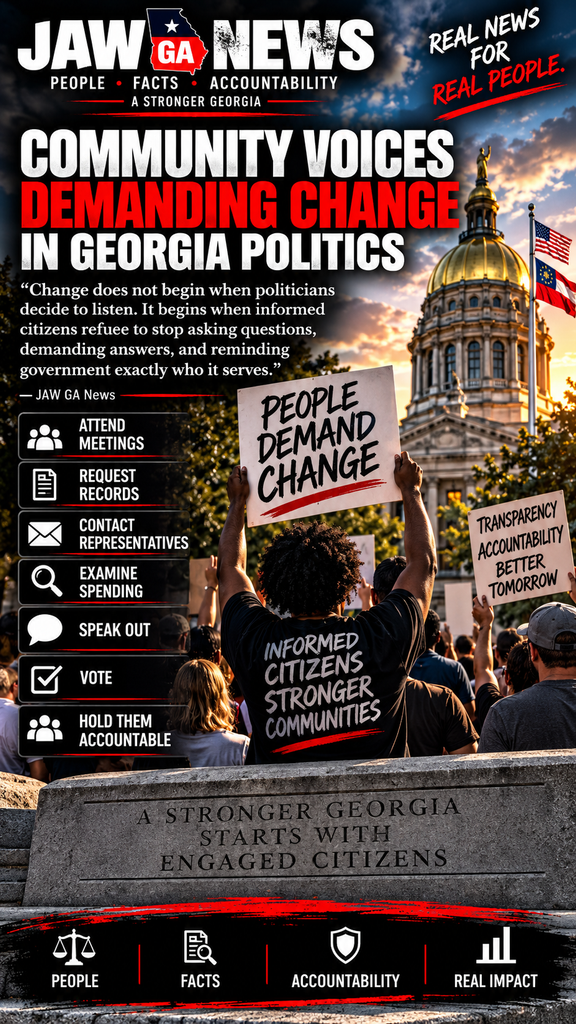
Community-driven political change also requires something harder than simply raising a voice: listening to voices that disagree. Georgia communities are politically, economically, and culturally diverse. Residents can share concerns about government accountability while disagreeing sharply about taxes, policing, education, elections, development, or how those problems should be solved. Genuine civic participation cannot exist only when everyone in the room agrees.
At JAW GA News, our responsibility is not to manufacture consensus or turn every disagreement into another political cage match. It is to examine competing claims fairly, identify the evidence behind them, and make room for legitimate perspectives while challenging misinformation regardless of where it originates.
Public officials should also have the opportunity to respond when citizens raise serious questions. Accountability works best when the process becomes a documented exchange: citizens raise concerns, journalists investigate them, officials respond, records are examined, and the public evaluates the evidence.
That is considerably more powerful than partisan outrage because it creates something politicians cannot easily dismiss as noise: an informed, engaged community with receipts.
Wrapping Up with Key Insights
Community voices matter because government accountability was never supposed to be a spectator sport. Citizens have the right to question decisions, examine records, criticize policies, petition their government, organize around issues, speak publicly, and vote according to the evidence they see. Those rights become meaningful only when people actually use them.
At JAW GA News, we want to help turn community concerns into something stronger than another temporary burst of outrage. We investigate tips, examine public records, compare official statements with documentation, seek responses from the people involved, correct the record when evidence demands it, and report what can actually be established.
We will not assume that every allegation against government is true. We also will not assume that an official explanation ends legitimate scrutiny. Neither skepticism nor authority gets the final word. Evidence does.
Georgia belongs to millions of people with different backgrounds, beliefs, priorities, and politics. They will not always agree about what change should look like. They do not have to. Democracy depends upon disagreement being transformed into participation rather than silence.
Ask questions. Request records. Attend meetings. Contact representatives. Follow the money. Verify claims. Speak up. Vote. And keep watching after Election Day.
Politicians may hold the offices.
Government agencies may hold the records.
Institutions may hold tremendous power.
But the people still hold the voice.