

Government transparency rarely arrives gift-wrapped. Some of the most important facts are buried inside emails, incident reports, personnel files, meeting minutes, financial records, contracts, investigative documents, body-camera footage, and correspondence the public may never see unless someone specifically asks for it.
That is where public records requests become one of the most powerful tools in investigative journalism.
At JAW GA News, we use public records to move beyond rumors, political talking points, social-media claims, and carefully prepared official statements. Records can establish when something happened, who knew about it, how taxpayer money was spent, what officials documented internally, and whether the public explanation matches the government’s own paper trail.
Public records do not automatically prove corruption, misconduct, or wrongdoing. They provide something more fundamental: evidence that can be examined, compared, challenged, and independently verified.
Sometimes those records confirm exactly what officials have told the public. Sometimes they reveal important context that was previously missing. Other times, contradictions emerge between public statements and the government’s own documentation.
And occasionally, one seemingly insignificant email, report, invoice, timestamp, or line buried deep inside hundreds of pages changes the direction of an entire investigation.
That is where the paper trail becomes the story.
“Public records do not belong to the government. They belong to the people. When questions arise, follow the documents, verify the facts, and let the evidence speak for itself.”
— JAW GA News
Public records requests give journalists something rumors and secondhand accounts cannot: a path back to the original documentation. Under Georgia’s Open Records Act, records maintained by public agencies are generally available for inspection and copying unless a specific legal exemption applies. That can include emails between officials, contracts, financial records, meeting documents, incident reports, policies, personnel-related records that are legally releasable, photographs, video, and other materials created or maintained through government business.
For investigative journalists, obtaining the record is only the beginning. At JAW GA News, we compare documents against timelines, public statements, court filings, previous reporting, agency responses, and other available evidence. A date that appears insignificant in one email may become important when compared with meeting minutes. An invoice may raise questions about how taxpayer money was spent. An internal message may provide context missing from a public statement. Even an agency’s response to a records request can become part of the story when it clarifies what records exist, what has been withheld, and the legal basis being asserted for withholding them.
The objective is not to begin with an accusation and search for documents that support it. The objective is to obtain the records and determine what they actually show. Sometimes they expose serious questions. Sometimes they resolve them. Either result matters because credible investigative journalism follows evidence rather than forcing evidence to follow a predetermined conclusion.
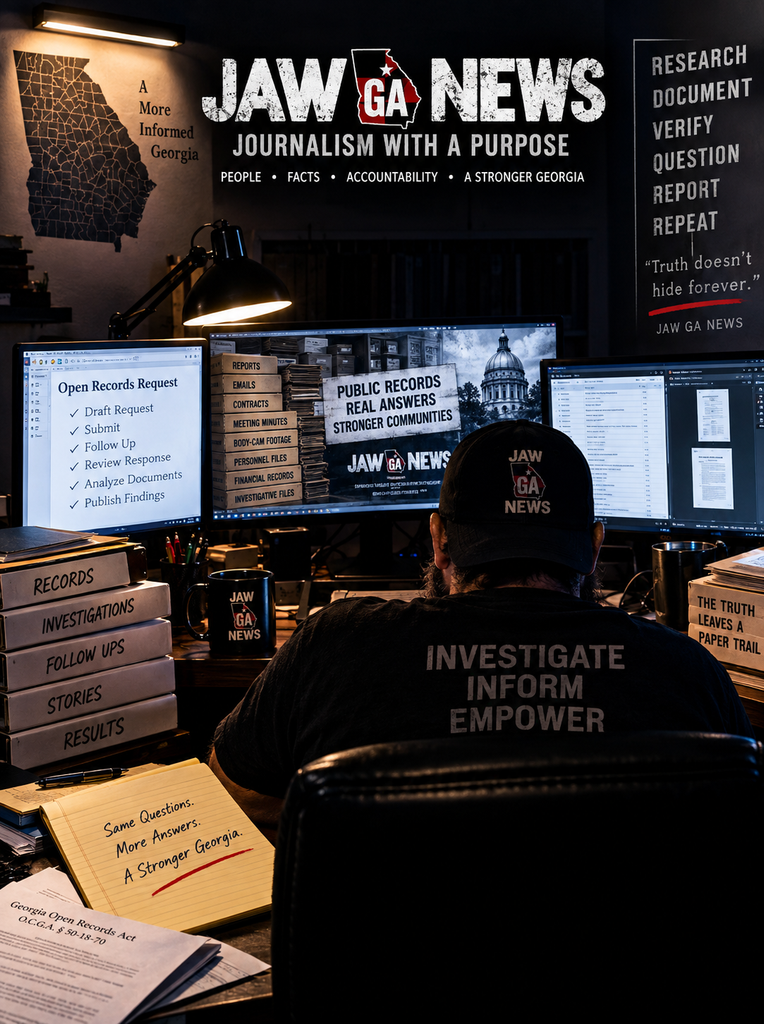
One of the biggest misconceptions about public records requests is that requesting information from a government agency automatically means the journalist suspects corruption. It does not. A records request is fundamentally a request for verification. Government officials may have legitimate explanations for their decisions, agencies may lawfully withhold certain records, and documents may ultimately support the government’s version of events. Responsible scrutiny requires leaving room for those possibilities.
There is also an important difference between a record being withheld and a government cover-up. Georgia law contains exemptions that can restrict access to certain records, particularly during active investigations or when privacy, security, or other legally protected interests are involved. When an agency denies access, the important questions become: What specific exemption is being invoked? Does it actually apply to the requested material? Is only part of the record exempt? Can the remaining portions be released? Those questions turn frustration into meaningful accountability.
This is why JAW GA News approaches public records as pieces of a larger evidentiary puzzle. We examine what was released, what was withheld, what officials have said, what other records establish, and whether those pieces fit together. Transparency is not about assuming government is lying. It is about making sure the public has enough information to determine whether government is telling the truth.
Wrapping Up with Key Insights
Public records are more than paperwork stored in government offices. They are part of the public’s ability to understand how decisions are made, how taxpayer money is spent, how laws are enforced, and how officials exercise the authority entrusted to them. Used responsibly, records requests allow journalists and citizens to replace speculation with documentation and transform unanswered questions into facts that can actually be examined.
At JAW GA News, obtaining a document is never the finish line. Records must be verified, placed in context, compared with other evidence, and reported fairly. When the evidence supports an agency’s explanation, we should report that. When records reveal contradictions, unanswered questions, or potential misconduct, we should pursue those findings with the same determination.
Government transparency ultimately belongs to everyone, not merely journalists, attorneys, or public officials. Asking questions is not an attack on government. It is part of holding public institutions accountable to the people they serve.
The paper trail is there for a reason.
Request it. Read it. Question it. Verify it. Follow it.
Because when public power leaves a record, the public has every right to know where that record leads.