
The Kayla Lackey Story: Four Years of Service, Seven Minutes of Termination, and a Fight to Clear Her Name
JAW GA NEWS | SPECIAL INVESTIGATIVE DOCUMENTARY
By Rev. Joseph Allen Wolfe
Founder, Publisher & Editor-in-Chief
JAW GA News
October 20, 2026 | Nashville, Georgia
A Career That Ended Behind Closed Doors
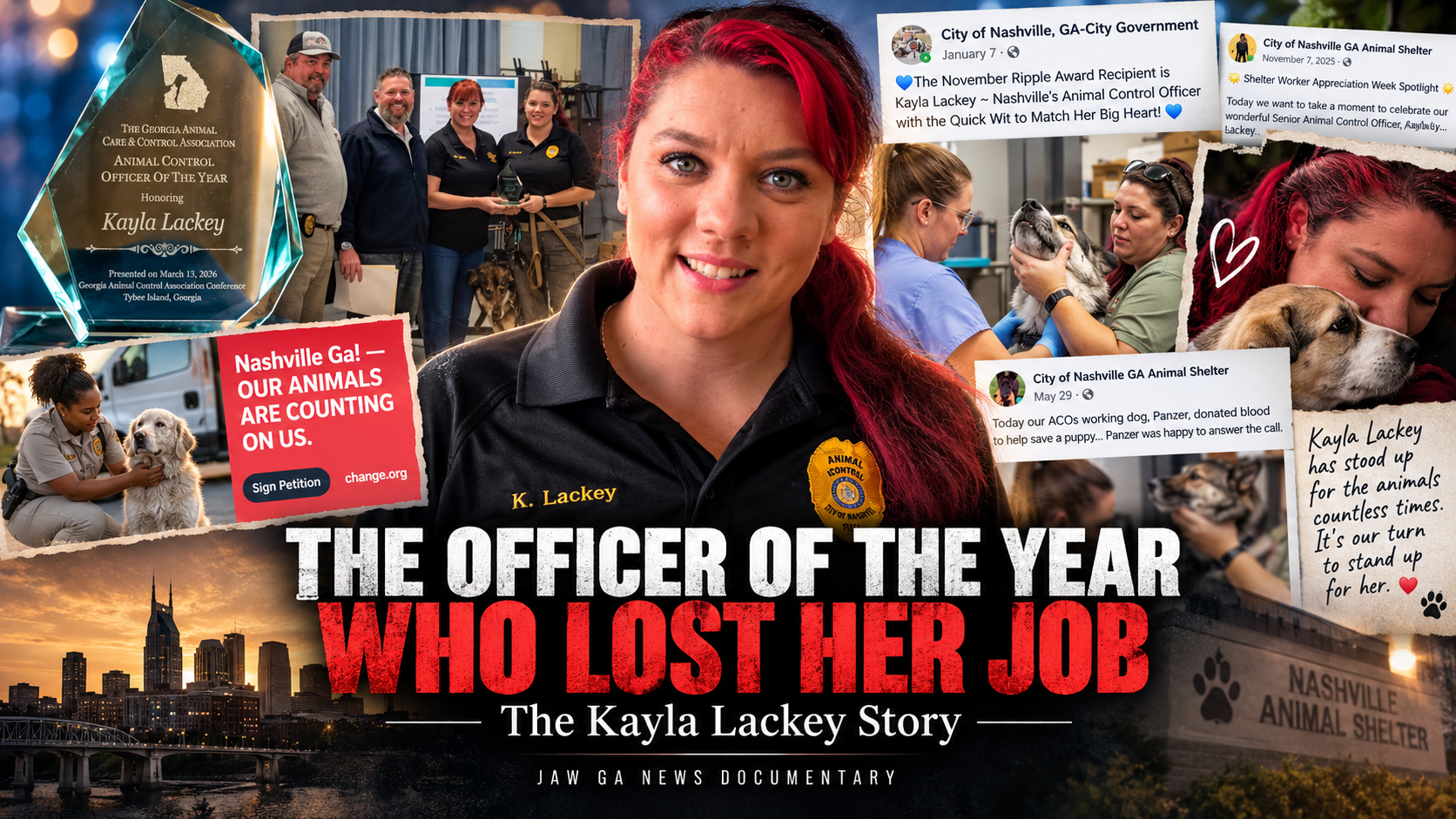
NASHVILLE, GEORGIA — On March 13, 2026, Kayla Lackey stood before fellow animal-control professionals in Tybee Island, Georgia, where she received one of the highest honors available in her profession.
She had been named Animal Control Officer of the Year by the Georgia Animal Care & Control Association.
Her dedication, compassion, and years of hard work had earned her recognition beyond Nashville and Berrien County.
Four months later, on July 23, 2026, her employment with the City of Nashville came to an end.
According to Kayla, the termination meeting lasted approximately seven minutes.
No lengthy public explanation. No detailed accounting of what the city believed she had done wrong. Just the end of a career she had spent years building.
At least, that is how Kayla describes it.
And now, JAW GA News is investigating what actually happened.
Because when an employee receives statewide recognition in March and loses her job in July, there are some reasonable questions that deserve answers.
What changed?
What evidence did city leadership rely upon?
Who made the decision?
And did Kayla Lackey receive a fair examination of the allegations against her?
Those are the questions at the center of this investigation.
But to understand why this situation has drawn so much attention, we first need to understand who Kayla was to the community she served.
More Than a Dog Catcher
For approximately four years, Kayla Lackey worked in animal control for the City of Nashville.
According to her account, she eventually became responsible for nearly every aspect of the city’s animal shelter operations.
And when I say nearly everything, I mean everything.
She responded to reports of loose and dangerous dogs. She investigated animal cruelty and neglect. She handled bite cases, rabies quarantines, abandoned animals, injured animals, and situations involving residents who needed help.
Then she returned to the shelter.
There were kennels to clean, animals to feed, vaccinations to administer, adoption applications to process, and veterinary appointments to arrange.
There were also financial records, donations, rescue arrangements, foster homes, reports, and the daily responsibilities that come with keeping a shelter operating.
According to Kayla, she performed much of this work as the city’s only full-time Animal Control Officer, earning compensation equivalent to approximately $17 an hour.
She says she remained on call during nights, weekends, holidays, and even vacations.
Those compensation and scheduling claims still require verification through the city’s payroll, personnel, and timekeeping records.
But her involvement in Nashville’s animal-welfare programs is supported by independent reporting.
In January 2024, WALB reported on Nashville’s Community Cat Program, which aimed to reduce uncontrolled breeding through spaying and neutering.
Kayla publicly explained why removing feral cats without addressing breeding would not solve the underlying problem.
In February 2025, WALB again interviewed Kayla, this time about the shelter’s need for a trailer to continue transporting cats for its low-cost sterilization program.
By February 2026, she was organizing a regional animal-control conference intended to bring animal-control workers, law enforcement, and local officials together.
Lanier County News reported that the conference was held in Nashville and attracted animal-control and law-enforcement personnel, although few local government leaders attended.
These weren’t stories published after Kayla lost her job.
They were reports documenting her work while she was still employed.
And that’s an important distinction.
The Recognition Came From Her Own Department
On November 7, 2025, the City of Nashville GA Animal Shelter published a message recognizing Kayla during Shelter Worker Appreciation Week.
The shelter identified her as its Senior Animal Control Officer.
The post praised her willingness to care for animals during difficult conditions, her long working hours, and her dedication to the animals depending on her.
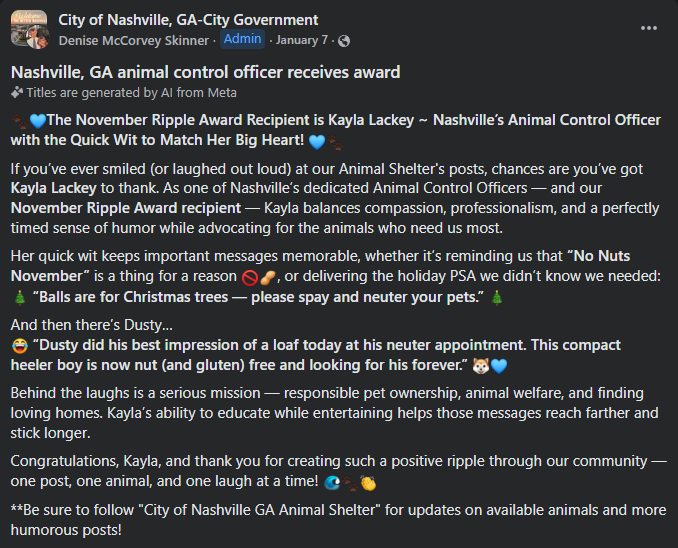
Another Facebook announcement, posted January 7, recognized Kayla as the recipient of Nashville’s November Ripple Award.
The announcement highlighted her compassion, professionalism, community education, and ability to use humor to encourage responsible pet ownership.
But the most significant recognition came from outside city government.
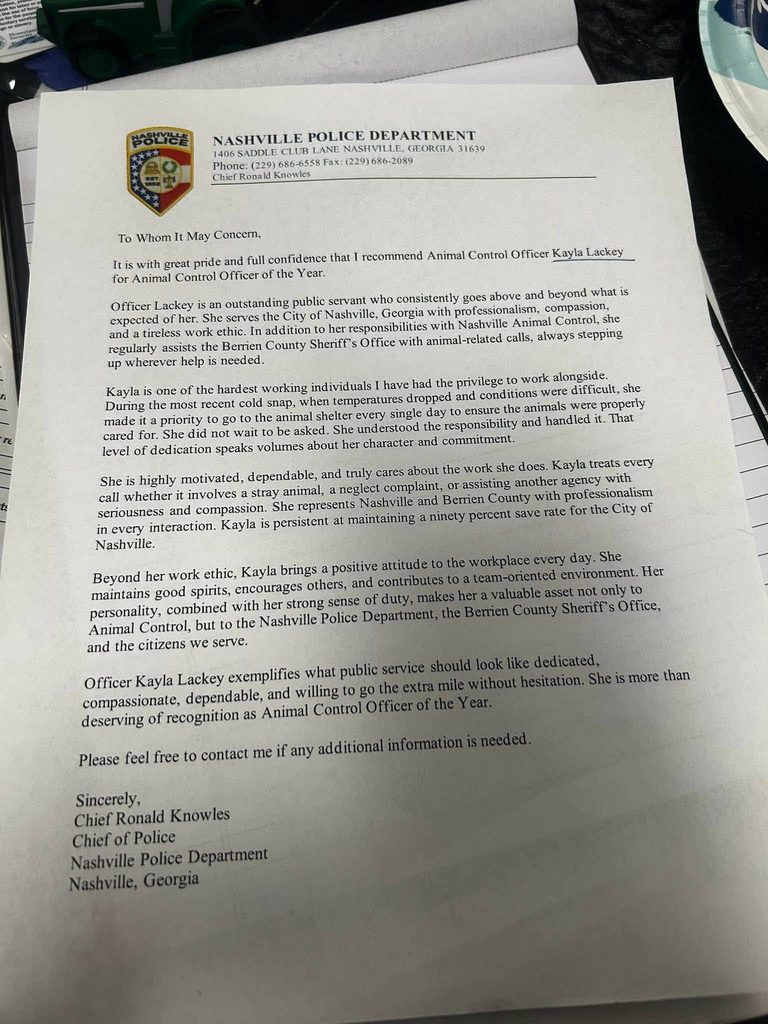
JAW GA News reviewed a photograph of a recommendation letter on Nashville Police Department letterhead, attributed to Chief Ronald Knowles.
In that letter, Knowles strongly recommended Kayla for Animal Control Officer of the Year.
He described an employee who worked hard, treated people and animals with compassion, supported surrounding law-enforcement agencies, and went beyond her ordinary duties.
The letter credited her with maintaining an approximately 90% animal save rate.
It also praised her dependability, teamwork, and dedication to public service.
The photograph does not establish the letter’s original date, and the document’s authenticity remains subject to independent confirmation.
However, we do have photographic evidence of what happened afterward.
On March 13, 2026, Kayla received the Georgia Animal Care & Control Association’s Animal Control Officer of the Year award.
A photograph of the engraved award identifies her by name and records the presentation date and location.
Another photograph shows Kayla participating in the award ceremony.
These materials establish that her professional accomplishments were recognized at the statewide level.
And even after that award, her work continued.
In a May 29 Facebook announcement, Nashville’s animal shelter reported that Panzer, the Animal Control Officer’s working dog, donated blood to help a puppy suffering from a serious intestinal parasite infection.
The Georgia Animal Care & Control Association subsequently shared recognition of Kayla and Panzer.
We have not independently verified every medical detail of that animal’s treatment, but the shelter’s own publication documents the event it described.
That’s the professional record we have been reviewing.
And it is the record Kayla says she wants people to remember.
July 23, 2026: The Termination
On July 23, Kayla publicly announced that the City of Nashville had terminated her employment.
In her initial Facebook statement, she identified herself as the city’s former Director and Animal Control Officer.
She said she was not asked to sign anything and did not receive what she considered a meaningful explanation during the meeting.
She also maintained that she had no previous disciplinary write-ups.
JAW GA News has since received a link to a recording identified by Kayla as the termination meeting, along with a rough speech-to-text rendering of the conversation.
The recording itself has not yet been independently authenticated or fully transcribed by our newsroom. Movement noise and unclear speech make some passages difficult to establish with confidence.
According to Kayla, those present included City Manager Randolph Hayden Hancock, a representative from finance named Lee, Police Chief Ronald Knowles, Brandon Rice, and representatives of Human Resources.
She further claims that her direct supervisor, Ed Yarborough, was unaware she was about to be terminated and was not present.
The city’s records have not yet confirmed the complete attendance list, who approved the dismissal, or whether her supervisor was consulted beforehand.
But the rough transcript of the meeting raises several questions.
The discussion reportedly included animal transfers, shelter money, private messages, an anonymous social-media account, and criticism of city government.
At one point, a male speaker appears to announce the termination.
Later, another passage appears to warn Kayla about speaking publicly against the city and the possibility of facing a lawsuit.
One particularly concerning statement appears in the rough transcript as:
“You can’t talk about your employer like that. You just can’t.”
We cannot yet establish the exact wording or identify the speaker with certainty.
And that matters.
A warning against knowingly making false factual allegations is different from telling a former government employee that she cannot criticize public officials or public policy.
JAW GA News is seeking clarification of exactly what was said, by whom, and why.
Because criticism of government operations is not automatically employee misconduct.
At the same time, public employees remain subject to lawful workplace rules, and not every workplace statement receives the same legal protection.
The specific circumstances matter.
So do the facts.
The Community That Refused to Stay Silent
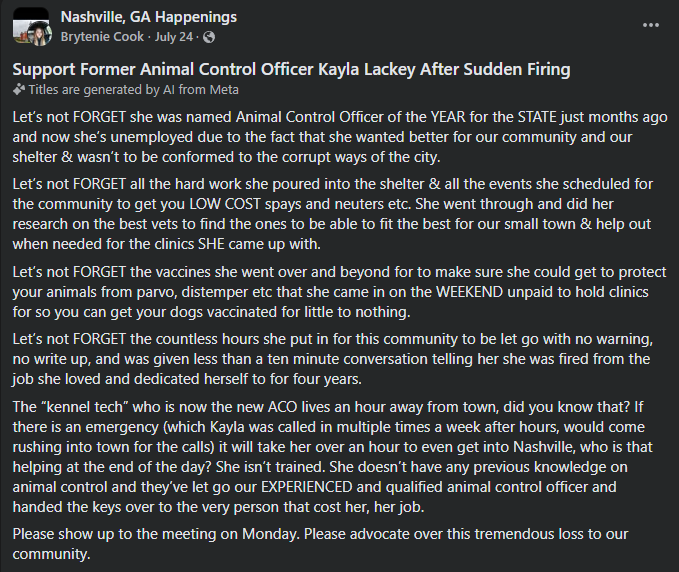
When the news broke that Kayla Lackey had been fired from the City of Nashville Animal Control Department, the reaction didn’t stop at the Berrien County line.
People from Lowndes County, Tifton, Quitman, and other communities started sharing their experiences.
Some had adopted animals from her. Others had followed the shelter’s social media pages for years. Some had never personally met Kayla but knew her through the animals she worked so hard to save.
One commenter using the name TrustworthySloth4341 said that coworkers regularly gathered to watch the shelter’s Facebook and TikTok updates because they enjoyed Kayla’s humorous approach to animal welfare.
That may sound like a small thing, but think about what it means.
She wasn’t simply posting pictures of dogs and cats. She was getting people interested in animals that needed homes.
Linda Steding described traveling five hours round trip to adopt a dog after working with Kayla. She said she was so impressed that she named her adopted dog after her.
Ellen Onorata described traveling more than two hours each way to adopt dogs from Nashville because of Kayla’s work.
Other residents described personal experiences receiving help with stray animals, injured dogs, and shelter adoptions.
These statements have not all been independently verified, but the number of people willing to publicly describe their experiences shows why her dismissal became such a significant community issue.
And the comments weren’t just about whether she should be rehired.
People wanted answers.
Nashville resident Tony Coelho repeatedly questioned why she had been fired and asked whether the replacement employee possessed the necessary qualifications.
Another commenter, Jerry Randy Lipsey, argued that the city should have documentation identifying the reason for separation.
Kayla responded that she had not received such paperwork.
Former kennel employee Brytenie Cook wrote that Kayla was given approximately seven minutes after four years of work before being asked to surrender her badge.
But not everybody agreed with the praise.
Bobby Wiley publicly complained about Kayla’s handling of a dog named Smoke. He alleged that she did not respond adequately when he attempted to explain his side of the situation and recover the animal.
That complaint deserves to be heard and examined just like the favorable accounts.
We cannot declare that Kayla handled every animal-control case properly simply because so many people admired her.
But we also cannot dismiss years of documented work because an allegation exists.
That’s why records matter.
There was another exchange in this public discussion that tells us something important about Kayla herself.
When asked whether she would consider returning to work for the city, Kayla said she would, provided certain conditions were in place.
She explained that she loved the people, the job, and the animals.
In another comment, she expressed concern that a lawsuit could ultimately cost the taxpayers who supported her.
So this was never as simple as somebody wanting a paycheck or trying to embarrass city leadership.
According to Kayla, it was about the work she lost, the animals she left behind, and the reputation she spent years building.
The community response does not prove that the City of Nashville acted unlawfully.
The signatures, comments, and testimonials are not substitutes for an investigation.
But they establish something else.
This decision affected more than one employee.
It affected a community of residents, adopters, volunteers, and animal advocates who believed they had benefited from her service.
And when that many people start asking the same question, their elected officials should understand why an accurate explanation matters.
Why was Kayla Lackey fired?
What evidence supported the decision?
And was the decision made fairly?
Those questions remain at the center of the JAW GA News investigation.
Because supporting Kayla doesn’t mean ignoring evidence against her.
And holding Nashville accountable doesn’t mean assuming every accusation against its officials is true.
It means following the evidence, hearing every side, and refusing to confuse allegations with proven facts.
People. Facts. Accountability.
The Private Messages and the Anonymous Account
One subject discussed during the termination meeting involved private group messages.
Kayla subsequently provided screenshots of a conversation she identified as involving herself, a participant referred to as Kerklin, and another participant named Evelin.
Some of those messages discussed dissatisfaction with city leadership, police staffing, and the possibility of preparing an anonymous letter addressing local government concerns.
Kayla acknowledged using angry language.
She also acknowledged that she considered writing anonymously about problems she believed existed within Nashville’s government.
In additional correspondence with JAW GA News, she confirmed operating an alternate Facebook account under the name Anita Foster.
According to Kayla, the account’s name was a reference to animals needing foster homes.
She says she used it occasionally to discuss animal welfare, respond to questions, and raise concerns while keeping some separation between her personal views and her official position.
Operating an alternate account is not, by itself, proof of unlawful impersonation or workplace misconduct.
The question is whether the city identified some specific violation and whether reliable evidence supported that conclusion.
Another question concerns the private messages themselves.
Who supplied them to city management?
Were officials given the entire conversation?
Were only selected screenshots reviewed?
Did investigators interview everyone involved?
And did Kayla have an opportunity to explain the context before the decision was made?
The screenshots contain remarks that could reasonably concern an employer, including angry statements about leadership.
We are not ignoring that evidence.
But we also cannot determine whether an employee’s conduct justified termination without knowing the city’s actual findings and the rules being applied.
That’s the difference between conducting an investigation and simply choosing which side to believe.
The Missing Context Behind the Money
Another part of the meeting concerned money handled through the animal shelter.
Kayla has acknowledged that she once forgot about cash collected at the shelter and initially gave an incorrect answer when asked whether certain funds were present.
According to her account, once she discovered her mistake, she admitted it and reported the situation to a superior.
She identifies Major Yarborough as someone who had knowledge of the circumstances.
Kayla also claims that, to her knowledge, he was not interviewed before her termination.
That allegation remains unverified.
But a separate financial document raises questions of its own.
JAW GA News reviewed a screenshot of a report titled “Payment Breakdown By Date,” generated September 17, 2024.
It records three transactions totaling $120:
An adoption fee of $75, a reclaim fee of $25, and a microchip transaction of $20.
The listed payment methods include cash, PayPal, and Cash App.
Kayla says this older report was included with records concerning her termination in a way that could lead people to suspect financial wrongdoing.
But the report itself establishes only that the transactions were recorded.
It does not establish that money was stolen, that deposits were missing, or that Kayla misappropriated public funds.
To make those determinations, we need the deposit history, transaction records, reconciliation reports, and the city’s final findings.
If money was missing, the city should be able to explain the discrepancy.
If the money was accounted for, that should also be documented.
And if someone publicly implied dishonesty without evidence supporting that accusation, the resulting harm to an employee’s reputation deserves scrutiny.
We are not declaring that anyone did so.
We’re asking what the records actually establish.
A Reported Injury and an Unpaid Bill
Kayla has also described suffering an animal bite while performing her duties.
She claims the incident resulted in a medical bill that remained unpaid.
JAW GA News reviewed a billing screenshot showing an outstanding balance of $772.12 after a self-pay adjustment.
That supports her statement that a bill of approximately that amount existed.
It does not independently establish that the bill resulted from the reported workplace injury, that a claim was filed, or that the city or an insurer was responsible for payment.
Those questions require additional documentation.
We have requested limited administrative records about incident reporting and claim handling without seeking Kayla’s private medical information.
The purpose is to establish whether the appropriate workplace procedures were followed.
Speaking Up About the Police Department
One of the most revealing parts of Kayla’s public statement concerns something other than animal control.
Police officer pay.
Kayla says that when her own compensation was being discussed, she suggested that money intended for a possible raise should instead go toward better pay for Nashville police officers.
She also describes an approximately $60,000 proposed shelter-building allocation and says she advocated using available city resources to retain experienced officers.
Whether that funding could legally have been redirected depends on its original source and any restrictions attached to it.
The relevant budget documents have not yet been verified.
But the underlying concern is clear.
Kayla believed that Nashville was struggling to retain qualified officers and that public safety should be a priority.
Her private messages, by her own account, reflected some of that frustration.
And the termination meeting appears to have included discussion of those communications.
That makes it important to determine whether her advocacy about staffing, officer pay, and city operations influenced the city’s employment decision.
We are examining that possibility.
We are not presenting retaliation as an established fact.
Georgia law provides certain protections for qualifying disclosures by public employees, and the First Amendment may protect some public-employee speech on matters of public concern.
But those protections depend on the legal requirements and the specific facts.
The fact that someone criticized government does not automatically prove that subsequent disciplinary action was unlawful.
Likewise, the fact that government officials considered an employee’s criticism does not automatically make the criticism a valid reason for dismissal.
The city’s actual justification is essential.
Concerns About Nashville’s Animal Shelter
Kayla has also provided photographs, video previews, and detailed statements describing conditions at Nashville’s animal shelter.
She says the kennel flooring previously included wood that deteriorated and was later replaced with donated plastic material.
She reports personally adding fans and taking other steps to protect animals from the heat and weather.
According to her account, the shelter’s available resources often left her trying to solve facility problems while also managing ordinary animal-control calls.
She further alleges that she proposed using an unused city-owned building and surrounding land for an improved shelter and public recreation area.
Kayla says City Manager Hancock rejected that proposal, citing concerns about the building, costs, and its proximity to nearby residents.
She also questions later expenditures involving fencing at the property.
The specific parcel, proposal, actual costs, council discussions, and final decisions have not yet been independently established.
These claims deserve review through property records, meeting minutes, invoices, and any engineering or safety assessments.
We also have photographs of kennel structures and videos supplied by Kayla, but the materials reviewed so far do not establish the complete current condition of the facility.
That distinction is important because poor conditions cannot be established solely from an incomplete image or an allegation.
Nevertheless, animal shelter conditions are a public concern.
The city has a responsibility to explain how its facilities are maintained, how animal welfare is protected, and whether its staffing and facilities meet applicable requirements.
The Eight Dogs and the Question of Euthanasia
During the reported termination meeting, one male speaker appears to question Kayla about an arrangement involving eight dogs and shelters in Quitman and Pearson.
Kayla describes transferring adoptable animals while accepting other dogs from outside facilities.
In later correspondence, she states that some transferred animals had serious aggression problems or bite histories and that euthanasia decisions were made after behavioral evaluation.
Those statements require verification.
JAW GA News has not obtained the individual animal records, transfer documents, bite histories, or euthanasia records needed to determine precisely what happened.
We cannot establish that any particular animal was improperly euthanized.
Nor can we accept every explanation without reviewing the records.
The issue is whether the transfers and decisions complied with applicable procedures and were properly documented.
Kayla’s broader public record shows that she opposed euthanizing animals merely because they were inconvenient to their owners.
In a May 10, 2026 Facebook post, she described a woman who reportedly came to her home on Mother’s Day seeking assistance with a dog that dug holes.
Kayla explained that she worked for the city rather than the county and described the limits of her authority.
Her post also alleged that the visitor suggested using the dog for target practice, a statement we have not independently verified from the complete video.
The exchange illustrates another pressure faced by animal-control workers: residents sometimes expect them to solve problems outside normal hours, outside their jurisdiction, and without understanding the resources available.
That does not excuse every decision an officer makes.
It does explain why animal control requires training, judgment, and knowledge that go beyond collecting stray animals.
The Community Responds
The public response to Kayla’s termination was not limited to a few Facebook comments.
WTXL ABC 27 reported in July that more than 500 people had signed a petition supporting her reinstatement.
Residents also appeared at Nashville City Hall to express their concerns.
The station interviewed supporters who described Kayla’s commitment to the shelter and the community.
Public support is not proof that a termination was wrongful.
Hundreds of petition signatures cannot replace a personnel investigation.
But the response demonstrates that the dismissal was a matter of genuine public concern.
And that is why city leadership should be prepared to explain its decision within the limits of the law.
Kayla later addressed Nashville City Council.
During her statement, she questioned how selected private communications were handled, why certain witnesses may not have been interviewed, and whether the city’s disciplinary standards were consistently applied.
She also raised questions about her attempt to bring employment concerns before elected officials.
Kayla maintains that she had asked council members for an opportunity to discuss her concerns privately before speaking publicly.
We have requested the corresponding records.
Most importantly, Kayla has said she is not seeking to return to her old job.
She wants her name cleared.
That changes the heart of this story.
Because this is no longer simply about whether the city should rehire a former employee.
It is about whether the allegations and explanations surrounding her dismissal accurately reflect what happened.
One City, Different Disciplinary Questions
There is another reason JAW GA News is examining Nashville’s personnel policies.
In May 2026, City Manager Randolph Hayden Hancock was cited following an off-duty Georgia State Patrol traffic stop.
The City of Nashville announced that Hancock had been placed on administrative leave pending an internal review.
The incident involved allegations including DUI, speeding, failure to maintain lane, and an open container.
Those allegations are not convictions, and we have not independently verified the final disposition of his court case.
The incident is also materially different from Kayla’s employment matter.
But both cases raise questions about how city officials determine appropriate personnel actions.
What standards apply to employees?
What standards apply to management?
Who reviews the evidence?
And how does the city ensure those decisions are fair and consistent?
We have requested the personnel policies and public records relevant to both matters.
The purpose is not to suggest that one employee’s situation automatically determines what should happen to another.
The purpose is to understand the rules and whether the city applied them properly.
Accountability should be based on documented conduct and established standards, not job titles or personal relationships.
The City’s Response to JAW GA News
On October 14, 2026, JAW GA News sent formal press inquiries and Georgia Open Records Act requests concerning Kayla’s termination and Nashville’s personnel practices.
We contacted Mayor Travis Brown, Chief Ronald Knowles, and City Manager Hayden Hancock.
We also requested records from City Clerk Amanda Thacker and the Georgia Department of Public Safety concerning the related Hancock investigation.
Additional requests followed on October 16 after new evidence identified more specific documents to examine.
Those requests covered the complete private-message records reviewed by management, any findings involving the Anita Foster account, the $120 financial report, employee disciplinary policies, the reported workplace injury, and city records involving police compensation and academy sponsorship.
On October 19, City Clerk Amanda W. Thacker acknowledged receiving our original Kayla Lackey records request.
Thacker explained that her office was reviewing the categories of requested records and anticipated additional staffing assistance on October 21.
She stated that responsive records within the city’s possession, custody, or control would be evaluated for production under Georgia’s Open Records Act.
She also identified potential legal exemptions and privileges that might apply to some personnel or investigative materials.
That acknowledgment is an official response, and we are reporting it accordingly.
However, as of this October 20 report, we had not received the complete termination findings, full message records, or financial reconciliation documents requested for this investigation.
JAW GA News has also continued seeking an on-the-record explanation from Hancock concerning the official reason for dismissal, the decision-making authority, and whether protected or ordinary criticism of government operations played any role.
Under Georgia’s Open Records Act, public agencies generally must provide available responsive records within three business days or issue the legally required explanation and production timetable when records cannot be produced within that period.
We will assess the city’s compliance based on the requests, acknowledgments, subsequent responses, and records ultimately produced.
The city has an opportunity to clarify its decisions, correct inaccuracies, and provide evidence supporting its actions.
And we intend to fairly examine that evidence.
What We Know, and What We Still Need to Prove
There are several facts we can establish at this stage.
Kayla worked in animal control for Nashville.
Her work was documented in outside news reporting.
She received professional recognition, including the Georgia Animal Care & Control Association’s 2026 Animal Control Officer of the Year award.
She was terminated in July 2026.
Her dismissal generated considerable public concern.
The city has acknowledged receiving JAW GA News’s records request and is reviewing responsive materials.
But significant questions remain unanswered.
We have not established that the city unlawfully retaliated against her.
We have not established that any official deliberately presented false information.
We have not established that shelter funds were missing or misappropriated.
We have not established the full circumstances of every animal transfer or euthanasia decision.
And we have not established that Kayla’s termination violated a specific employment policy or law.
Those findings require evidence that is still being sought.
The positive professional record matters, but it cannot erase legitimate misconduct if misconduct is proven.
At the same time, the existence of accusations does not mean those accusations are true.
That is precisely why we need the complete findings.
Her Name, Her Work, and the Record She Wants Remembered
Toward the end of her public statement following her termination, Kayla reflected on the work she had performed for Nashville.
She acknowledged that she had not done everything perfectly.
She also described the animals she helped, the programs she built, the people she worked alongside, and the time she gave to a community she cared about.
Her final message was straightforward.
“The City of Nashville may have ended my employment, but it cannot erase the work that was done, the lives that were saved, the people I advocated for or the record of what I gave.”
That is the part of this story that deserves to be heard alongside the questions about her dismissal.
Behind the personnel records and private messages is a real person whose professional reputation matters.
There are also real animals, real public-safety responsibilities, and taxpayers who deserve to know how their government is operating.
JAW GA News did not open this investigation to declare Kayla innocent of every allegation before reviewing the evidence.
And we did not open it to declare Nashville officials guilty of retaliation or corruption without proof.
We opened it because the circumstances deserve a fair and complete examination.
If the city had valid grounds to dismiss her, the public record should help explain what those grounds were.
If mistakes were made, they should be acknowledged.
If allegations were unsupported, they should be corrected.
And if an investigation establishes that officials violated applicable laws or policies, those findings should be addressed through the proper channels.
That’s accountability.
It isn’t about who holds the highest office.
It isn’t about who has the most influence.
And it certainly isn’t about who gets the loudest applause.
It is about the evidence.
Four months before her termination, Kayla Lackey stood before her peers and accepted an award recognizing her service to animals and her community.
Four months later, she lost the position through which she had performed much of that work.
The employment decision is a fact.
Whether the reasons behind it were justified remains the question.
And that is where our investigation continues.
Investigation Status
JAW GA News continues seeking the official termination findings, employee disciplinary policies, complete communications reviewed during the employment investigation, financial reconciliation documents, relevant witness accounts, and responses from the officials involved.
This is an ongoing investigation. No finding of unlawful termination, retaliation, theft, or official misconduct has been established by JAW GA News.
Statements attributed to Kayla Lackey are identified as her account unless independently corroborated. Photographs of documents, screenshots of conversations, and portions of the termination recording have not all been independently authenticated or verified as complete.
JAW GA News welcomes relevant records and corrections, including evidence that supports or disputes Kayla’s account. Any substantial official response will be evaluated fairly and incorporated into future reporting.
Sources and Supporting Reporting
- WTXL ABC 27: Support Grows for Fired Nashville Animal Control Officer
- WALB: City of Nashville Launches Community Cat Program
- WALB: Nashville Animal Shelter in Need of Trailer
- Lanier County News: Animal Control Conference Draws Public Safety Officials
- Georgia Animal Care & Control Association: Awards
- City of Nashville: Animal Control
- City of Nashville: Administration
- Georgia Attorney General: Open Government Guidance
- Source-provided photographs, public Facebook statements, financial document images, employment-related correspondence, and meeting transcription materials reviewed by JAW GA News.
- City Clerk Amanda W. Thacker’s October 19, 2026 email acknowledging the Kayla Lackey records request.
Rev. Joseph Allen Wolfe
Founder, Owner, Publisher & Editor-in-Chief
Independent Investigative Journalist
JAW GA News
People. Facts. Accountability.
A STRONGER GEORGIA.
Justice for Kayla Lackey.
The investigation continues.

Leave a Reply
You must be logged in to post a comment.