
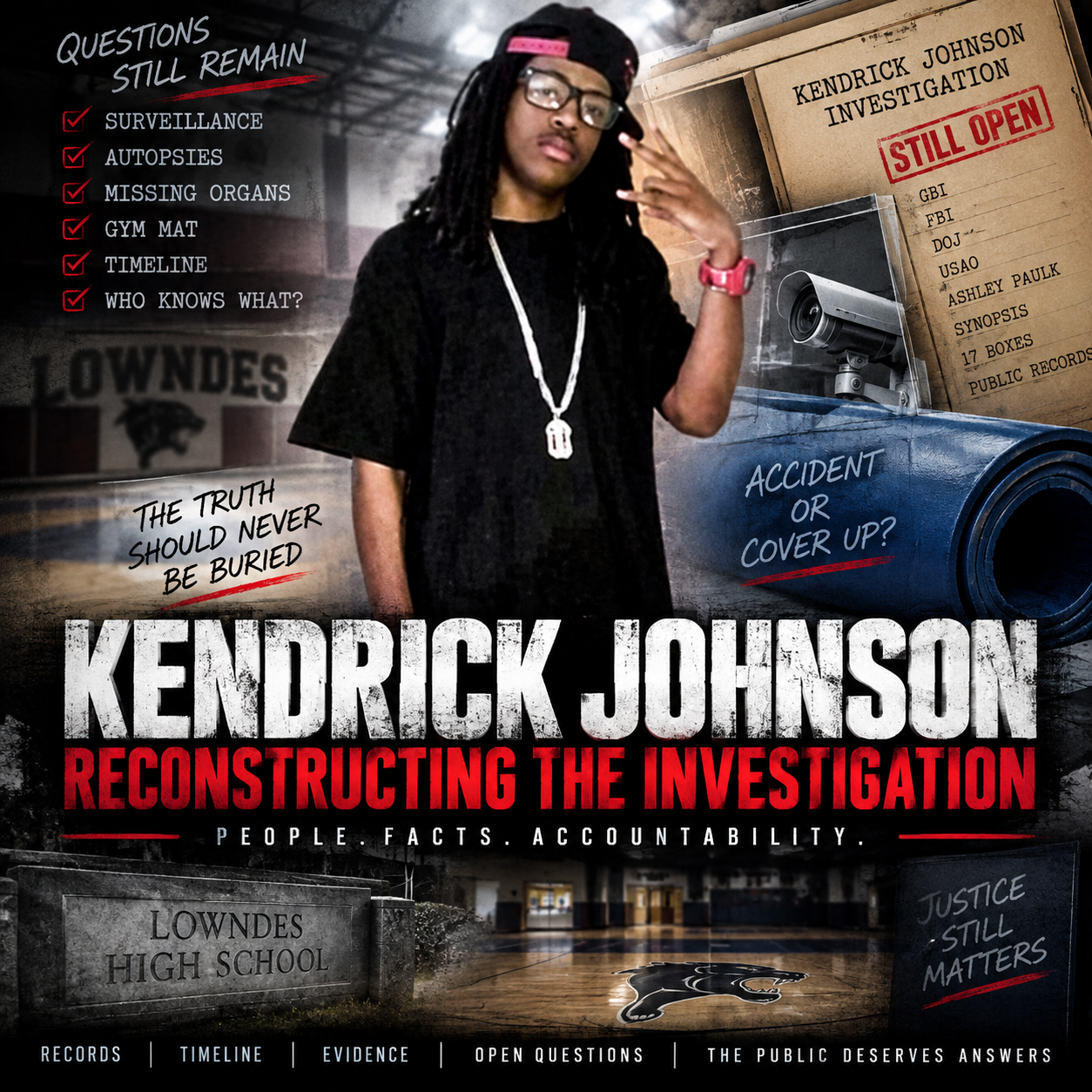
JAW GA News | Final investigative assessment | September 7, 2026
A documented audit of the original 2013 investigation, the Bell–Johnson conflict, the January 11 scene, the coroner delay, disputed forensic evidence, later state and federal reviews, and the questions the currently open Lowndes County investigation can still answer.


Images supplied by JAW GA News for publication layout. The report does not infer guilt, motive, or official responsibility from a photograph alone.
Thirteen years of argument have produced an enormous record and an equally enormous amount of noise. The useful question is no longer which side can repeat its theory the loudest. It is whether the original investigative foundation can withstand an independent reconstruction.
| CORE ASSESSMENT: The original investigation contains documented procedural irregularities and unresolved evidentiary conflicts serious enough to require an independent reconstruction of January 11, 2013. The evidence supports testing an intentional-cover-up hypothesis. It does not yet establish, as a proven fact, who killed Kendrick Johnson or that specific named individuals participated in a homicide or conspiracy. |
Executive assessment
The strongest finding is not that every allegation circulated over the years has been proved. It has not. The strongest finding is that the original death investigation was compromised early enough, and contains enough documented defects, disputed evidence and unresolved relationships, that its accidental-death conclusion cannot be treated as self-validating.
The critical failure point is January 11, 2013. Kendrick was discovered in the old gym. Law enforcement secured and processed the area. Coroner Bill Watson was not notified until hours later. When he finally entered, he documented that the body had been noticeably moved and that, in his opinion, the scene had been compromised. Whatever happened during that interval therefore matters to every later reconstruction.
The Bell–Johnson history is also material. Brian Bell and Kendrick had a documented physical confrontation during a 2011 football trip. Later accounts attributed to Kendrick alleged that the conflict remained unresolved, including an alleged rematch proposal involving Rick Bell and an alleged statement associated with Branden Bell that the matter was not over. Those accounts remain disputed and require corroboration, but they cannot be erased from the chronology merely because later witnesses described reconciliation.
The original Sheriff, Chris Prine, publicly advanced an apparent-accident theory extremely early. Developing an early hypothesis is not misconduct. The unresolved question is whether competing explanations were objectively tested after that theory had been publicly embraced, or whether the investigation became anchored to it.
Finally, the later state and federal investigations matter. DOJ reported an extensive federal review and concluded there was insufficient evidence to prove a federal crime beyond a reasonable doubt. That is significant counterevidence and must remain in any honest assessment. But a later review cannot retroactively give the original scene integrity it did not possess. The foundational question remains whether later investigators adequately resolved the defects inherited from January 11.
1. The January 11, 2013 scene is the center of the case
Any serious reassessment should begin with the first hours, not with the final accidental-death label. The key question is what the scene looked like when Kendrick was discovered and how it changed before the county coroner independently examined it.
Coroner Bill Watson later documented that he was not notified until 3:45 p.m. He described the investigative climate as extremely poor, said Kendrick’s body had been noticeably moved, said the scene had been compromised, and complained that information needed for his investigation was withheld. These statements came from an official participant in the death investigation, not from social-media speculation.
That does not establish intentional evidence manipulation. Students and personnel reportedly moved mats during discovery and recovery, and some later movement of Kendrick was necessary to remove him. But it does establish that the coroner did not observe the original scene. The pre-coroner period must therefore be rebuilt from photographs, first-responder accounts, officer narratives, crime-lab reports, timestamps and any entry log that exists.
Source: CNN transcript: Watson’s coroner report and scene complaints
Source: CNN transcript: Watson interview on moved body and compromised scene
The six-hour problem
The delay cannot be reduced to a clerical mistake. If the gym remained secured while investigators controlled access, then the relevant issue becomes exactly what occurred under that exclusive control before Watson entered.
- Who entered the old gym, and at what time?
- Who moved surrounding mats before and after law-enforcement arrival?
- When was the mat containing Kendrick first touched or repositioned?
- When and how was Kendrick’s body moved?
- Which photographs were taken before each movement?
- Who authorized each scene alteration?
- When did GBI personnel arrive, and what did they observe on first entry?
- When did Chris Prine arrive, and when did he first communicate an accidental-death theory?
- Was Rick Bell on school property or within the secured perimeter, and if so, in what capacity?
- Did Rick Bell and Chris Prine communicate that day, and what was the subject of that communication?
| WHY THIS MATTERS: A secured scene is not necessarily an intact scene. Security establishes who controlled access. Integrity requires documentation of what happened inside that control. |
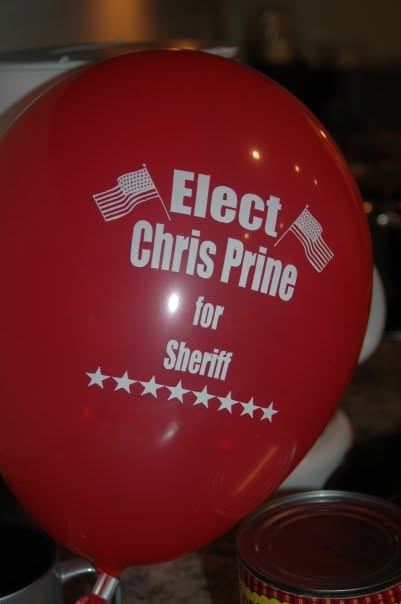

Campaign material supplied by JAW GA News. These images establish political/public-office context only; they are not evidence about the death investigation.
2. Chris Prine and the early accident theory
Contemporary reporting shows that an apparent-accident explanation was publicly advanced very early, before the complete autopsy and forensic process had concluded. That is a legitimate point of scrutiny because investigative hypotheses can become anchors: once publicly embraced, later evidence may be unconsciously interpreted through them.
Nothing in this assessment treats the mere existence of an early theory as proof of corruption. Investigators must form working theories. The question is whether Prine’s office meaningfully tested competing explanations after the accident theory was stated, particularly given the coroner’s later complaints about scene integrity.
The eventual GBI medical examiner determination of positional asphyxia and accidental manner supplied forensic support for the theory. But that later support does not answer what evidence Prine had at the precise moment the theory was first advanced, nor does it resolve whether the original scene had already been altered in ways that affected later reconstruction.
Source: DOJ closure statement summarizing official findings
The tunnel-vision test
| TESTABLE QUESTION: Did the investigation use subsequent evidence to test the accident hypothesis against reasonable alternatives, or did it primarily use subsequent evidence to reinforce a conclusion already publicly chosen? |
3. Bill Watson: documented objections, then a documented change in posture
Watson’s criticism did not end with the timing of the call. He publicly discussed the compromised scene. CNN later reported that he asked the network to destroy an interview in which he discussed the case, saying he did not want the situation aired. CNN declined.
Watson also initially expressed willingness to conduct or welcome an inquest and later refused to discuss it or explain what had changed. That reversal does not prove intimidation, pressure or conspiracy. But it is an unexplained change by a material official witness and therefore belongs in the investigative timeline.
The proper question is not to assume why Watson changed. It is to establish what occurred between his earlier and later positions: communications, meetings, legal advice, contacts from local or state officials, or other documented events.
Source: CNN: request to destroy interview
Source: CNN: inquest discussion and later reversal
4. Witness accounts and crime-scene photographs must be time-synchronized
Witnesses did not all observe the same moment. Some accounts describe the scene before surrounding mats were moved; others describe later recovery stages; still others describe Kendrick after personnel had begun manipulating the mat or his body. Treating all of those statements as descriptions of one static scene produces false contradictions.
The correct method is chronological. Each witness account should be assigned to the earliest moment that witness can reliably establish. Each photograph should then be placed in sequence using metadata, visible changes, personnel, mat positions and evidence markers. Only then can an actual contradiction be declared.
This is also where the previously reviewed photographic evidence remains valuable. Several witness descriptions can be reconciled as descriptions of different recovery stages, while other issues, especially arm position and the degree to which Kendrick was exposed, require more precise sequencing.
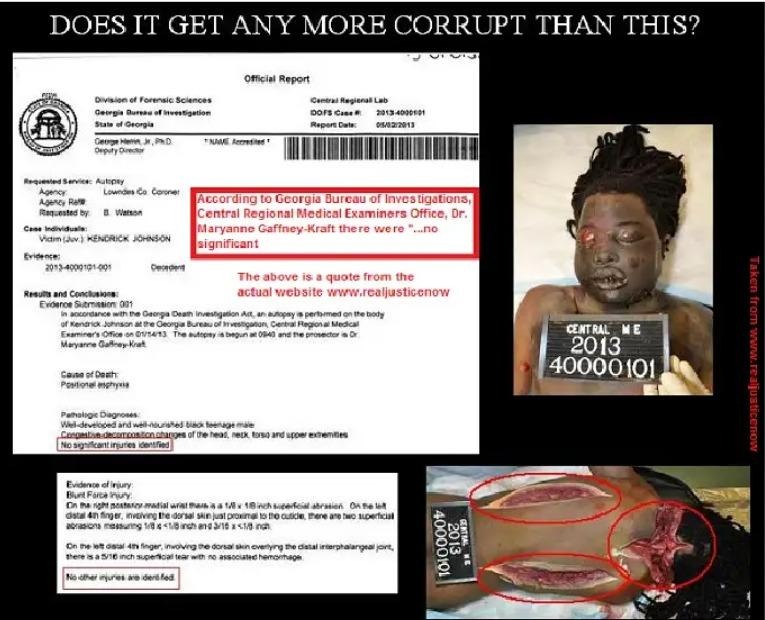
Graphic supplied by JAW GA News. Embedded text and circles are advocacy annotations and are not treated in this report as independent forensic findings. The underlying images require comparison with original autopsy documentation.
5. Disputed injuries, including alleged stun-gun markings
The family’s allegation that certain paired or patterned marks are compatible with stun-gun prongs is not merely an internet rumor. The allegation appears in later federal litigation and related filings. That elevates it from social-media gossip to a documented forensic claim made by the family, but it still does not establish the mechanism of injury.
The photographs need independent examination by a qualified forensic pathologist or physician with experience in conducted-energy weapon injuries. The examiner should be blinded to the preferred theory where practical and asked to identify all plausible causes, not merely whether the marks can be made to resemble a Taser pattern.
The same method should be applied to alleged restraint marks. Search terms and record review should include paired punctures, probe wounds, electrical injury, conducted-energy device, stun gun, dart, wrist abrasion, circumferential injury, patterned bruising and restraint marks.
Source: Eleventh Circuit opinion summarizing family’s stun-gun-mark allegations
Source: 2025 amended complaint/exhibits reported by 41NBC
6. The autopsy record materially conflicts
The first GBI autopsy concluded that Kendrick died from positional asphyxia and classified the manner as accidental. That is the official foundation of the accidental-death determination.
The second autopsy obtained by the family reached a materially different interpretation, identifying blunt-force trauma in the right neck/jaw region and concluding that the death was not accidental. DOJ acknowledged the existence of this conflicting conclusion when it announced the closure of its federal investigation.
Paulk’s later synopsis also described additional medical review, including an Armed Forces Medical Examiner assessment. The existence of multiple medical reviews does not automatically validate one side, but it demonstrates that the forensic history is more complicated than a single unanimous finding.
Source: DOJ: federal investigation closure and discussion of medical evidence
Source: WCTV: Paulk synopsis and later medical-review discussion
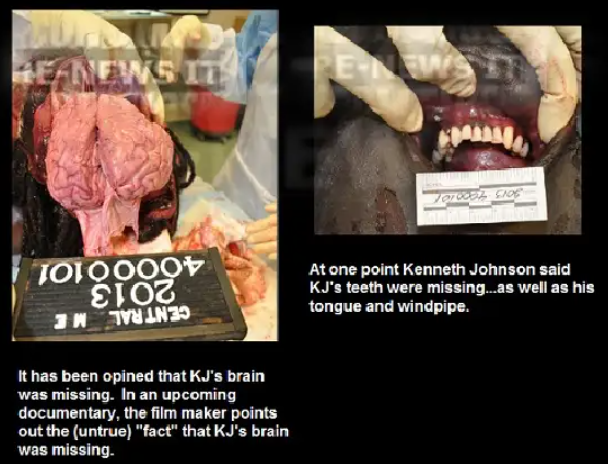
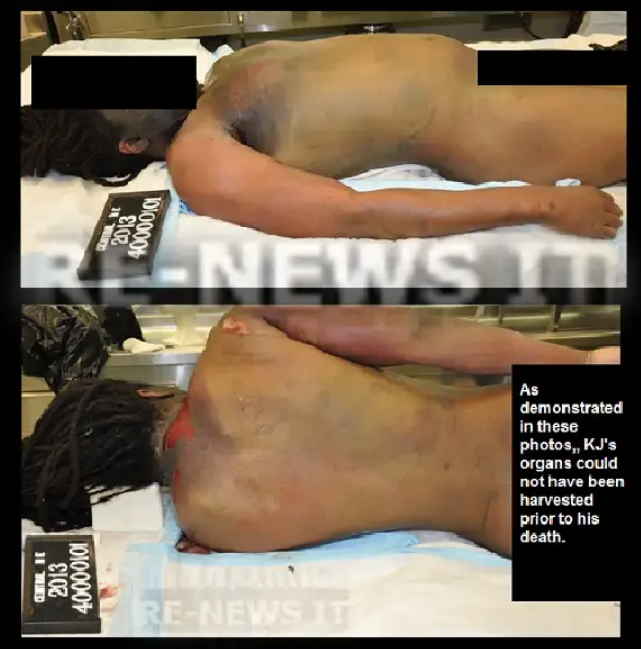
Postmortem graphics supplied by JAW GA News. Graphic content. The report distinguishes the underlying photographs from captions or claims embedded by third parties.
7. The organs and biological-evidence chain
When Kendrick was later exhumed for an independent autopsy, his internal organs were no longer present and the body cavity contained newspaper. That discovery produced a major chain-of-custody dispute.
The GBI position and the funeral home’s account did not align. The GBI maintained that the viscera were handled or released according to its process, while the funeral home disputed receiving the organs. Coroner Watson also described a conversation with a GBI death investigator concerning disposition, which the GBI later disputed in part.
The appropriate conclusion is not that organs were deliberately destroyed to hide evidence. The defensible conclusion is that the disposition became disputed and the organs were unavailable to later examiners, permanently limiting the ability to reproduce parts of the first examination.
Source: CBS: missing organs and family concerns
Source: CBS: conflicting accounts of what happened to organs
Source: Georgia DPS/GBI board material
8. The Bell–Johnson history: established confrontation, disputed aftermath
Brian Bell and Kendrick Johnson had a documented physical confrontation on a football-team trip in November 2011. Paulk’s synopsis describes coaches intervening and later accounts that the boys showed no continuing animosity and even worked together on a class project.
That reconciliation narrative is important counterevidence and must remain in this report. But it is not the only account. Later litigation preserved Kenneth Johnson’s account that Kendrick told him Rick Bell approached him at school, characterized the original fight as unfair and proposed another fight with Brian. Other later accounts attributed to Kendrick alleged that Branden Bell indicated the matter was not over.
Those are hearsay statements attributed to Kendrick, not proven events. Their significance is that they identify concrete propositions that can be investigated. If independently corroborated, they would undermine the claim that the 2011 confrontation was completely forgotten. If disproved, they strengthen the reconciliation narrative.
Source: Paulk investigation synopsis
Source: Bell v. Pollock federal decision discussing documentary statements
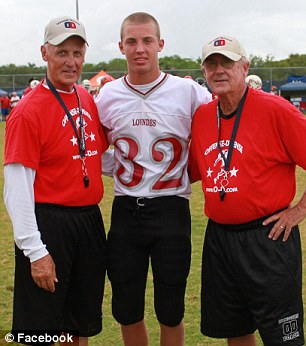
Football-related images supplied by JAW GA News. They provide visual context for the athletics thread; they do not establish motive or culpability.
The humiliation hypothesis
The motive theory worth testing is broader than the later girlfriend rumor. If the reported post-fight statements are accurate, the chronology contains a football-context confrontation, accounts that Kendrick got the better of Brian, an alleged statement that the fight was unfair, an alleged proposed rematch, and an alleged later indication that the dispute was not over.
That pattern is compatible with an unresolved humiliation or grievance hypothesis. Compatibility is not proof. The theory must be connected to January 2013 through contemporaneous evidence: another confrontation, threats, school discipline, texts, social-media posts, witness accounts or other records dating before Kendrick’s death.
9. Rick Bell, Chris Prine and the unresolved communication question
Rick Bell’s relevance is not limited to being Brian’s father. He was an FBI agent, and later material indicates that he had his own football background and was supportive of Brian’s athletic career. That context makes the alleged rematch approach especially relevant if it can be corroborated.
A separate allegation states that Rick Bell communicated with then-Sheriff Chris Prine around the time of Kendrick’s death. Another reportedly circulating image is said to place Rick on Lowndes High grounds around a taped-off area during the response. JAW GA News has not authenticated that specific scene image in the present evidence set.
The correct investigative questions are therefore narrow and answerable: Was Rick on campus during the January 11 response? Did he communicate with Prine? At what time? In what capacity? What did Prine know about the 2011 fight when he first advanced the accident theory?
Professional familiarity between an FBI agent and a county sheriff in the same regional law-enforcement ecosystem is plausible, but a close personal friendship should not be asserted without pre-2013 documentation such as joint cases, task-force assignments, training records, photographs, correspondence or sworn testimony.
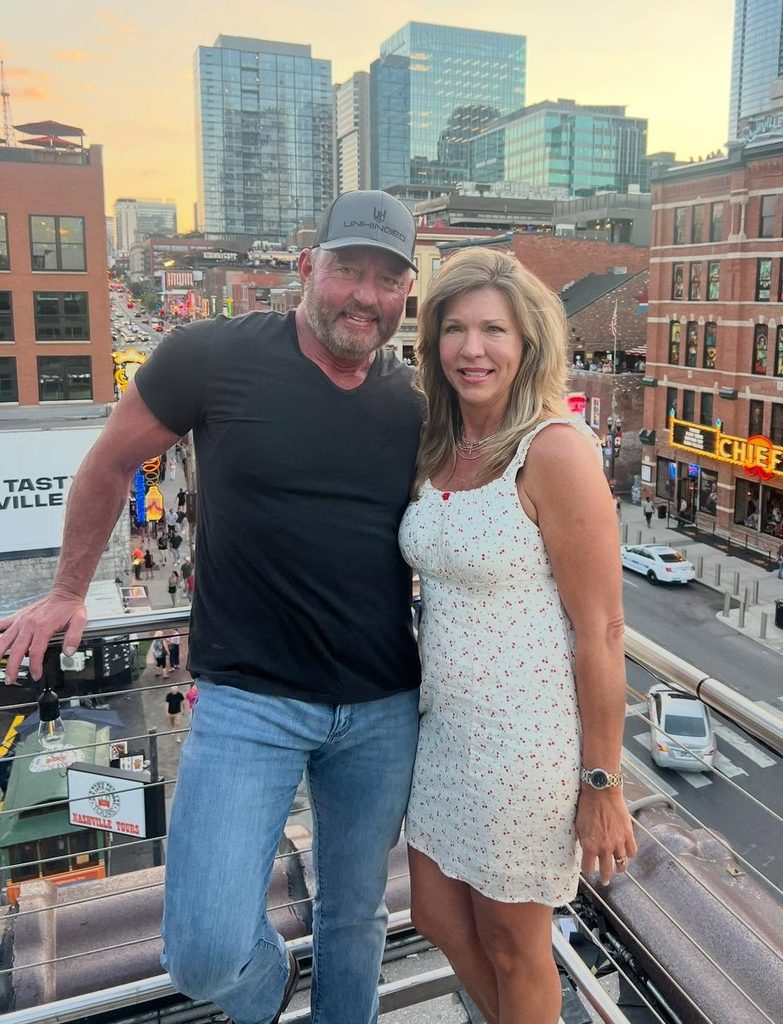
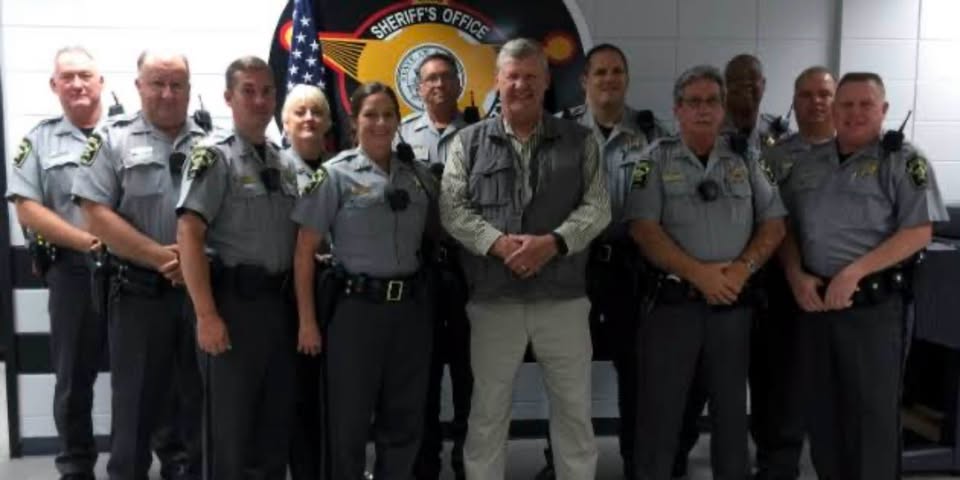
Additional source images supplied by JAW GA News. Identity, date, location and evidentiary significance should be independently authenticated before publication as proof of any relationship or event.
10. Surveillance: same-hallway evidence and the need for corrected timestamps
Federal litigation concerning the documentary Finding Kendrick Johnson discusses imagery showing Brian Bell and Kendrick in the same hallway on the day Kendrick died. Bell’s side argued that the image was not sufficiently close in time or place to the death to establish meaningful contact.
Paulk’s synopsis, meanwhile, states that surveillance tracking showed the relevant paths did not cross during the critical period. Those propositions may be reconcilable if “same hallway” occurred outside the critical window or without interaction, but the apparent tension must be resolved technically rather than rhetorically.
The yellow folder Kendrick carried can assist continuity analysis because a yellow folder was documented near the gym mat area. But the folder cannot, by itself, prove that two surveillance frames were only minutes apart. The cameras were not necessarily synchronized, so corrected server/camera time is essential.
Source: Bell v. Pollock federal decision
11. The federal investigation is significant counterevidence
DOJ reported a substantial federal investigation. Investigators interviewed nearly 100 people, reviewed tens of thousands of emails and text messages, examined surveillance footage and consulted medical experts. The investigation closed without federal charges because prosecutors concluded there was insufficient evidence to prove a federal criminal offense beyond a reasonable doubt.
That conclusion must be treated seriously. A responsible assessment cannot simply erase it because it conflicts with a preferred theory.
At the same time, the federal closure does not mean every historical question was resolved, and it cannot recreate an untouched January 11 scene. Any allegation of a federal cover-up requires additional proof that identifiable federal personnel knowingly suppressed, altered, concealed or materially misrepresented evidence. Disagreement with DOJ’s conclusion is not enough.
Source: U.S. Department of Justice, June 20, 2016
12. Ashley Paulk inherited an evidentiary problem, not a clean slate
Paulk’s 2022 synopsis reflects an effort to review a massive inherited record from local, state and federal investigations. He also identified problems he believed existed within parts of that record, including what he described as errors or questionable investigative conduct.
That is precisely why the current investigation should not merely reread the inherited file and ask whether it supports the same conclusion. It should audit whether the processes that generated the file were sound at the points that matter most.
Paulk was not the sheriff who initiated the January 2013 investigation. That gives him an opportunity his predecessor did not have after publicly embracing the accident explanation: he can test the original work without having to defend the decisions that produced it.
Image supplied by JAW GA News for the section addressing the current Lowndes County investigation.
13. What the cover-up hypothesis currently explains – and what it still must prove
The cover-up hypothesis has been useful as an investigative model because it predicts where documentary contradictions should appear: scene-access records, communications, report revisions, evidence movements, unexplained omissions, pressure points and decisions that preserve an early theory despite contrary information.
The evidence presently supports testing that hypothesis aggressively. It does not yet establish a complete intentional conspiracy as fact.
To move from “serious investigative irregularities” to “proven cover-up,” the record must show that identifiable people knew material evidence contradicted the accepted account and deliberately concealed, altered, destroyed, suppressed or materially misrepresented that evidence for the purpose of preventing the true circumstances of Kendrick’s death from being discovered.
| THE FALSIFICATION RULE: Do not ask Ashley Paulk to accept JAW GA News’s theory. Give him the reconstruction and require the evidence to break it. If independent records disprove the theory, the theory changes. If repeated attempts to disprove it instead expose additional documented contradictions, the evidentiary weight changes. |
14. Investigative roadmap for the open Lowndes County investigation
The most efficient route is to stop treating the case as one giant file and reconstruct three separate chains from primary records.
A. Reconstruct January 11 minute by minute
- Fix the discovery time and identify every first responder and school employee who entered the old gym.
- Create a scene-entry ledger from logs, narratives, photographs and timestamps, including any person who entered before Watson.
- Identify every movement of a mat, Kendrick’s body and personal items, with the person responsible and the photograph taken before and after.
- Fix GBI arrival time and first observations.
- Fix Prine’s arrival, movements and first statement of the accident theory.
- Fix the time Watson was first discussed, the time he was actually contacted and the reason for the delay.
- Authenticate or disprove the reported image placing Rick Bell on campus around the secured area.
- Obtain or reconstruct Rick Bell–Chris Prine communications for that day.
- Establish exactly when Prine learned of the 2011 Bell–Johnson fight and any alleged later conflict.
B. Reconstruct the biological-evidence chain
- Inventory every organ, tissue block, slide, blood sample, toxicology specimen and other retained biological item from the first autopsy.
- Identify every transfer between the regional crime laboratory, GBI, transport provider, funeral home and any subsequent custodian.
- Locate signatures, release forms and evidence/property records for each transfer.
- Reconcile the conflicting accounts concerning the viscera and document the point at which they became unavailable.
- Identify which retained slides or blocks, if any, remain available for modern independent review.
C. Test the Bell hypothesis without assuming the answer
- Reconstruct the November 2011 fight from coaches, students, discipline records and any surviving bus video.
- Establish whether Kendrick and Brian reconciled and when Kendrick left football.
- Investigate the alleged Rick Bell rematch encounter and seek independent witnesses.
- Investigate the alleged Branden “not over” statement and its earliest source.
- Search for contemporaneous pre-death records of additional tension: texts, Facebook posts, disciplinary referrals, SRO records and witness statements.
- Rebuild Brian and Branden’s January 10 movements using corrected surveillance times, not raw timestamps.
- Establish Rick Bell’s January 11 whereabouts and communications.
- Have disputed injuries reviewed independently without telling the examiner which theory is preferred.
15. Evidence-status matrix
| Proposition | Current status |
| 2011 Brian–Kendrick physical confrontation | Documented |
| Later reconciliation/class project | Reported in official/later accounts; material counterevidence |
| Rick allegedly proposed a rematch | Specific hearsay allegation attributed to Kendrick; uncorroborated |
| Branden allegedly indicated the matter was not over | Specific hearsay allegation; uncorroborated |
| Rick–Prine contact around the death | Published allegation; not independently verified here |
| Rick present at the January 11 secured scene | Unresolved; reported image not authenticated here |
| Coroner notified hours after discovery | Documented |
| Watson said body moved/scene compromised | Documented |
| Watson asked CNN to destroy interview | Documented by CNN |
| Prine publicly advanced accident theory early | Documented in contemporary reporting/litigation chronology |
| Paired marks alleged as stun-gun injuries | Documented family allegation; mechanism unproven |
| Handcuffs/restraints used | Unverified allegation |
| First autopsy accidental positional asphyxia | Official finding |
| Later autopsy identified blunt-force trauma | Documented conflicting medical conclusion |
| Organs unavailable at later autopsy | Documented |
| Disposition of organs | Disputed chain of custody |
| Federal investigation found insufficient evidence for charges | Documented DOJ conclusion |
| Intentional local/federal cover-up | Investigative hypothesis; not yet established as fact |
| Specific perpetrator(s) of homicide | Not established by this assessment |
Final assessment
JAW GA News has reduced a sprawling thirteen-year controversy to a finite set of testable propositions. That is the most valuable result of this investigation.
The accidental-death conclusion may ultimately survive renewed scrutiny. But it should survive because the evidence independently supports it after the original investigative defects are confronted, not because the conclusion has been repeated for years.
The case should no longer be framed only as whether Kendrick could physically become trapped in a rolled gym mat. The more important question is whether the accidental-death conclusion can be relied upon when the original scene was described by the county coroner as compromised before he independently examined it, the coroner was notified hours late, witness and photographic evidence require chronological reconciliation, medical conclusions materially conflict, biological evidence later became unavailable, and several potentially relevant relationships and communications remain disputed.
That is the task now facing the open Lowndes County investigation.
Ashley Paulk does not need another pile of speculation. He needs the chronology, the contradictions, the primary records and the falsification tests. This assessment supplies the map. The remaining obligation is to follow the evidence wherever it goes.
| JAW GA NEWS STANDARD: Documented fact is labeled as fact. Official findings are attributed. Allegations remain allegations. Counterevidence stays in the record. Inference is identified as inference. The conclusion must be strong enough to survive attempts to disprove it. |
Selected source record
1. U.S. Department of Justice – Closure of federal investigation
2. CNN – Coroner report and scene complaints
3. CNN – Watson interview on compromised scene
4. CNN – Watson request concerning interview
6. Bell v. Pollock – federal decision
7. Eleventh Circuit – Johnson litigation opinion
8. Sheriff Ashley Paulk – Investigation Synopsis
9. WCTV – 2022 synopsis reporting
10. CBS – Missing-organs reporting
11. CBS – Conflicting organ-disposition accounts
12. Georgia DPS/GBI – December 2013 board minutes
Editorial note on images
Several supplied graphics contain embedded claims, labels or advocacy annotations. JAW GA News should preserve the distinction between an original photograph and text later added to that photograph. Unless an annotation can be traced to an official report or qualified examiner, it should be described as an allegation or third-party interpretation. Identity, date and location should also be independently authenticated before an image is used to prove a relationship, presence or event.
JAW GA News | Building trust through credibility, not popularity.
JAW GA NEWS | INVESTIGATIVE RESEARCH FILE
INVESTIGATIVE PROFILE
KENDRICK JOHNSON: THE RECORD WILL NOT BE SILENCED
Evidence, institutional power, and a family’s thirteen-year fight for truth
An investigative report by JAW GA News — September 2026
“Our case is closed.” Those four words did not answer the evidence. They only revealed how badly the institution wanted the questions to stop.
Editorial declaration
This is bigger than freedom of the press. It is freedom of speech. Freedom of expression. Freedom of assembly. Freedom to protest. Freedom to petition the government for answers when the government’s own records leave blood-red question marks across an official conclusion.
JAW GA News will not be intimidated into silence. We will not treat a badge, government title, federal résumé, court victory, or agency press release as a substitute for evidence. Public officials do not own the truth. Courts do not erase contradictions merely by disposing of a lawsuit on procedural grounds. And no family should be condemned for refusing to accept an explanation that has never fully reconciled the record.
This report supports Kenneth and Jacquelyn Johnson’s pursuit of truth and justice for their son, Kendrick Johnson. Their demand for answers is neither irrational nor manufactured. It is grounded in conflicting medical findings, disputed surveillance, delayed coroner notification, altered-scene concerns, missing viscera, documented blood and injury observations, inconsistent public statements, and an investigative culture that repeatedly appeared more interested in defending its conclusion than testing it.
We will not call an allegation proven before the supporting record is authenticated. That is not censorship; it is how evidence becomes bulletproof. But we will not hide documented contradictions beneath cowardly “both sides” fog either.
Records beat rank. Evidence outranks authority. Questions are not crimes.
Important legal reality
Truth is a defense to defamation. Accurate reporting of official records and proceedings may receive substantial protection under the First Amendment and applicable fair-report principles. Clearly disclosed opinion is also protected in many circumstances. But using a public record does not create automatic immunity if the record is quoted inaccurately, stripped of context, or used to state an unproven accusation as established fact.
That is why this report identifies the source of each major claim. Where a court merely repeated allegations from a complaint, we say so. Where Sheriff Ashley Paulk made a claim without publishing the underlying evidence, we identify it as Paulk’s claim. Where surveillance allegedly contradicts an interview, the footage, timestamp, synchronization method, and statement must be displayed together. Precision is not surrender. Precision is the blade that cuts through censorship and survives afterward.
1. A family forced to become investigators
Kendrick Johnson was seventeen years old when he was found headfirst inside a rolled gym mat at Lowndes High School in January 2013. His parents were expected to accept an accidental-death theory assembled with breathtaking speed. They did not.
For more than thirteen years, the Johnson family has pursued independent autopsies, challenged official conclusions, demanded surveillance and investigative records, petitioned state and federal authorities, protested, endured arrests, faced lawsuits and public hatred, and continued saying their son’s death deserved an investigation capable of surviving independent scrutiny.
Their persistence is not the scandal. The scandal is that grieving parents had to fight this hard to obtain evidence concerning their own child’s death.
The family’s position is supported by evidence obtained outside the original official chain, including Dr. William R. Anderson’s conclusion of non-accidental blunt-force trauma. That conclusion does not automatically establish who caused the injuries. It does destroy any honest claim that the medical record is unanimous.
2. Chris Prine: conclusion first, investigation second
The initial response began as a possible homicide investigation. Yet on January 11, 2013—before the autopsy—Sheriff Chris Prine publicly said nothing had been discovered to indicate foul play. He also assured the public that the campus was safe.
Prine later argued that this was not a final closure and that the investigation continued. Technically, that is true. Institutionally, it misses the point. The sheriff had planted the accident flag before the medical examiner had opened the body. Once that public position was announced, every later question threatened not only the theory but the credibility of the sheriff, the school, and every investigator who stood behind it.
That is textbook anchoring. The investigation may have remained open on paper, but its public direction had already hardened.
Prine subsequently defended the investigation as complete and thorough. When approached by CNN, he refused to discuss it: “Because our case is closed.” A closed file is not an answer to contrary forensic findings. It is an administrative status. Treating closure as a shield against scrutiny exposed the very institutional defensiveness the family had been describing.
The delayed coroner
Coroner Bill Watson was not notified for hours. Prine later admitted that, if handled again, the coroner should be contacted immediately. That admission matters.
The coroner was an independently elected death-investigation official, not an accessory to be summoned after the sheriff’s team decided it was ready. Delayed notification compromised confidence in the scene process and deprived Watson of contemporaneous access to the earliest investigative decisions. “That is how we handled prior cases” is not a defense. Bad practice does not become good practice through repetition.
Refusal to confront Anderson’s findings
Anderson concluded that Kendrick suffered non-accidental blunt-force trauma involving the right neck and mandible. His later work added right-thorax trauma. The professional response should have been a transparent, evidence-by-evidence reconciliation among Anderson, the GBI, the EMT observations, scene photographs, tissue findings, and later Armed Forces review.
Instead, Prine publicly remained welded to the original conclusion. The refusal to meaningfully engage a materially contrary medical opinion supports an inference of confirmation bias. It does not prove a criminal cover-up by itself. It does show a sheriff defending institutional closure where renewed scientific examination was warranted.
3. Ashley Paulk: reopening, reclosing, and the status contradiction
Sheriff Ashley Paulk reopened the investigation in 2021. In January 2022, he released a sixteen-page synopsis and declared that he found no evidence of foul play or conspiracy. Contemporary coverage described the renewed investigation as closed.
In September 2026, however, counsel for the Lowndes County Sheriff’s Office told JAW GA News that the sheriff’s investigation is “pending and remains open.” Meanwhile, the GBI told JAW GA News that its involvement is closed.
Those positions cannot be waved away with word games. If LCSO closed the investigation in 2022, when was it reopened? Who authorized the change? What new investigative action occurred? What exactly remains pending? If it never closed, why was the public led to believe Paulk had delivered a final conclusion?
Transparency is not telling the public to trust a synopsis. Transparency is providing enough evidence for an independent reviewer to reproduce the conclusion.
Paulk’s treatment of federal investigators
Paulk’s own synopsis reportedly accused federal investigators or prosecutors of questionable conduct, including witness pressure, inducements, unreliable affidavits, and what he characterized as a witch hunt. Those are serious accusations coming from a sheriff.
They also create a glaring contradiction. Paulk asks the public to distrust federal investigative conduct when it conflicts with his conclusion, while asking the public to accept his own undocumented characterizations concerning the surveillance, alleged confession, alibis, and witness credibility.
We will apply one standard to everyone: produce the underlying records.
4. Surveillance: the official story has a timestamp problem
The surveillance evidence is not a side issue. It is the skeleton holding up competing narratives.
Paulk’s synopsis says investigators examined approximately sixty-two cameras, accounted for different servers and timestamps, and tracked Kendrick Johnson, Brian Bell, Branden Bell, and Ryan Hall. According to Paulk, their paths did not cross during the relevant period.
Evidence possessed by JAW GA News reportedly challenges that conclusion. Unredacted footage is said to place Kendrick and Brian in the same location, side by side, on the day Brian reportedly claimed he had not seen Kendrick. If authenticated, synchronized, and accurately dated, that is not a minor discrepancy. It is a direct credibility issue requiring a new recorded interview and an explanation of the FBI’s tracking methodology.
The responsible presentation is devastatingly simple:
Play Brian’s complete statement without selective editing.
Display the original surveillance segment.
Identify the camera, native filename, server, export history, and timestamp offset.
Show the synchronization calculation.
Ask whether “I did not see him” meant no visual recognition, no interaction, or no physical proximity.
If the statement and footage conflict after that test, report the contradiction plainly. A badge-connected family does not receive a softer definition of truth.
Missing and redacted footage
Officials maintained that there were no deleted or missing images and attributed gaps to motion activation, pixel-change recording, and different servers. The family had to litigate for broader disclosure, and a judge ordered release of surveillance and reports.
Later assessments reportedly challenged the completeness or continuity of the released footage. That does not allow anyone to declare intentional deletion without forensic proof. It does require access to native server images, audit logs, camera configurations, export histories, file hashes, timestamp offsets, and the complete FBI frame-by-frame analysis.
The question is not whether a compressed clip “looks suspicious.” The question is whether the official export can be reproduced from the native system without unexplained omissions. If authorities cannot or will not demonstrate that, their assurance of completeness is not independently verifiable.
The wrestling-trip timeline
Official accounts have relied on travel or activity records to place at least one Bell brother away from the school. JAW GA News possesses or is reviewing evidence that reportedly places both brothers on school grounds and indicates the wrestling bus was not scheduled to depart until approximately 4 p.m.
That conflict must be resolved through the original itinerary, driver log, bus GPS if retained, departure video, school attendance, cellular records, motel registration, weigh-in records, witness statements, and all corresponding surveillance. A later summary cannot substitute for the contemporaneous records.
5. Motive evidence and the prior conflict
Evidence of motive does not prove commission of a crime. But investigators do not get to ignore motive merely because acknowledging it complicates the preferred conclusion.
The record describes a prior confrontation between Kendrick and Brian during a bus trip. Paulk characterized the incident as horseplay or a limited fight. Other accounts say Kendrick got the upper hand and that resentment followed. Kendrick reportedly told his father that Brian’s father invited him over for a rematch and that Kendrick walked away.
There were also allegations involving Kendrick’s relationship with Brian’s girlfriend. Paulk’s synopsis says federal interviews and telephone review did not substantiate the rumor. The underlying interviews and records—not the sheriff’s summary—must decide that question.
Brian’s football trajectory is relevant only insofar as it may establish a reason that adults or institutions had to protect reputation, eligibility, recruiting prospects, or the school program. A promising athletic career is not evidence of murder. It is potential institutional context that should be examined through communications, disciplinary records, coach statements, and any deviation from ordinary investigative treatment.
6. The law-enforcement and football connection
JAW GA News has identified evidence indicating that an individual connected to Prine’s office also worked with the school’s football program. That relationship matters because overlapping loyalties can create conflicts, information channels, and pressure—even without an explicit conspiracy.
The proper investigation must establish the person’s exact role, employment dates, command relationship, access to the scene or evidence, communications with coaches and administrators, involvement in interviews, and whether the connection was disclosed or managed.
Institutional conflicts thrive in the shadows. Disclosure drags them into daylight.
7. The medical evidence refuses to stay buried
The first autopsy
The GBI autopsy concluded positional asphyxia and classified Kendrick’s death as accidental. That opinion became the foundation of the sheriff’s closure.
Anderson’s examination
At the family’s request, Dr. William R. Anderson conducted an independent examination. He reported hemorrhage involving the right neck, mandible, soft tissue, and carotid-body region and concluded the injury was inflicted and the death non-accidental. His later addendum identified right-thorax trauma.
Anderson’s findings did not come from Prine, Paulk, the school, or officials responsible for defending the original investigation. They represent independent forensic evidence supporting the family’s demand for renewed scrutiny.
The Armed Forces Medical Examiner amendment
The Armed Forces Medical Examiner initially reported positional asphyxia and accident. After receiving additional information from the Justice Department—including information reportedly involving the right-jaw bruise—the examiner amended the cause or manner classification to undetermined.
Undetermined does not mean homicide. It also does not mean accident. Anyone presenting the amended opinion as confirmation of the original accidental ruling is erasing the amendment’s meaning.
The essential unanswered question is: what exact new material caused the examiner to abandon the accidental classification? Every item submitted, every communication, and the complete written reasoning should be released.
Blood, swelling, and discoloration
Crime-scene documentation records blood around Kendrick, swelling, blood around the eyes, nose, and mouth, petechiae, discoloration, and decomposition. Other blood was documented elsewhere in the gym and school. Every sample must be mapped and tied to final DNA and laboratory results.
Lividity and congestion can explain purple discoloration in an inverted body. They cannot be used as a universal eraser for tissue-level hemorrhage documented by an independent pathologist. External appearance and microscopic injury are separate questions. Both must be reconciled.
8. The missing viscera: evidence lost in institutional fog
When Kendrick’s body was examined independently, internal organs were missing and the body cavity contained newspaper. The funeral home admitted using newspaper but said the organs were absent when the body arrived. The GBI said organs are ordinarily returned to the body cavity. A state regulatory inquiry did not determine where the viscera went.
That is not a conspiracy theory. It is an unresolved chain-of-custody failure involving evidence from a contested death.
The missing organs may not have prevented every later medical conclusion, but their absence permanently limited what could be independently tested. The public deserves the autopsy disposition record, transport manifest, body-bag seals, transporter testimony, funeral-home intake notes, photographs, and every communication concerning disposal.
9. The Bells, legal representation, and institutional privilege
Hiring counsel is a constitutional right and is not proof of guilt. A father advising his children not to discuss a death publicly is not, by itself, obstruction. Those principles remain true.
They do not grant the Bell family immunity from evidence-based scrutiny. If a statement conflicts with authenticated footage, the contradiction must be reported. If complaints alleged intimidation, those complaints and their dispositions must be examined. If Rick Bell’s federal position opened doors, shaped credibility assessments, or influenced how local officials handled his family, that is a legitimate public-interest inquiry.
The Bells’ defamation case against the makers and distributors of *Finding Kendrick Johnson* does not establish that every documentary claim was false. The April 2025 order was issued at the pleading stage. Some claims survived and others were dismissed; the court was not conducting a murder trial or finally adjudicating the complete evidence concerning Kendrick’s death.
JAW GA News also recognizes a serious institutional-bias question: did courts or officials extend greater deference to a decorated FBI agent and his family than they extended to a Black working family challenging law enforcement? That motive cannot simply be declared. It must be tested through rulings, comparators, judicial language, conflicts, disclosure decisions, and treatment of similarly situated litigants.
10. Marshals activity and the alleged third participant
The family and other sources have described U.S. Marshals activity involving a Bell residence, including an alleged raid, and have asserted that investigators examined a possible third participant and potential involvement by an adult.
These claims require the operational plan, warrant, affidavit, return, inventory, agency case number, task-force reports, body-camera or residential-camera footage, and any charging or declination records. Residential security footage may establish that an operation occurred. It does not, without the warrant and case file, establish what investigators suspected or why they were there.
The records should be demanded. Until obtained, the raid and third-participant theory must be described as documented source claims supported to the extent shown by video—not as a final finding of guilt.
11. The disputed audio confession: “trust Ashley” is not authentication
The Johnson family reportedly paid approximately $1,000 for an audio recording presented as a confession. The recording appears to contain multiple male voices, and one voice reportedly uses the name “Brian.” JAW GA News has not independently authenticated those voices.
Paulk called the recording a hoax or fraud. His synopsis reportedly says investigators located the seller, obtained an admission that the recording was fabricated or created using manipulated audio, learned that the person did not act alone, and arrested the individual. Yet Paulk reportedly declined to credit or record parts of the person’s account because of previous dealings with him, while the person’s identity, arrest record, forensic analysis, and alleged accomplices were not fully disclosed.
That is not enough. The public is being asked to accept a sheriff’s summary of an unnamed person’s confession concerning a disputed confession.
Release the identity if legally permitted. Release the warrant, arrest report, charges, disposition, interview recording, device extractions, audio-forensic methodology, software findings, payment trail, and evidence identifying every participant. If the audio is fake, prove it with the forensic record. If accomplices existed, explain why their statements were omitted or discounted. “We investigated ourselves and reached a conclusion” is not authentication.
12. Protest, retaliation, and the First Amendment
The Johnson family and supporters protested because ordinary requests failed. Some demonstrations resulted in arrests.
The First Amendment protects speech, peaceful assembly, expressive conduct, press activity, and petitioning government. It does not provide automatic immunity for trespass or physically blocking access. But government may not weaponize neutral laws as retaliation for protected criticism, apply restrictions selectively, or arrest speakers because officials despise their message.
Prine’s visible hostility toward protests, his dismissive public posture, and arrests involving Johnson family members create a legitimate retaliation inquiry. That inquiry requires every video, warning, command, arrest affidavit, probable-cause narrative, charging decision, disposition, comparator, and internal communication.
If arrests were supported by neutral, consistently enforced rules, the records will show it. If enforcement was used to punish a family for embarrassing local officials, the records may show that too. Either way, the badge does not get the last word. The Constitution does.
13. The real bias: Thin Blue Line loyalty
The record reviewed by JAW GA News does not presently establish that Prine or Paulk acted from personal racial hatred. The more strongly supported theory is institutional loyalty: law enforcement trusting law enforcement, protecting institutional reputation, and granting insider families a presumption of innocence and credibility that critics never receive.
This pattern can exist without a racist slur or written conspiracy agreement. It appears when:
Officials announce conclusions before contrary evidence is complete.
A federal agent’s family receives immediate institutional credibility.
Independent medical findings are treated as hostile rather than reconciled.
Surveillance is released only after litigation and remains disputed.
Critics are dismissed, arrested, or portrayed as dangerous.
Agencies rely on summaries while withholding reproducible evidence.
Court procedure protects defendants without answering factual contradictions.
Officials invoke closure as though it were proof.
That is the Thin Blue Line problem: not every officer conspiring in a room, but a system reflexively defending itself until accountability becomes the enemy.
14. Findings
Based on the present record, JAW GA News finds:
The Johnson family has substantial, evidence-based grounds to reject unquestioning acceptance of the accidental-death conclusion.
Prine publicly discounted foul play before the autopsy and later used case closure to avoid evidence-specific public scrutiny.
Delayed coroner notification was a serious investigative and transparency failure acknowledged in substance by Prine.
Anderson’s non-accidental blunt-force conclusion and the Armed Forces amendment to undetermined prevent any honest claim of unanimous forensic agreement.
The missing-viscera chain remains unresolved and impaired later independent examination.
The completeness, synchronization, and interpretation of surveillance cannot be independently settled without native files and the full FBI analysis.
Alleged contradictions between statements and unredacted footage require renewed, recorded interviews.
Paulk’s hoax conclusion regarding the audio is not independently reproducible from the limited public account.
The 2022 closure narrative conflicts with LCSO counsel’s 2026 statement that the investigation is pending and remains open.
The total pattern justifies investigation of institutional and Thin Blue Line favoritism.
The current public record does not responsibly establish the identity of anyone who caused Kendrick’s death.
Lack of proof sufficient for criminal charges is not the same as proof that the original investigation was complete, unbiased, or correct.
15. Demands for transparency
JAW GA News calls for release of:
The complete LCSO, GBI, FBI, U.S. Marshals, and federal-prosecutor files permitted by law.
Native surveillance and forensic images, camera maps, server data, audit logs, exports, hashes, and the complete frame-by-frame report.
Every interview of Brian Bell, Branden Bell, Rick Bell, Ryan Hall, coaches, students, employees, janitorial staff, and relevant officers.
School attendance, athletic, transportation, itinerary, departure, weigh-in, lodging, and relevant cellular records lawfully available.
All autopsy reports, amendments, photographs, histology, tissue material, consultation records, and inter-examiner communications.
The EMT report documenting the right-jaw observation.
Complete blood and DNA results tied to a scene-location map.
Viscera custody, transportation, disposition, and funeral-home intake records.
Records concerning alleged complaints, intimidation, witness pressure, inducements, and questionable affidavits.
The audio-confession forensic report, seller identification where lawful, arrest and charging records, interview recording, and alleged accomplice evidence.
All Marshals warrants, returns, inventories, and reports legally releasable.
Records identifying and managing any overlap between sheriff’s personnel and the football program.
Protest-arrest video, reports, warnings, charges, dispositions, and internal communications.
A complete chronology explaining why the case was described as closed in 2022 but “pending and remains open” in September 2026.
Conclusion: fuck censorship—publish the record
Kendrick Johnson’s family did not create the autopsy conflict. They did not delay the coroner. They did not lose the viscera. They did not design the surveillance system, control the native files, issue the redactions, or declare the case closed. They did not force public officials to answer difficult questions with institutional slogans.
They refused to surrender.
That refusal deserves support.
JAW GA News will not accuse a person of murder without evidence capable of carrying that accusation. We also will not sanitize documented failures to protect the comfort of law enforcement, politically connected families, or public officials. The government’s version is not sacred scripture. It is a conclusion—and conclusions must kneel before evidence.
This is freedom of the press.
This is freedom of speech.
This is freedom of expression.
This is peaceful protest and petition.
This is a family demanding that their child’s life matter more than institutional reputation.
Fuck censorship. Release the records. Reconcile the evidence. Answer the family. Justice for Kendrick Johnson.
Core sources and authorities
WTXL, January 2013 investigation updates and Prine statements: https://www.wtxl.com/news/local/update-deputies-investigate-student-s-death-at-lowndes-high-school/article_5f7def5e-5c17-11e2-8666-0019bb30f31a.html
Valdosta Daily Times, October 2013 written interview with Chris Prine: https://valdostadailytimes.com/2013/10/31/sheriff-prine-answers-questions-about-kj-investigation/
CNN transcript containing Prine’s “case is closed” response: https://transcripts.cnn.com/show/cnr/date/2013-12-22/segment/02
U.S. DOJ, closure of federal investigation: https://www.justice.gov/usao-mdga/pr/justice-department-closes-investigation-death-kendrick-johnson
U.S. Attorney remarks announcing federal review: https://www.justice.gov/usao-mdga/pr/united-states-attorney-remarks-regarding-kendrick-johnson-investigation
WTXL, Anderson autopsy coverage: https://www.wtxl.com/news/local/new-kendrick-johnson-autopsy-report-released-contradicts-original-ruling/article_daef243a-14c4-11e3-8a20-001a4bcf6878.html
WALB, 2018 Anderson findings/addendum: https://www.walb.com/2018/11/15/third-kendrick-johnson-autopsy-results-released/
CBS News, missing-organs and funeral-home inquiry: https://www.cbsnews.com/news/no-wrongdoing-detected-in-kendrick-johnson-funeral-home-probe/
WTVM/AP, judicial order releasing surveillance and reports: https://www.wtvm.com/story/23833516/judge-orders-release-of-full-surveillance-footage-in-kendrick-johnson-death-investigation/
*Bell v. Pollock*, No. 8:22-cv-2677, Doc. 65 (M.D. Fla. Apr. 17, 2025): https://law.justia.com/cases/federal/district-courts/florida/flmdce/8:2022cv02677/408164/65/
CBS News, seven Southern Judicial Circuit judges recuse: https://www.cbsnews.com/news/7-judges-recuse-themselves-in-kendrick-johnson-gym-mat-death/
Lowndes County Sheriff’s 2022 investigative synopsis, preserved in JAW GA News research materials.
Valdosta-Lowndes Regional Crime Laboratory scene documentation, preserved in JAW GA News research materials.
September 2026 correspondence from LCSO counsel stating the investigation is “pending and remains open,” preserved by JAW GA News.
September 2026 GBI correspondence stating its involvement is closed, preserved by JAW GA News.
Publication status
This report is a publication-ready investigative framework. Claims based on footage, schedules, warrants, complaints, or source-supplied files should be accompanied by the cited exhibit, timestamp, or document page before final publication. Requests for comment should be sent to every living person or agency whose conduct is materially criticized, and complete responses should be reported fairly.
JAW GA News | September 6, 2026 |
Kendrick Johnson — Photographic Evidence & Witness-Account Audit
Prepared for JAW GA News | Investigative evidence review
Scope: scene photographs supplied for review, February 21, 2013 Harold L. Lee Investigations memorandum, body-position chronology, arm-position conflicts, mat orientation, and reconstruction limits.
Executive assessment
The photographic record materially challenges any attempt to treat the various witness recollections as descriptions of one unchanged scene. The evidence supplied for this review depicts or records different stages: the body entirely inside the mat, partial emergence, complete removal, and the empty mat after removal.
The strongest conflict concerns arm position. The February 21, 2013 memorandum records that the arms were “not stretched above the head” while “the entire body was in the mat.” The apparent partial-emergence images likewise do not clearly depict both arms extended longitudinally beyond the crown. Later recovery photographs show flexed arms in somewhat different positions after extraction.
This report does not establish homicide and does not establish that a witness intentionally lied. It does establish a narrower point: later recollections and later photographs cannot automatically be projected backward and treated as proof of the body’s original position.
1. Documentary baseline: February 21, 2013 memorandum
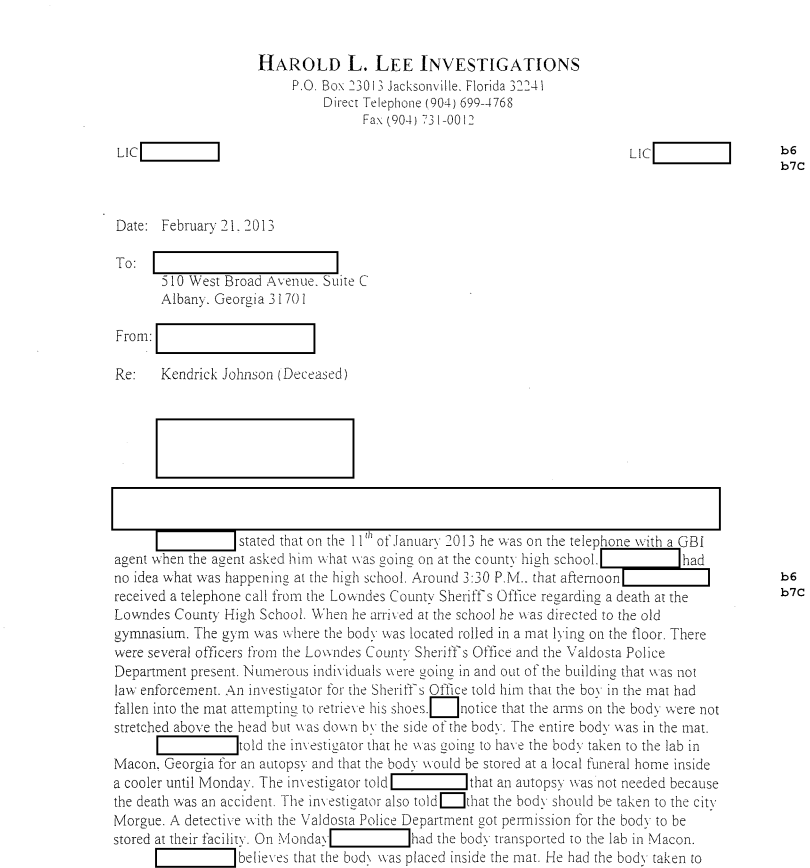
Exhibit 1A. Harold L. Lee Investigations memorandum, page 1.
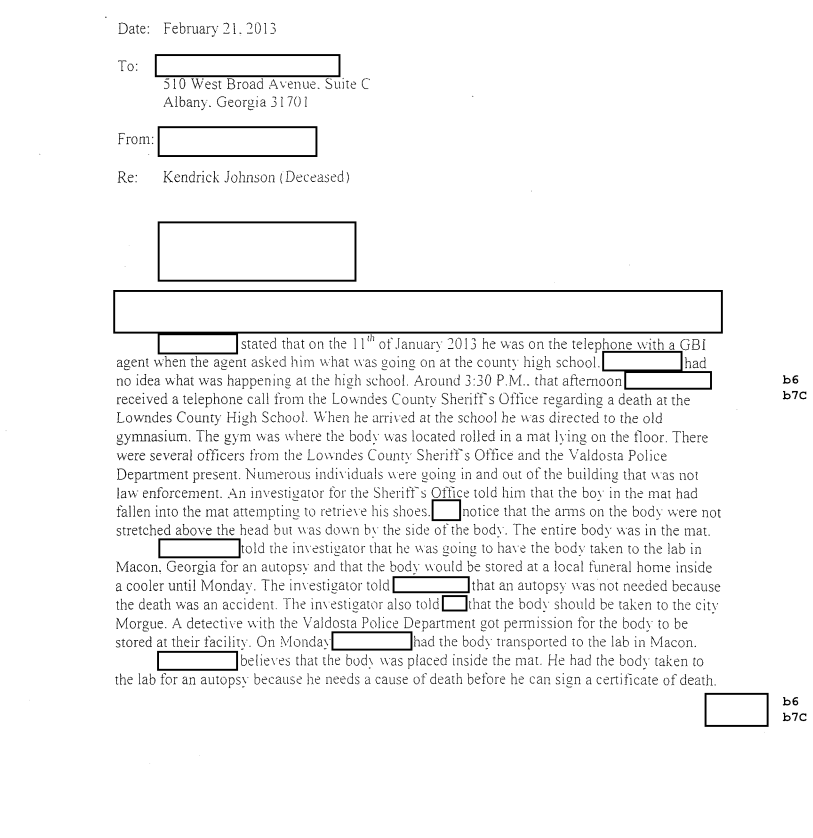
Exhibit 1B. Harold L. Lee Investigations memorandum, page 2.
The memorandum records an account in which the witness arrived at the old gym and observed the body rolled in a mat. The critical passage states that the arms were “not stretched above the head” and describes them as down by the side of the body. It then states that “the entire body was in the mat.”
The later FBI interview reportedly disputes portions of this private investigator’s summary. That means the memorandum cannot be treated as an uncontested verbatim transcript. But the conflict itself matters: the record contains materially different descriptions of the arms and mat position.
Investigative finding: the original arm position cannot be resolved merely by selecting the later recollection and ignoring the earlier recorded account.
2. Apparent partial-emergence stage
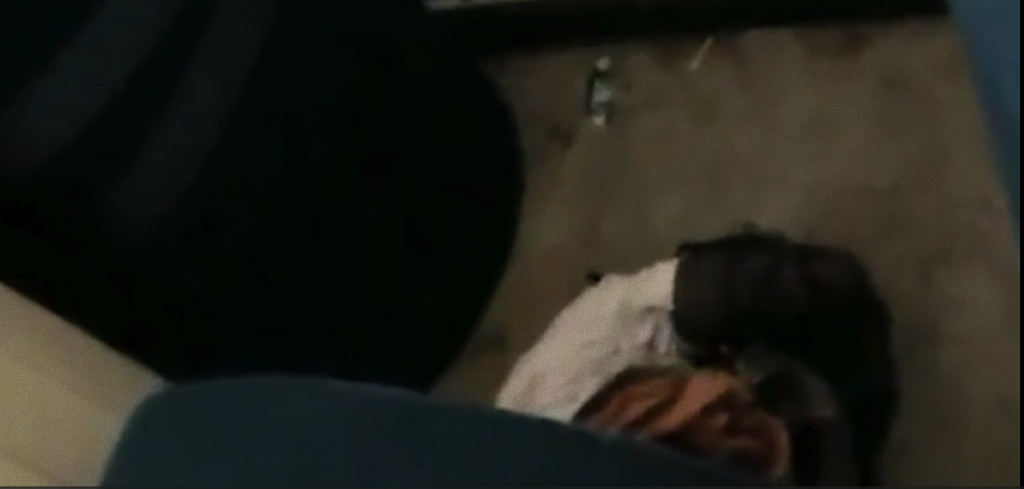
Exhibit 2A. Wider apparent partial-emergence view.
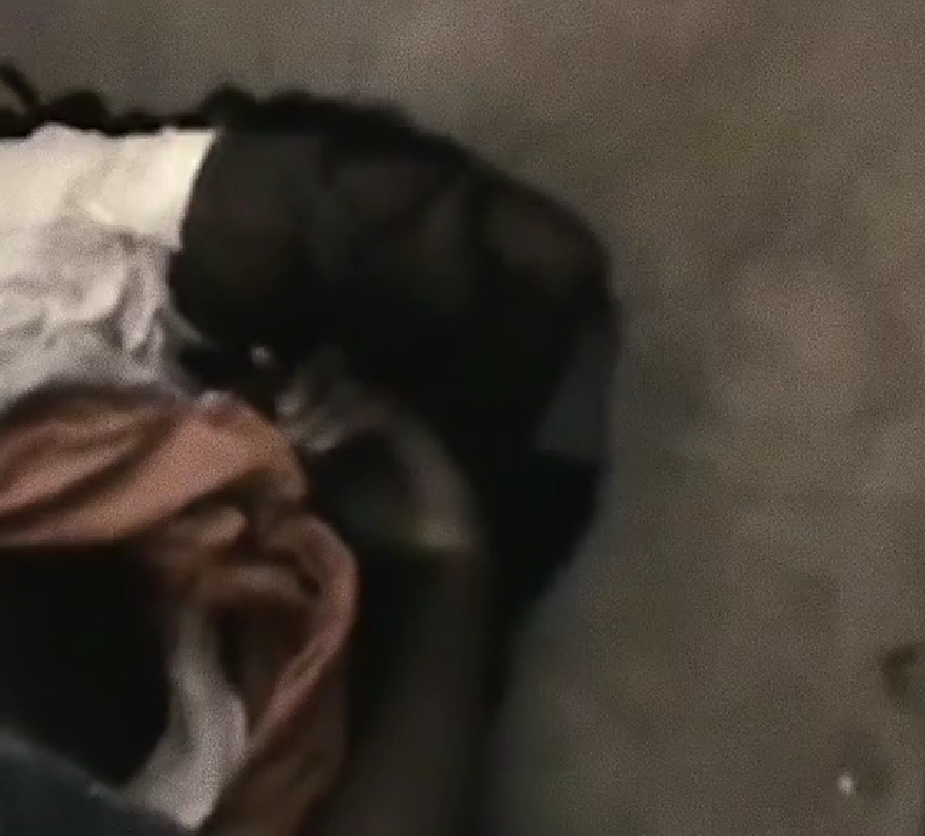
Exhibit 2B. Closer apparent partial-emergence view.
These images appear to document an intermediate recovery stage rather than the final removed-body position. Using the crown of the head as an anatomical reference, the photographs do not clearly show both arms extended beyond the crown. The visible upper-extremity configuration appears flexed around the face/head and upper torso.
The imagery is low-resolution and partially obstructed. It therefore cannot support millimeter-level anatomical claims. But that limitation cuts both ways: the photographs cannot honestly be converted into proof of an arms-overhead posture simply because that posture makes a reconstruction easier.
Investigative finding: the supplied partial-emergence photographs do not establish both arms stretched overhead as the original in-mat position.
3. Feet near the opposite opening
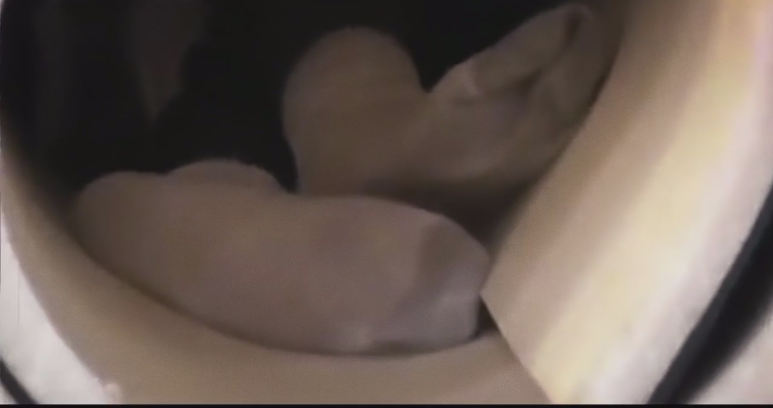
Exhibit 3A. Feet visible near the opposite opening of the rolled mat.
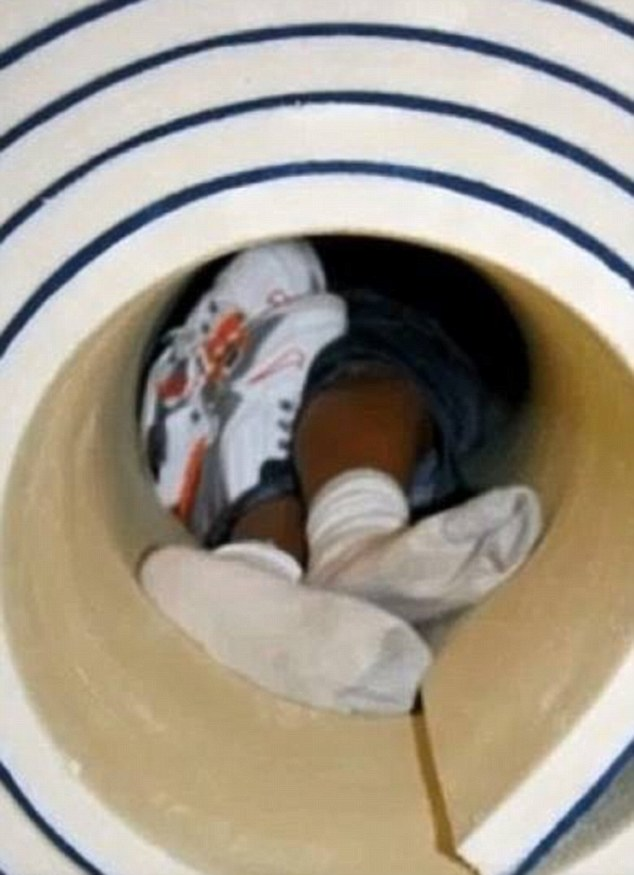
Exhibit 3B. Clearer view of feet and athletic shoes inside the mat.
The feet appear positioned close to the open end of the mat, providing a useful spatial constraint on how the body occupied the roll. The clearer photograph also shows athletic shoes deeper within the opening.
The darker image does not visibly identify the same shoes. That difference does not by itself prove removal or movement. Camera angle, obstruction, timing, and scene movement are alternative explanations. It does show why the images must be chronologically ordered instead of treated as interchangeable snapshots.
4. Post-removal arm configuration
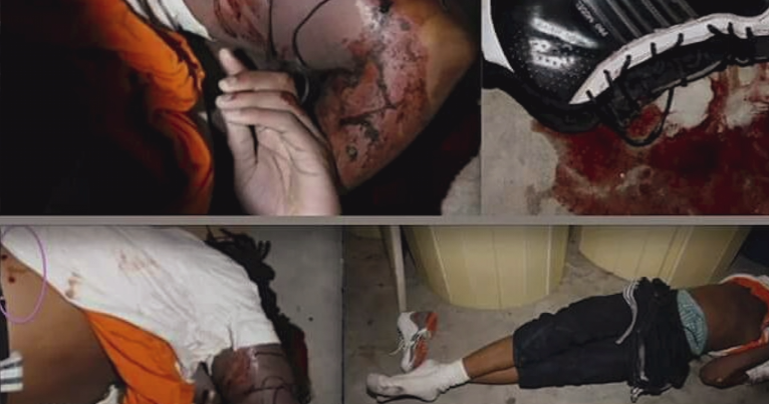
Exhibit 4A. Composite post-removal recovery photographs.
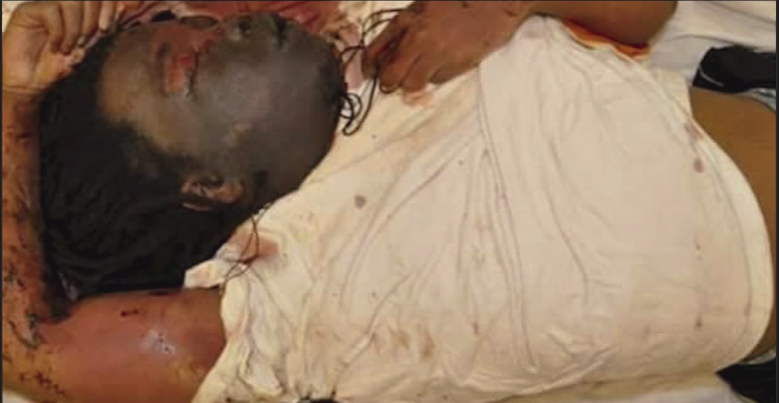
Exhibit 4B. Post-removal upper-body view.
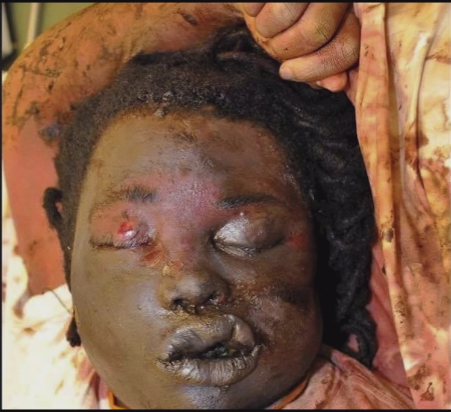
Exhibit 4C. Closer post-removal head and hand view.
After complete removal, the photographs show substantial elbow flexion and hands/forearms positioned around the head and upper torso. At least one later view places a hand alongside or above the head in a relationship that differs from the apparent earlier partial-emergence images.
That distinction is central. A later photograph can accurately document the body after extraction and handling while still failing to establish the body’s posture before extraction.
Investigative finding: the upper-extremity configuration appears to change during recovery. Later arm positions cannot automatically be projected backward through known scene movement.
5. Bottom of the mat after removal
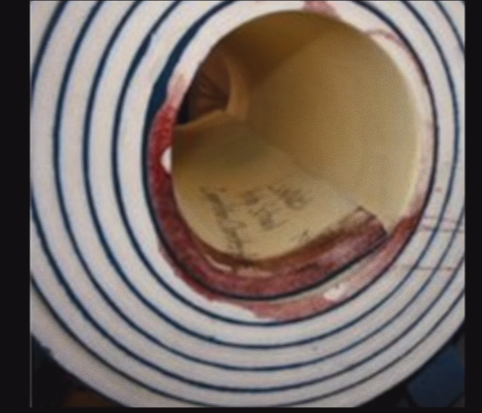
Exhibit 5. Bottom end of the rolled mat after removal, showing visible reddish staining.
This photograph has been identified for this investigation as the bottom end of the mat after the body was removed. Visible reddish staining is present around portions of the inner opening. The investigative account supplied with the image identifies the material as blood.
The photograph establishes location and appearance. Biological identity, source, time of deposition, and mechanism require the underlying scene documentation and laboratory testing. Because the head/upper-body end was oriented toward this end in the reconstruction under examination, the staining is relevant to any complete account of the scene.
6. What the photographs do to the witness accounts
Claim: both arms were stretched above the head. The February 21 memorandum records the opposite observation, and the apparent early partial-emergence imagery does not clearly show both arms beyond the crown. The later recovery images cannot repair that gap because the body had already been moved.
Claim: a later observed hand position establishes the original position. The recovery sequence itself shows differing configurations. Without independent continuity evidence, a post-extraction posture cannot establish the posture inside the mat.
Claim: the witnesses were all describing the same untouched scene. The documentary and photographic record contains materially different configurations of the mat and body. Those differences are consistent with different stages, conflicting recollections, or both.
Finding: the photographic record challenges the reliability of merging multiple witness recollections into one static account of the original scene.
7. Mechanical problem with the accidental-entry reconstruction
The FBI material reviewed during this investigation contains discussion of an approximately 14-inch mat opening and comparison with an approximately 19-inch shoulder width, although the witness discussing those figures reportedly did not personally know who performed the mat measurement. Those dimensions should therefore be traced to their original measurement records before being treated as final forensic values.
Arm position is mechanically important. Fully extending both arms overhead changes shoulder geometry. Flexed elbows and arms around the face/upper torso produce a different profile. An experiment showing that a person can enter a rolled mat with both arms overhead does not answer the case-specific question unless the evidence first establishes that this was the original posture.
Investigative finding: the accidental-entry mechanism contains an unresolved biomechanical question. It must account for the actual mat geometry, documented body dimensions, earliest supportable arm position, and the depth of the body inside the roll.
8. Rigor mortis and scene manipulation
A reported postmortem interval cannot, by itself, establish how movable the body was. Rigor mortis varies with temperature, decomposition, exertion, body condition, and other factors. A body in rigor can be repositioned with sufficient force, and such movement can mechanically break rigor in affected muscle groups.
The decisive evidence would be contemporaneous documentation of rigor, lividity, decomposition, and any resistance encountered during recovery. If substantial rigor was documented while the elbows were flexed, a materially different later arm position could require physical manipulation. If rigor was resolving, easier movement would be plausible.
Final investigative assessment
The scene photographs supplied for this review materially complicate the witness narrative surrounding Kendrick Johnson’s position inside and during removal from the rolled gym mat.
The strongest conflict concerns the arms. An early February 2013 memorandum records that the arms were not stretched above the head while the entire body remained inside the mat. The apparent early partial-emergence photographs do not clearly show both arms extended beyond the crown. Later photographs show altered upper-extremity positions after extraction.
The feet appear close to the opposite opening, adding another physical constraint. The post-removal photograph of the bottom end documents visible staining that must also be incorporated into any complete reconstruction.
The photographic record undermines any claim that the various witness descriptions can simply be merged into one unquestioned account of Kendrick Johnson’s original body position. The scene changed during discovery and recovery, and the earliest supportable configuration must be reconstructed separately from later positions.
This does not prove homicide. It does not prove intentional deception by witnesses. It does show that the accidental-entry mechanism should not be treated as mechanically self-evident until it reproduces the actual mat geometry, authenticated measurements, earliest supportable arm position, feet position, scene chronology, and relevant forensic findings without changing the variables that make the theory difficult.
Evidence-handling note
The images reproduced in this report are the files supplied for this investigative review. Interpretation is limited by resolution, cropping, compression, camera angle, and the absence of original metadata in the supplied copies. Chronology, biological identification of stains, and exact measurements should be verified against the original investigative records before publication as established fact.

Leave a Reply
You must be logged in to post a comment.