
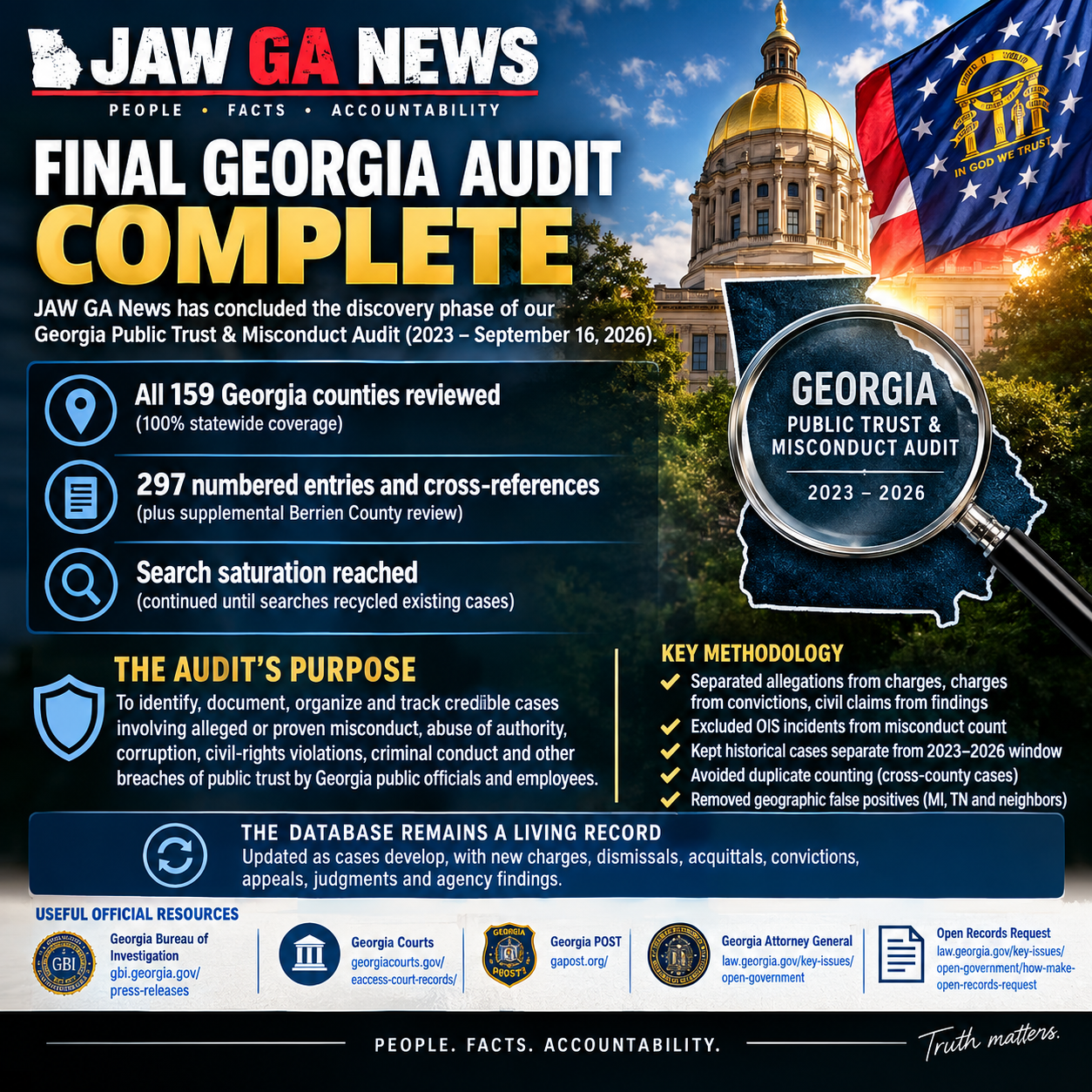
JAW GA News Statewide Review | January 1, 2023 – September 16, 2026
JAW GA News has completed a statewide review of all 159 Georgia counties as part of the Georgia Public Trust & Misconduct Audit, examining publicly available records concerning alleged or proven misconduct, abuse of authority, corruption, civil-rights violations, criminal conduct and other matters involving people entrusted with public authority.
The primary review period covers January 1, 2023 through September 16, 2026.
The project also preserves selected historical cases when they provide relevant context or when investigations, prosecutions or other proceedings continued into the primary audit period.
This was not simply a search for police officers who had been arrested. The review included law-enforcement officers, deputies, jailers, correctional officers, elected officials, municipal employees, government administrators, public-school employees, probation and community-supervision personnel, public-safety officials and government institutions.
The original working audit produced 297 numbered entries and cross-references.
That number requires an important explanation.
297 entries does not mean 297 guilty public officials. It does not mean 297 convictions. It does not even mean 297 independent misconduct cases.
The master audit included individual defendants, separate incidents involving the same person, parent investigations, cross-county references, civil litigation, institutional findings, historical references, officer-involved-shooting reviews, reviewed-but-excluded cases and other records necessary to document how the statewide search was conducted.
The purpose of the project is accountability through documentation, not guilt by spreadsheet.
WHY JAW GA NEWS CONDUCTED THIS AUDIT
Government employees and elected officials are entrusted with powers ordinary citizens do not possess.
Police can detain and arrest.
Jail and correctional employees exercise direct control over people in government custody.
Public officials spend taxpayer money and control government property.
Government employees can access databases containing information unavailable to the general public.
Schools place children under the supervision of public employees.
Government agencies maintain evidence, surveillance systems, criminal-history information and sensitive records.
Those powers make accountability essential.
The purpose of this audit is to identify, document, organize and track credible cases involving alleged or proven misconduct while preserving accurate outcomes and the legal status of each case.
JAW GA News does not determine criminal guilt.
Courts do that.
Our responsibility is to examine the public record, distinguish allegations from established outcomes, identify contradictions when they exist and make the underlying record easier for the public to examine.
HOW THE AUDIT WAS CONDUCTED
JAW GA News conducted a geographic review covering all 159 Georgia counties.
The research included county-by-county searches as well as reverse searches organized around particular categories of conduct.
Those categories included:
Excessive force
Civil-rights violations
Sexual misconduct
Child sexual offenses
Custodial abuse
Domestic violence involving public personnel
Unauthorized entry
Evidence fabrication or manipulation
False reports and false statements
Evidence handling and integrity
Bribery and public corruption
Theft or fraud involving public positions
Violation of oath
Misuse of government databases
Misuse of license-plate-reader systems
Misuse of protected government information
Obstruction and witness interference
Misuse of government authority
Interference with or failure to properly conduct official investigations
Public-record and government-transparency concerns
High-interest counties and categories were searched repeatedly.
Duplicate cases were identified and separated from genuinely independent incidents.
Cross-county cases were cross-referenced rather than automatically treated as multiple independent investigations.
Historical cases were separated from conduct occurring during the primary audit period.
Criminal accusations were separated from convictions.
Civil allegations were separated from criminal findings.
Private defendants were excluded unless their presence was necessary to understand a qualifying government investigation.
Officer-involved shootings were not classified as misconduct merely because a shooting occurred.
The statewide search ultimately reached practical search saturation, meaning additional searches increasingly returned cases already identified rather than substantial numbers of previously undiscovered qualifying records.
That does not mean every possible record in Georgia has been discovered.
Cases may be sealed, poorly indexed, recently filed, unavailable online or otherwise inaccessible through the sources examined.
HOW TO READ THE DATABASE
A person’s appearance in this audit does not establish guilt or misconduct.
The status assigned to each entry matters.
| Status | Meaning |
|---|---|
| ALLEGATION | A reported allegation that has not been established as fact |
| CHARGED | Criminal charges have been filed; guilt has not been established |
| INDICTED | A grand jury or federal charging process has formally accused the defendant |
| GUILTY PLEA | The defendant entered a guilty plea |
| CONVICTED | Guilt was established through the criminal process |
| CIVIL ALLEGATION | A claim asserted through civil litigation |
| CIVIL FINDING | A finding reached through civil proceedings |
| INSTITUTIONAL FINDING | An investigative authority reached findings concerning an institution |
| HISTORICAL REFERENCE | Relevant conduct occurring outside the primary audit period |
| AUDIT-PERIOD PROSECUTION / PRE-2023 CONDUCT | Proceedings occurred during 2023–2026 but the underlying conduct occurred earlier |
| OIS REVIEW / NOT COUNTED | An officer-involved shooting was reviewed without treating the shooting itself as proof of misconduct |
| CROSS-REFERENCE | Another record associated with the same investigation, person or jurisdiction |
| EXCLUDED | Reviewed but excluded under the audit methodology |
| PUBLIC-OFFICE NEXUS NOT ESTABLISHED | A public employee or former official was identified, but available evidence did not establish that the alleged conduct involved the person’s government authority |
| DISMISSED / ACQUITTED / CLEARED | A later disposition materially changed the original status |
These distinctions are fundamental.
An arrest is not a conviction.
An indictment is not a conviction.
A civil lawsuit is not a criminal prosecution.
Surviving a motion to dismiss is not winning a lawsuit.
Being investigated is not the same as being found responsible.
And holding a government job does not automatically transform unrelated private conduct into abuse of public office.
THE GOOD: WHEN ACCOUNTABILITY SYSTEMS WORK
A statewide misconduct audit should not merely document what government gets wrong.
It should also document situations where accountability mechanisms worked as intended.
Several investigations examined during this project began after government agencies discovered potential problems themselves and referred the matter for independent investigation.
The growing number of investigations involving automated license-plate-reader systems provides a notable example.
Internal reviews by agencies including the Albany and Savannah police departments led to outside investigations concerning alleged non-law-enforcement use of protected license-plate information.
That distinction matters.
An agency discovering possible misconduct, preserving the evidence and requesting an independent investigation can be evidence of accountability working rather than evidence that the entire agency is corrupt.
Other positive accountability indicators found during the statewide review included:
Internal audits
Independent GBI referrals
Supervisors reporting missing government property
Criminal referrals following internal investigations
Publicly accessible court proceedings
Documented disciplinary proceedings
Government records produced under Georgia’s Open Records Act
Accountability does not require pretending misconduct never occurs.
It requires responding appropriately when it does.
THE BAD: RECURRING PUBLIC-TRUST PROBLEMS
The statewide review identified recurring categories of alleged or established misconduct.
They included allegations involving:
Excessive force against restrained or compliant people
Sexual misconduct involving people under governmental authority
Sexual offenses involving students or minors
Improper sexual contact involving incarcerated people
Theft of government property
Misuse of government credit cards and financial accounts
Fraud involving government employment
False statements
Allegedly falsified official reports
Violation of oath
Unauthorized entry into residences
Evidence-handling failures
Misuse of surveillance systems
Unauthorized searches of protected databases
Bribery
Public corruption
Failure to intervene during alleged unlawful force
Improper disclosure of protected government information
These cases vary substantially in seriousness, evidentiary strength and procedural status.
The audit does not flatten those differences.
THE UGLY: WHEN THE PROBLEM BECOMES INSTITUTIONAL
Some of the most significant findings were not limited to one employee.
They involved government institutions.
Fulton County Jail
The United States Department of Justice opened an investigation into conditions at the Fulton County Jail in 2023.
Federal authorities subsequently announced findings concerning constitutional and federal statutory violations involving conditions at the jail.
The findings addressed issues including violence, excessive force, unsafe living conditions, medical and mental-health services, restrictive housing and treatment of people with disabilities.
The audit therefore classifies the Fulton County Jail matter as an:
INSTITUTIONAL FINDING
rather than an accusation against every person employed by the Sheriff’s Office.
Its procedural history is also important:
2023 — Federal investigation opened
2024 — DOJ institutional findings announced
2025 — Federal enforcement and proposed consent-decree proceedings
This demonstrates why accountability records should be updated as cases develop.
Georgia Prison System
The Georgia Department of Corrections represents another major institutional entry.
In 2024, the Justice Department announced findings concerning unconstitutional conditions within Georgia’s state prison system.
The investigation addressed violence, sexual abuse, homicides, understaffing and failures to adequately protect incarcerated people from harm.
Again, an institutional finding concerning a prison system is not an accusation against every correctional officer working within that system.
The distinction is essential.
THE SURVEILLANCE AND DATABASE PROBLEM
One of the clearest emerging patterns during the later portion of the audit involved alleged misuse of license-plate-reader systems, government databases and protected information.
These systems provide law enforcement with extraordinary investigative capabilities.
That power creates an equally serious responsibility to prevent access for personal, retaliatory or otherwise unauthorized purposes.
The audit identified investigations involving personnel associated with multiple jurisdictions.
| Jurisdiction / Agency | Issue Identified |
|---|---|
| Albany Police Department | Five former officers charged following investigation of alleged Flock/LPR misuse |
| Savannah Police Department | Four former employees charged following internal audit |
| Acworth / Emerson Police Departments | Former officer investigated concerning alleged LPR misuse spanning employment with both departments |
| Clayton County Sheriff’s Office | LPR misuse investigation |
| Colquitt County Sheriff’s Office | Former deputy charged concerning alleged LPR misuse |
| Braselton Police Department | Police chief charged in surveillance-related investigation |
| Echols County Sheriff’s Office | Former employee charged with multiple alleged LPR-data misuse offenses |
| Ogeechee Judicial Circuit District Attorney’s Office | Former investigator charged following alleged repeated non-law-enforcement searches |
| Georgia Department of Corrections | Investigation involving alleged LPR misuse by supervisory investigative personnel |
| Jefferson Police Department | Sergeant charged concerning alleged disclosure of protected GCIC information |
The broader accountability category used by JAW GA News is:
Misuse of government databases, surveillance systems or protected information.
Flock Safety may be the technology appearing in many current cases.
The underlying issue is considerably larger than one company.
SELECTED PUBLIC-TRUST CASE DIRECTORY
The following table contains a selection of cases documented during the statewide audit. It does not represent the complete 297-position working ledger.
| County / Jurisdiction | Person / Agency | Position | Conduct / Case | Status |
|---|---|---|---|---|
| Atkinson / Pearson | Robert “Buster” Johnson | Mayor | Bribery, theft and municipal-corruption allegations | CHARGED |
| Atkinson / Pearson | Patricia Ballard | City Clerk | Theft, conspiracy, false-statement and records-related allegations | CHARGED |
| Banks | Sammy Reece | Former Detention Officer | Allegedly supplied inmates drugs, alcohol and unauthorized cellphone access | CHARGED |
| Berrien / Enigma | Cecil Giddens | Mayor | Battery, assault and disorderly-conduct allegations | CHARGED |
| Bryan / Richmond Hill | Robert Edward Littlejohn | Former Police Sergeant | Bribery, oath and false-statement allegations | INDICTED |
| Camden | Buck William Aldridge | Sheriff’s Sergeant | Federal allegations involving excessive force and misleading official reports | FEDERALLY INDICTED |
| Camden | Jacoby Anderson | Deputy | Alleged assault of jail inmate | CHARGED |
| Camden | Ryan Robert Biegel | Former Deputy / Jail Corporal | Assault of restrained pretrial detainee | GUILTY PLEA / SENTENCED |
| Catoosa | Keith Cantrell | Former Sheriff’s Lieutenant | Allegedly billed for security work not performed | CHARGED |
| Chatham / Savannah | Four former department employees | Police personnel | Alleged LPR/Flock misuse | CHARGED |
| Cherokee / Woodstock | Robert William Brown | Former Police Officer | Alleged computer/privacy misuse and false statements | CHARGED |
| Clayton | Jabin Bethea | Former Correctional Officer | Excessive force against compliant detainee | GUILTY PLEA |
| Clinch / Homerville | Dearin “Mack” Drury | Police Chief | Evidence, theft, false-statement and oath allegations | CHARGED |
| Coffee / Nicholls | Ashley Wilson | Police Chief | Child-enticing and attempted-child-molestation allegations | CHARGED |
| Coffee | Shantokeo Rolax | Sheriff’s Investigator | Harassment, surveillance, trespass and obstruction-related allegations | CHARGED |
| Colquitt | Bentley Hughes | Former Deputy | Alleged LPR misuse and oath violations | CHARGED |
| Cook | Trey Kenny | Former Deputy | Burglary, surveillance, theft and stalking allegations | CHARGED |
| Coweta | Justin Alexander Woods | Former Deputy | Alleged force against restrained inmate | CHARGED |
| Dougherty / Albany | Tytianna Davis | Former Police Officer | Alleged Flock/LPR misuse | CHARGED |
| Dougherty / Albany | Jade Jackson | Former Police Officer | Alleged Flock/LPR misuse | CHARGED |
| Dougherty / Albany | Nicholas Richardson | Former Police Officer | Alleged Flock/LPR misuse | CHARGED |
| Dougherty / Albany | Brittney Smith | Former Police Officer | Alleged Flock/LPR misuse | CHARGED |
| Dougherty / Albany | Issac Whitus | Former Police Officer | Alleged Flock/LPR misuse | CHARGED |
| Echols | Anna Altobello | Former Sheriff’s Office Employee | Multiple alleged LPR-data misuse offenses and stalking allegations | CHARGED |
| Fulton | Monique Clark | Former Detention Officer | Federal civil-rights prosecution involving strangulation of detainee | CONVICTED / SENTENCED |
| Fulton | Khadijah Solomon | Former Jail Sergeant | Federal excessive-force and false-report allegations | FEDERALLY INDICTED |
| Fulton | Louis Brown III | Former Sheriff’s Sergeant | Alleged excessive force against handcuffed detainee | FEDERALLY INDICTED |
| Fulton / Hapeville | Shevoy Brown | Former Police Officer | Taser use against handcuffed detainee and false report | CONVICTED / SENTENCED |
| Habersham / Baldwin | Justin Ferguson | Former Assistant Police Chief | Alleged theft from police evidence room | CHARGED |
| Houston / Warner Robins | Ray Dexter Ewings | Former Police Officer | Alleged on-duty sexual battery | CHARGED |
| Jackson | Zachary Billings | Deputy | Alleged unauthorized entry into residence | CHARGED |
| Jackson / Braselton | Michael Steffman | Police Chief | Alleged LPR misuse, stalking and harassment | CHARGED |
| Madison / Hull | Paul Walton | Former Mayor | City credit-card misuse, theft and fraud allegations | INDICTED |
| McDuffie | Bobby Evans | Community Supervision Officer | Sexual-assault allegations involving person under supervision | CHARGED |
| Newton | George Rahming | Deputy | Sexual-assault allegations | CHARGED |
| Rabun | Chad Nichols | Sheriff | Public-indecency, sexual-battery and oath allegations | CHARGED |
| Richmond | Robert “Robbie” Silas | Former Sheriff’s Major | Pandering, solicitation and oath allegations | CHARGED |
| Richmond | Dantavion Jones | Former Deputy | Federal civil-rights prosecution involving detainee assault | GUILTY PLEA |
| Thomas | Ron James | Former Chief Deputy | Alleged theft of Sheriff’s Office firearms | CHARGED |
| Towns | Ken Henderson | Sheriff | Financial/public-office allegations | CHARGED |
| Walton | Owen Thomas | Detention Officer | Alleged sexual assault involving person in custody | CHARGED |
| Wilkinson | Thomas Earl “Buster” King | Detention Captain | Alleged sexual misconduct involving inmate | INDICTED / CHARGED |
PUBLIC CORRUPTION AND GOVERNMENT MONEY
The audit identified repeated allegations involving public money, municipal property, government purchasing systems and government credit cards.
Examples were identified in jurisdictions including Pearson, Pendergrass, Rossville, Cornelia, Pineview, Guyton, Ellaville, Cairo, Peach County and Douglas County.
Some involved allegations concerning individual purchases.
Others involved substantially larger amounts or allegations concerning government contracting.
Examples include allegations involving:
Municipal credit cards
Government fuel cards
Government purchasing accounts
Municipal land
Public equipment
Evidence-room property
Government firearms
Contracting and procurement
Employee time records
Government financial accounts
The dollar amount does not determine whether public trust matters.
Public money remains public money whether an allegation concerns $500 or $500,000.
CUSTODIAL ABUSE AND EXCESSIVE FORCE
Some of the strongest records in the audit involve people who were already detained, restrained or incarcerated when force was used against them.
Federal civil-rights prosecutions involving Georgia personnel have resulted in guilty pleas and convictions in multiple jurisdictions.
These cases deserve particular attention because government exercises extraordinary authority over people in custody.
A person in handcuffs, a restraint chair or a jail cell cannot simply walk away from government authority.
That is precisely why constitutional limits on force matter.
The audit contains custodial-force cases involving personnel associated with Fulton, Clayton, Camden, Richmond and other Georgia jurisdictions.
Some resulted in convictions or guilty pleas.
Others remain allegations.
The database preserves that distinction.
CIVIL LITIGATION
Criminal prosecution is not the only mechanism through which government conduct is challenged.
The audit also preserves relevant federal civil-rights litigation.
Civil complaints may contain allegations involving:
Excessive force
Unlawful detention
Unlawful searches
Failure to protect
Constitutional violations
Government policies or practices
Those allegations are classified as CIVIL ALLEGATIONS unless a court reaches a finding supporting a different status.
The filing of a lawsuit does not prove the allegations.
Likewise, a claim surviving dismissal does not mean the plaintiff has ultimately prevailed.
JAW GA News will not manufacture a verdict that the court has not reached.
OFFICER-INVOLVED SHOOTINGS
The statewide review encountered numerous officer-involved shootings.
JAW GA News does not classify a shooting as misconduct merely because a person was injured or killed by law enforcement.
The Georgia Bureau of Investigation routinely conducts independent investigations of officer-involved shootings at the request of local agencies.
Where the available record established only that a shooting occurred and was independently investigated, the audit uses the classification:
OIS REVIEW / NOT COUNTED
A shooting moves into the misconduct portion of the audit only when reliable evidence establishes a relevant criminal charge, civil allegation, administrative finding or other qualifying accountability issue.
Anything less would turn an accountability audit into a list of deaths rather than an examination of government conduct.
HISTORICAL REFERENCES
The primary audit period begins January 1, 2023.
However, several earlier cases were preserved as HISTORICAL REFERENCES because they provide useful context or because later proceedings overlapped the audit period.
Examples identified during the research include earlier cases involving law-enforcement officers, jailers, elected officials and other government personnel.
Historical entries are clearly labeled so readers do not mistake pre-2023 conduct for current-period conduct.
Likewise, where prosecution or sentencing occurred during 2023–2026 but the underlying conduct occurred earlier, the audit uses:
AUDIT-PERIOD PROSECUTION / PRE-2023 CONDUCT
One example is former Clayton County Sheriff Victor Hill, whose federal sentencing occurred in 2023 following his conviction in a civil-rights prosecution involving earlier conduct.
WHAT WAS EXCLUDED
The audit deliberately excluded cases that failed the public-trust test.
A private defendant does not become a public-corruption case merely because the GBI investigated the crime.
Likewise, a former government employee accused of unrelated private conduct does not automatically become a government-misconduct case.
The audit therefore distinguishes among:
Current public employees accused of conduct involving their authority
Current public employees accused of conduct without an established governmental nexus
Former public employees accused of later private conduct
Private defendants
Public institutions
Civil defendants
Historical public-authority cases
Where employment was established but a connection between the alleged conduct and governmental authority was not, the audit may use:
PUBLIC-OFFICE NEXUS NOT ESTABLISHED
This protects the integrity of the database.
BERRIEN COUNTY SUPPLEMENTAL REVIEW
Berrien County received additional review because JAW GA News has separately examined public-record, law-enforcement and government-transparency issues within the county.
Those investigations are related to our broader accountability work but should not be confused with the statewide misconduct count.
The supplemental Berrien record includes matters concerning:
Public-record responses
Law-enforcement practices
Federal civil litigation
Evidence handling
Government transparency
Public meetings
Unresolved death investigations
Conflicting or incomplete government records
An unanswered question is not automatically evidence of corruption.
A contradiction is not automatically evidence of a crime.
An unresolved death is not automatically proof of homicide or official misconduct.
But documented contradictions, missing information, procedural failures and unanswered questions can justify additional reporting and additional records requests.
That is part of investigative journalism.
PRIMARY RESEARCH RESOURCES
JAW GA News relied heavily on official government records and primary sources whenever those materials were publicly available.
Readers should examine those records themselves and check for later case developments.
Georgia Bureau of Investigation
The Georgia Bureau of Investigation was one of the principal sources used to identify investigations involving Georgia public officials, law-enforcement personnel, jail employees and government workers.
GBI Press Releases
https://gbi.georgia.gov/press-releases
The GBI archive includes year-specific releases and officer-involved-shooting investigations.
Georgia Courts
Court records are particularly important because an arrest announcement usually represents the beginning of a criminal case, not its final outcome.
Georgia Courts — E-Access to Court Records
Georgia Courts — Data and Records
These resources provide access points for researching court records and available case-information systems throughout Georgia.
Georgia Peace Officer Standards & Training Council
Georgia POST records can provide information concerning the certification and professional history of Georgia peace officers and other certified criminal-justice personnel.
Georgia POST
The Georgia POST website also provides access to its POST Data Gateway and other certification resources.
Georgia Attorney General — Open Government
Georgia’s Open Records Act is one of the most important tools available to journalists and members of the public seeking government records.
Georgia Attorney General — Open Government
https://law.georgia.gov/key-issues/open-government
Georgia Open Records Law
https://law.georgia.gov/key-issues/open-government/law
How to Make an Open Records Request
https://law.georgia.gov/key-issues/open-government/how-make-open-records-request
Georgia Attorney General guidance explains that public records are generally available for inspection and copying unless specifically exempted from disclosure. When an agency withholds records, the custodian must identify the statutory basis relied upon for withholding them.
Written requests also create a clearer record of exactly what was requested and when.
United States Department of Justice
Federal records were particularly important for researching civil-rights prosecutions, excessive-force cases, custodial abuse, public corruption and institutional investigations.
United States Department of Justice
DOJ records were used when federal authorities prosecuted Georgia government employees or announced findings concerning Georgia governmental institutions.
EXAMPLES OF DIRECT PRIMARY-SOURCE RECORDS
Readers should not have to take our word for it.
Whenever possible, individual audit records should link directly to the government document supporting the entry.
One example is the Albany Police Department license-plate-reader investigation.
GBI — Five Former Albany Police Department Officers Charged in License-Plate-Reader Investigation
The GBI identified former officers Tytianna Davis, Jade Jackson, Nicholas Richardson, Brittney Smith and Issac Whitus and announced charges involving alleged misuse of license-plate data and violation of oath.
The completed public version of the audit should provide similar direct-source links wherever an official source remains available.
SOURCE PRIORITY
When multiple sources were available, JAW GA News generally prioritized sources in the following order:
| Priority | Source |
|---|---|
| 1 | Court records and filed judicial documents |
| 2 | Georgia Bureau of Investigation records |
| 3 | United States Department of Justice records |
| 4 | Georgia POST records |
| 5 | Official state, county and municipal records |
| 6 | Records obtained through the Georgia Open Records Act |
| 7 | Established news reporting for additional context or when primary material was unavailable |
News reporting can provide valuable context.
Whenever possible, however, JAW GA News attempts to trace a significant claim back to the court filing, government record, investigative agency or original source document.
Readers should be able to inspect the evidence instead of merely being told what somebody else says it means.
CORRECTIONS AND CONTINUING UPDATES
The Georgia Public Trust & Misconduct Audit is a living accountability record.
Criminal cases change.
Charges can be dismissed.
Defendants can be acquitted.
Defendants can plead guilty.
Juries can return convictions.
Convictions can be appealed.
Civil claims can be dismissed.
Courts can enter judgments.
Government investigations can clear employees or substantiate allegations.
Administrative agencies can impose discipline.
When a reliable later development materially changes an entry, the audit should change with it.
The purpose is not to preserve the most damaging version of a story forever. The purpose is to preserve the most accurate version of the record available.
Corrections should also remain transparent.
If JAW GA News incorrectly identifies an employer, jurisdiction, status, date or outcome, the information should be corrected rather than quietly left in place because the original version attracted attention.
Credibility requires being willing to correct the record.
WHAT THIS AUDIT DOES NOT CLAIM
This audit does not claim that every person identified committed misconduct.
It does not claim every allegation is true.
It does not claim every arrest will result in conviction.
It does not claim every civil lawsuit has merit.
It does not claim every Georgia county contains corruption.
It does not treat every officer-involved shooting as misconduct.
It does not treat every government employee accused of private criminal conduct as having abused government authority.
And it does not claim that the completion of our statewide search means no additional case exists.
Some records may be sealed.
Some may not be available online.
Some cases receive little or no news coverage.
Some local records are poorly indexed.
Some investigations remain confidential.
And new cases will continue to develop after publication.
Completion means the statewide search reached practical saturation under the methodology used. It does not mean Georgia stopped generating public records at midnight.
WHY THIS PROJECT MATTERS
Public trust does not require assuming every government employee is corrupt.
It also does not require pretending every documented problem is an isolated event that should never be examined alongside similar cases.
Patterns matter.
Evidence matters.
Context matters.
Internal accountability matters.
Acquittals matter.
Dismissals matter.
Convictions matter.
Guilty pleas matter.
Civil findings matter.
Institutional findings matter.
Corrections matter.
The statewide review identified serious allegations and proven misconduct.
It also identified agencies that discovered potential misconduct themselves, preserved records, conducted internal reviews or requested independent investigations.
Both sides belong in an honest accountability record.
That is why JAW GA News calls this an audit, not a blacklist.
We do not decide who is guilty.
We document the record, follow the evidence, track the outcome and give the public the information necessary to examine it for themselves.
People. Facts. Accountability.
A STRONGER GEORGIA.
Building trust through credibility, not popularity.
JAW GA News
“We don’t decide who is guilty. We bring what is hidden into the light, put the record before the people, and let the truth do the judging.”

Leave a Reply
You must be logged in to post a comment.