
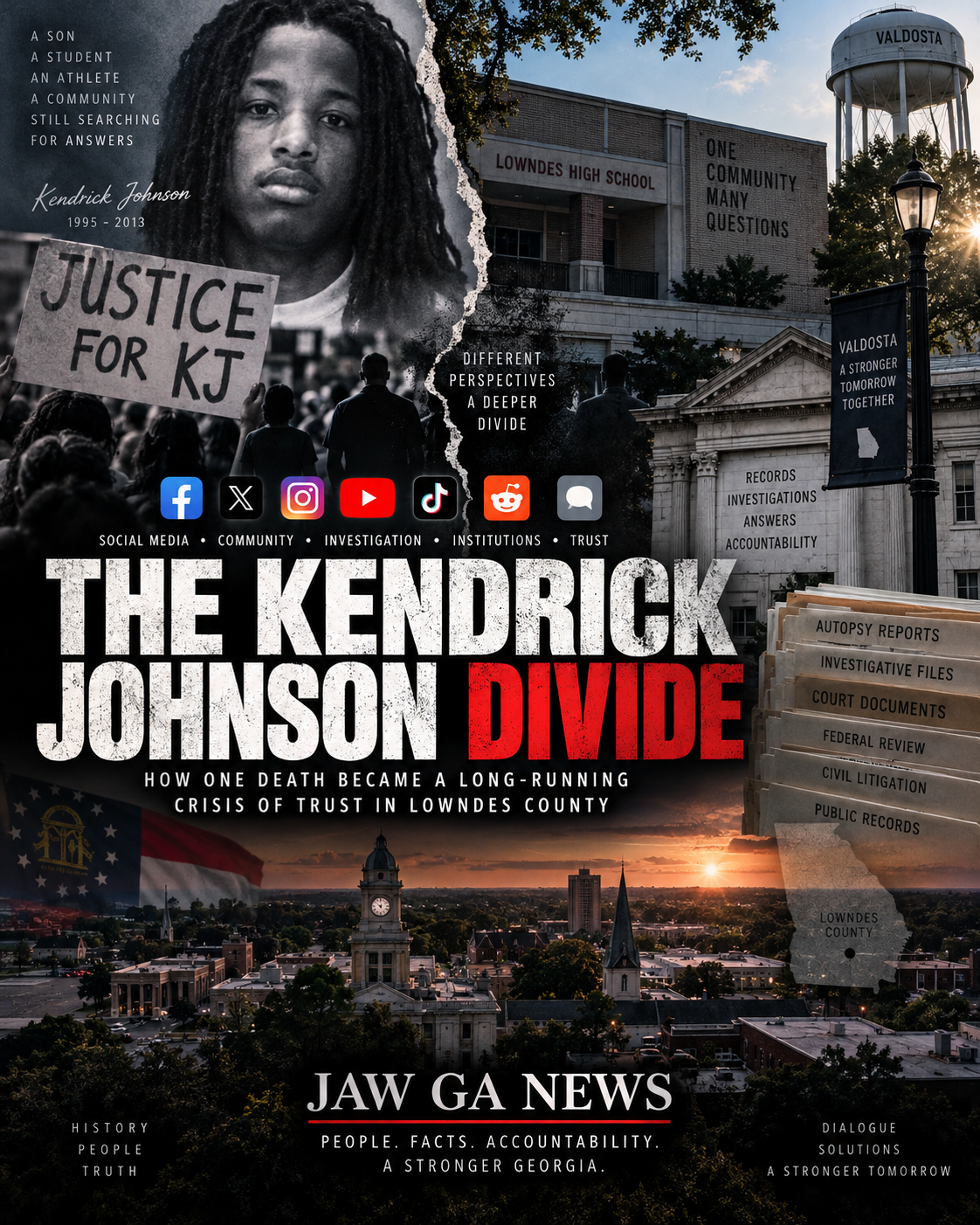
Thirteen years after Kendrick Johnson was found dead inside a rolled gym mat at Lowndes High School, disagreement over his death continues across Lowndes County and far beyond it. JAW GA News examined historical reporting, government records, demographic data, community history and years of social-media activity to determine whether the case contributed to a lasting social divide.
On January 11, 2013, 17-year-old Kendrick Johnson was found dead inside a rolled wrestling mat in the old gymnasium at Lowndes High School in Valdosta, Georgia. What followed became far more than a disagreement over the circumstances surrounding one teenager’s death.
Over the next thirteen years, Kendrick’s case became the subject of state and federal investigations, multiple autopsies, civil litigation, demonstrations, petitions, documentaries, news reports, podcasts and millions of social-media interactions. His death also became connected to broader arguments involving race, law enforcement, government transparency, forensic evidence, misinformation and public trust.
JAW GA News reviewed evidence of that public divide to answer a narrower question than the question of how Kendrick died: What did the Kendrick Johnson controversy do to the community surrounding it?
The available evidence supports a significant conclusion, but it requires careful wording. Kendrick Johnson’s death did not create racial or institutional distrust in Lowndes County from nothing. Documentary evidence establishes that those tensions existed decades before 2013. The Johnson controversy instead appears to have exposed existing divisions, intensified some of them and provided a continuing focal point around which competing views of local institutions developed.
Contemporary reporting provides some of the strongest evidence. In 2015, the Atlanta Journal-Constitution reported that the continuing investigation had aggravated existing tensions and quoted Valdosta community figure Angela Penn saying the controversy had “re-divided us on racial and class lines.” The newspaper described substantial distrust of police and the justice system among portions of Valdosta’s Black community while also documenting residents who believed Valdosta was being unfairly portrayed as racist and corrupt. ajc
By 2016, after federal authorities announced that they had insufficient evidence to support federal criminal charges, the AJC reported that wounds within Valdosta remained open. Its reporting found that disagreement over whether Kendrick was murdered or died accidentally fell strongly along racial lines, while importantly acknowledging that not everyone in Valdosta’s Black community believed Kendrick had been murdered or that authorities had covered up his death. The newspaper also documented Black public officials and residents who accepted the accidental-death explanation and faced criticism or harassment from some members of the Justice for KJ movement. ajc
That qualification is important. The evidence does not support reducing the Kendrick Johnson controversy to a simple Black-versus-White conflict.
Race was clearly part of the division documented by reporters on the ground, but so were class, institutional trust, attitudes toward law enforcement, interpretation of forensic evidence, confidence in government investigations and reactions to the Johnson family’s allegations. When Sheriff Ashley Paulk reopened the case in 2021, the AJC again described racial and class divisions as important factors fueling the controversy. ajc
The demographic environment makes that division particularly significant. Current U.S. Census Bureau QuickFacts estimates show Lowndes County with approximately 122,867 residents in 2025. Census figures list the county as approximately 54.4% White and 38.5% Black under its race categories. Valdosta itself has a different demographic balance, with Census QuickFacts listing approximately 55.4% of residents as Black and 36.3% as White. Census.gov
Those figures should not be interpreted as evidence of what either racial group believes about Kendrick’s death. Census data cannot tell us that. They establish only the demographic environment in which the controversy unfolded.
That distinction is critical throughout this investigation.
JAW GA News found no scientifically representative survey establishing what percentage of Lowndes County residents currently believe Kendrick’s death was accidental, what percentage believe he was killed, or what percentage remain undecided. Social-media activity cannot substitute for such a survey. National audiences participate heavily in Kendrick-related discussions, algorithms amplify highly engaged users, private groups cannot be comprehensively examined, and people who never post about the case are largely invisible in online data.
We therefore will not manufacture percentages that the evidence cannot support.
What can be documented is the existence and persistence of the disagreement.
The historical context predates Kendrick’s death by decades. Valdosta State University’s archives document that Project Change was established in Valdosta in 1991 specifically to combat friction between racial and ethnic groups and address institutional racism. The program worked on community empowerment, education, homeownership and related issues. Valdosta State University
The same archival collection documents an especially relevant development from 1998 and 1999. Following the disputed death of Willie James Williams while in police custody, Project Change established the Lowndes County Sheriff’s Advisory Board. The stated purpose included improving communication and addressing community concerns involving law enforcement. Valdosta State University
Valdosta State University’s historical materials also document earlier conflict surrounding desegregation. In 1967, a federal hearing examiner recommended withholding hundreds of thousands of dollars from Lowndes County Schools over noncompliance with the Civil Rights Act of 1964, helping push the school board toward further desegregation measures. Valdosta State University
None of that evidence proves anything about the cause of Kendrick Johnson’s death.
It establishes something different: institutional and racial distrust existed in Lowndes County long before January 2013.
Kendrick’s death entered that existing environment.
The initial disagreement centered on forensic and investigative evidence. Authorities concluded Kendrick’s death was accidental, while his family rejected that conclusion and pursued additional forensic examinations and investigations. Over time, disagreements surrounding autopsy findings, surveillance recordings, scene handling, potential suspects, investigative procedures and government conclusions became part of competing public narratives.
Those narratives eventually became larger than the underlying investigative files.
Social media played a major role in that transformation.
Facebook became one of the earliest organizing platforms for Justice for KJ activism. Pages and groups circulated photographs, allegations, petitions, news stories and calls for demonstrations. Supporters used social media to maintain attention on Kendrick after conventional news cycles moved elsewhere.
The consequences were not confined to screens.
Allegations against individual students circulated publicly, and members of the Bell family became targets of accusations and harassment. Litigation eventually arose involving people associated with a Kendrick Johnson Facebook group. Whatever position someone takes regarding Kendrick’s death, those events demonstrate that the online controversy developed real-world consequences for people publicly associated with the case.
The government’s response eventually entered the same digital arena. Law-enforcement officials increasingly used social media and public statements to challenge information they considered inaccurate and explain investigative developments. The controversy therefore developed a feedback loop: activists challenged institutions online, institutions responded publicly, those responses generated additional discussion, and each new development was interpreted through competing views of the case.
Twitter, now X, helped nationalize the movement through hashtags including #JusticeForKJ and related campaigns. Instagram provided another distribution channel for photographs, advocacy and allegations. YouTube allowed the story to expand into longer-form videos, interviews and eventually true-crime productions. Blogs and online forums preserved years of theories and arguments that remain searchable today.
Reddit now provides a particularly visible example of how divided interpretations continue.
Some large Reddit discussions argue that Kendrick’s death was accidental and criticize claims about the case that participants believe have been repeatedly disproven. Other discussions continue to question the official explanation or treat Kendrick’s death as an example of institutional or racial injustice.
That conflict remains active in 2026. A July 2026 discussion in the TrueCrimeDiscussion community specifically concerned the Kendrick Johnson case “resurfacing on TikTok” and criticized what its author considered misinformation being repeated by a new generation of users. The discussion attracted more than 1,200 votes. Reddit
That does not establish which interpretation is correct.
It establishes something directly relevant to this investigation: thirteen years after Kendrick died, social media continues introducing the case to new audiences and reproducing the same fundamental disagreement.
TikTok creates an especially difficult environment for historical cases because complicated evidence must compete with short-form storytelling. A thirteen-year investigative history involving forensic reports, surveillance evidence, litigation and thousands of pages of government records cannot be compressed into seconds without losing context.
That problem exists regardless of which side is doing the compressing.
A video arguing that Kendrick was unquestionably murdered can omit evidence supporting an accidental-death conclusion.
A video declaring every question about the investigation debunked can omit genuine disputes or historical context.
Both can receive enormous engagement.
Neither engagement nor virality establishes factual accuracy.
This is one reason the Kendrick Johnson controversy appears to have survived multiple investigative conclusions. Social media allows users to construct different informational environments from the same case.
One environment emphasizes independent autopsy findings, photographs, disputed investigative procedures, surveillance questions, the Johnson family’s allegations, racial history and distrust of government institutions.
Another emphasizes the original investigative findings, surveillance analysis, alibis, government investigations, court proceedings, alleged misinformation and evidence authorities have cited in support of accidental death.
People operating primarily inside one information environment may encounter little of the strongest evidence emphasized by the other.
The resulting divide therefore concerns more than the physical circumstances of Kendrick’s death.
It concerns who is trusted to establish those circumstances.
For some supporters of the Johnson family, government conclusions are viewed through longstanding distrust of law enforcement and institutions.
For people who accept the accidental-death conclusion, repeated accusations against students, officials and investigators can appear to demonstrate how misinformation and online speculation can overwhelm documentary evidence.
The same event can consequently produce opposite interpretations.
An additional investigation may be viewed by one person as evidence that previous authorities failed.
The same investigation may be viewed by another as authorities making an extraordinary effort to resolve persistent public concerns.
A discrepancy may be interpreted as evidence of concealment by one group and an ordinary investigative imperfection by another.
A disproven allegation may strengthen skepticism toward the entire Justice for KJ movement among some residents while having little effect on people who believe other evidence remains unresolved.
This creates what social researchers commonly describe as an echo-chamber effect: people repeatedly encounter information reinforcing beliefs they already hold while contradictory information is dismissed because the source itself is distrusted.
The Kendrick Johnson controversy contains another unusual characteristic: it has repeatedly connected with larger national events.
The original Justice for KJ movement became connected with civil-rights organizations and racial-justice activism. Years later, renewed attention surrounding George Floyd and nationwide protests over policing again brought Kendrick’s name into broader discussions about Black deaths, law enforcement and institutional accountability.
That widened the audience dramatically.
But it also meant the Lowndes County case increasingly became interpreted through national political and racial debates that extended far beyond the evidence contained in Kendrick’s individual investigative file.
For supporters, national attention prevented the case from disappearing.
For skeptics, national attention sometimes amplified claims they believed had already been disproven.
Both phenomena can exist simultaneously.
The result is an unusually persistent controversy.
A typical local investigation may dominate news coverage for weeks or months before gradually disappearing from public discussion. Kendrick Johnson’s case instead moved through repeated cycles of attention: the original 2013 investigation, subsequent autopsies, federal involvement, lawsuits, demonstrations, investigative developments, renewed national racial-justice activism, Paulk’s reopening of the case, later reporting and continuing social-media rediscovery.
Each cycle brought new people into an argument whose original participants had already been debating for years.
That makes the Kendrick Johnson controversy more than a true-crime story.
It is also a case study in how modern communities process disputed events when traditional institutions and digital communities operate with fundamentally different levels of trust.
A useful way to visualize the evidence identified by JAW GA News is not to attempt to chart public opinion, because reliable polling does not exist. Instead, the documented development can be represented as a timeline:
| Period | Documented development | Social significance |
|---|---|---|
| Before 2013 | Historical racial and institutional tensions documented in Valdosta and Lowndes County | Establishes that community distrust did not originate with Kendrick’s death |
| January 2013 | Kendrick Johnson is found dead at Lowndes High School | Beginning of the modern controversy |
| 2013-2014 | Family challenges accidental-death conclusion; demonstrations and Justice for KJ organizing expand | Local dispute becomes organized movement |
| 2013 onward | Facebook, Twitter, YouTube, blogs and forums distribute competing claims | Controversy expands beyond Lowndes County |
| 2014-2016 | Federal investigation and litigation intensify national attention | Competing institutional and activist narratives become entrenched |
| 2016 | Federal investigation ends without federal criminal charges | Government conclusion fails to end public disagreement |
| 2020 | George Floyd protests and racial-justice movement generate renewed attention | Kendrick’s case becomes connected to broader national debate |
| 2021 | Sheriff Ashley Paulk reopens investigation | Case receives another comprehensive local review |
| 2022 | Paulk releases investigative synopsis supporting accidental-death conclusion | Another official conclusion enters the competing public record |
| 2024-2026 | Continued demonstrations, online discussion and renewed social-media attention | Controversy persists more than a decade after Kendrick’s death |
| 2026 | TikTok and other platforms continue resurfacing the case | A new generation encounters and debates the same evidence |
The table demonstrates persistence, not causation. It does not establish that social media created every division or that everyone in Lowndes County participated in the controversy.
It does establish that the disagreement repeatedly survived events that might ordinarily have ended public attention.
Another useful visualization is the information cycle itself:
Death and investigation → disputed interpretation → social-media distribution → public reaction → government response → additional records or investigation → competing interpretation → renewed social-media distribution.
That cycle appears repeatedly throughout the history of the case.
It also helps explain why declaring one side “the community” would be inaccurate.
There is no evidence that Lowndes County speaks with one voice about Kendrick Johnson.
There is evidence of multiple communities within the same geographic area and an enormous national audience outside it.
There are people who believe Kendrick was killed.
There are people who believe his death was a tragic accident.
There are people who distrust the original investigation but have not concluded murder occurred.
There are people who believe mistakes occurred without believing those mistakes establish a conspiracy.
There are people who have changed their views after reviewing additional evidence.
There are people who remain undecided.
And there are undoubtedly thousands of Lowndes County residents who rarely or never discuss the case publicly.
Any serious assessment has to leave room for all of them.
That is also why JAW GA News is not using social-media likes, shares or comments as a substitute for public-opinion polling. A post receiving 100,000 interactions does not mean 100,000 Lowndes County residents agree with it. Many participants may live hundreds or thousands of miles away. Algorithms favor controversy and engagement, making the loudest positions considerably easier to observe than quiet or undecided ones.
Current Census figures provide another useful visualization of the community in which the local controversy exists:
| Area | White alone | Black alone |
|---|---|---|
| Lowndes County | 54.4% | 38.5% |
| Valdosta | 36.3% | 55.4% |
These figures describe population characteristics only. They must not be interpreted as measurements of opinion about Kendrick Johnson. Census.gov
After reviewing the historical and current evidence, JAW GA News finds substantial support for describing the Kendrick Johnson controversy as a long-running social and institutional trust divide affecting Valdosta and Lowndes County.
The evidence does not support claiming that Kendrick’s death created the area’s racial divisions.
Those existed beforehand.
The evidence does support finding that the controversy exposed and intensified existing tensions involving race, class and confidence in institutions, a conclusion also reached by journalists documenting the community while the controversy was unfolding. ajc
Social media then gave those divisions something previous local controversies did not possess at the same scale: a permanent international distribution system.
Facebook organized supporters and opponents. Twitter and X spread campaigns and hashtags. Instagram circulated imagery and commentary. YouTube transformed the case into long-form digital storytelling. Reddit became a continuing forum for adversarial debate. TikTok is introducing the controversy to another generation. Blogs, podcasts and forums preserved and repackaged older claims.
Meanwhile, government agencies, journalists, attorneys, activists, family members and members of the public contributed additional records, arguments and interpretations.
The result is not simply disagreement over a forensic conclusion.
It is disagreement over which institutions, evidence and sources deserve trust.
That may be the most significant social legacy of the Kendrick Johnson controversy in Lowndes County.
Thirteen years later, the central public disagreement has not disappeared.
It has migrated.
From the gymnasium to the courthouse.
From the courthouse to demonstrations.
From demonstrations to national media.
From national media to Facebook and YouTube.
From those platforms to Reddit, X and TikTok.
And now to another generation of people examining the same evidence, often without having witnessed the events that produced it.
JAW GA News is not using this investigation to determine which “side” represents Lowndes County. The available evidence does not permit that conclusion.
Instead, this investigation establishes a starting point for something that has largely been missing from thirteen years of argument: a direct measurement of what people living in Lowndes County actually think today.
The next phase of this project will examine current community sentiment while separating local responses from national social-media activity. Any meaningful assessment should distinguish between Lowndes County residents, former residents, former Lowndes High School students and employees, people professionally connected to local institutions, and people whose knowledge of the case comes primarily from national media or social platforms.
Participants should also be allowed to identify themselves as undecided rather than being forced into an accident-versus-homicide binary.
That distinction may reveal something social media cannot.
Whether Lowndes County is actually as divided as the internet makes it appear.
For now, the documentary record supports a narrower conclusion.
The death of Kendrick Johnson became a persistent focal point for preexisting questions about race, class and institutional trust in Valdosta and Lowndes County. Social media amplified those disagreements, carried them far beyond Georgia and has repeatedly introduced them to new audiences. More than thirteen years later, the argument continues.
What remains unknown is how accurately that highly visible online conflict represents the people who actually live there.
That is the question JAW GA News intends to examine next.
JAW GA News
People. Facts. Accountability.
A Stronger Georgia.